Gaia, the goddess who brought order out of
chaos, was the appropriate title for a hypothesis about an Earth system that
regulate its climate and chemistry so as to sustain habitability --- James
Lovelock (author of Gaia, a new look at life on earth, Revenge of Gaia).
What Lovelock wanted to
say, has probably been earlier (much earlier) incorporated in our
life-philosophies by the duo of Shiva
and Shakti. This philosophy is perhaps
best incorporated in Himalayan Hindu (Indian) philosophies by the concept of Ardhanareshwar --- half Shiva and half Parvathi, a manifestation of Shakti.
I will briefly describe below an interpretation (my?) for those unfamiliar. For
a visual image of Ardhanareshwar I choose
Amita Pandey’s interpretation (Fig below) of Ardhanareshwar (http://fineartamerica.com/products/ardhnarishwar-shiv-amita-pandey-poster.html)
which has Shiva in a tandaav dance and Parvati (or Shakti)
with fire (energy) in her hand. I will, for
convenience, also use the term Gaia philosophy (or just Gaia) which means the
sustaining of the earth ecosystem by regulation and redress of trespasses from
excesses.

The Colossal
Himalayan devastations of 2013 involve not only landslides of hill slopes into
the rivers below but also involve the thrusting up of ill-prepared, soft,
people from the plains to unfamiliar hilly terrains. It is the catering to the
unpreparedness of the latter that could have precipitated the former. These devastations
being over for the moment, this blog would speculate on what has to be kept in
mind before one attempt a recovery.
I have
been reading newspapers and watching television for the last week or so, to
understand objectively what reasons could have been behind the recent Himalayan
devastations of 2013 must have tremendously increased television channel TRP
ratings/profits. I did not get informed any better nor did I really expect to.
One
would have expected these channels to have studied the problem a little more in
detail and highlight what could have happened from a studied
historical/technological viewpoint. In this way they could have perhaps
succeeded in injecting a sense of responsibility into their usual irresponsible,
ill-researched, and unnecessarily dramatized shrieks and screeches for TV
audiences that like saas-bahu serials.
So I
read up further on things that could be important to see whether I could have
reinforced my earlier impressions that were formed during my early (pre-1980)
contacts with tree-hugging (chipko) environmental
activists. At that time Sunderlal Bahagunaji was echoing earlier concerns that
deforestation and road-building was causing havoc on the hill-slopes because pf
landslides of proportions not seen earlier at that time.
Even
earlier to that time of my first Himalayan walk, I had read about the Gaia
theory, and it had been reinforced by those early landslides and during
conversations with the original mountain people, many of whom were of
Tibetan-Nepali ethnicity, They shared the same belief even if they would not
have heard of Lovelock nor Gaia. These hill people, however, would have lived the
philosophy and thereby created and contributed to the worship of Ardhanareshwar even if they may have
known it.
The Gaia
hypothesis could also extend to the dangers of peopling the mountains by
plainsmen. The hill-people carry the load of visiting un-acclimatized pilgrim plainsmen
who can hardly stand straight on these steep slopes when they first land there.
In these early days the outsiders from the plains with different ethnicity kept
calling the hill-people bahadur much
to their resentment. Gaia, must be having her method to keep these unfit people
away from places where only the ethnic or fit (and gods) walk.
Post
the tragedy, there has been statements that there will be reconstruction on a
more massive scale. The Gaia hypothesis would say that Gaia’s revenge would be
proportionately damaging. It is time we stepped back and let nature rebuild the
safest way that only she knows and she can.
This
blog will essentially agree with the refreshing view of Tom Alter on NDTV
(27-06-2013) who spoke so eloquently on how one should pause, look back, go
back to the old ways and let the wounds on the Himalayas recover. The blog was
written before the interview. It will outline the reasons why we should do so.
Gaia as Ardhanareshwar
I
started this blog keeping in mind James Lovelock’s Gaia hypothesis. I will save
the details of this hypothesis for another blog. Most of the attention on Lovelock’s
work concerns global warming. As some skeptic (Alain Bates) put it, some
evidence for this hypothesis may lie in the changes in the size of swim-wears
with increasing time of global heating as in the cartoon below.

I am
not a skeptic, however. I like the concept of Gaia. The absence of global warming
at rate predicted by Lovelock could only mean that Gaia is cooling down the
earth by other mechanisms such as heavy rainfall, tornadoes, storms,
landslides. The Gaia philosophy is, moreover, rooted in our blood, especially
if we are not of the very clichéd and very real petit-bourgeois kind.
Just as
a reminder or a paraphrase, this Gaia hypothesis is more familiar as a Mother
Earth image that we (hindus and other pagans) instinctively have. It moulds (at
least it used to) our mind to thinking that mother Earth looks after all her
children equally. The essence of this philosophy is that in order to save the
tiger one needs also to save the toads and the bugs and the weeds. This
philosophy, I guess, should also include the notion that the very notion of looking
after each other is more than just food for thought; it is food (or action) as
well should we be hungry.
The
Gaia hypothesis basically states that every harm that is seen by Mother Earth is
redressed so as to restore the desired balance as perceived by her infinite
wisdom and within her time-scale. The goddess Durga or Shakti (right of figure 1 below) are figures of
worship of those who already the mindset of Gaia.
It is
the goddess Shakti who, I think, has
the energy to restore balance. For this, Shakti
or mother Earth has Shiva doing his dance of creation and destruction. Amita-Pandey’s
image of Ardhanareshwar is therefore
appropriate for this blog.
Shiva would
be very unforgiving at times if Shakti
urges him to be so. We therefore pray more to Shiva for forgiveness during his
redress of trespasses.

It is not as if the benevolent all-knowing mother Earth
concept is not known to the ordinary Westerners. They may require giving it
more tangible form especially once their religions bcame mono-theistic and
institutionalized. One of these forms could be the goddess Venus (the yielding,
watery female principle, essential to the generation and balance of life, ---
Wikipedia). The birth of Venus is depicted in Fig 1, left (read legend, click
to expand) as painted by Botticelli (1443-1510). As an aside, we should note
that the main figure, Venus, in Botticelli’s very famous painting, Primavera (1482) has a very striking
resemblance to the very young Simonetta Vespucci (1453-1476; Botticelli, I have
read, was buried at the foot of her tomb 35 years after her death) who looks
like Venus in The Birth of Venus. It
is because of Simonetta that all of us ---certainly I --- like Primavera so
much! It requires a lot of love for
Botticelli to choose her as Venus the mother goddess. Boticelli’s image of
Venus is probably the basis for the image of Gaia in the modern (1990s) Elsie
Russell’s altar painting (middle of picture above) even if Russell’s interpretation
of the painting has a mix of everything including Pan, Jimi Hendrix with
guitar, the Green Man (European deity of virgin forest), a snake goddess, as
well as Dionysus (god of chaos, spontaneity, freedom, fertility).
Landslides and McAdam’s
peril.
The question here is whether the landslides and devastation
in the Uttarakhand area is Gaia’s redress of one of its inhabitant’s excess. If
one jumps to conclusions, as one must to
begin with, it would seem (Fig 2) that the landslides are associated with man’s
road building. In the image of landslides below (taken from a Landslide Blog of
Durham University) it is clearly seen that the fan-shaped landslide begins from
a point on a road. The devastation becomes bigger as the road become bigger and
firmer with macadamized roads!

John Loudon McAdam, a Scot, laid his first roads in Bristol, Scotland. Wikipedia
informs us “McAdam's method was simpler,
yet more effective at protecting roadways: he discovered that massive
foundations of rock upon rock were unneces sary, and asserted that native soil
alone would support the road and traffic upon it, as long as it was covered by
a road crust that would protect the soil underneath from water and wear”.
We forget that the soil on the Himalayan terrain is not
protected from water and from wear. How come this is not schoolboy knowledge as
yet?
It would seem that, at least, for some parts of the Himalayan
topography there is a limit to the size of the roads that can afford such a
Macadam protection. In such cases Gaia takes her revenge through landslides. Torrents
of water cut fast and deep through loose soil to form deep gorges. Mountain
roads in the Garhwal hills should then avoid such gorges. A Gaia-safe road path
(say, in the future) in the Himalayas must traverse through firm rocky terrain!
Geologists need to find such terrain for roads that Gaia could approve. The small,
older paths which skirt river sides should be left to the local people and
foot-pilgrims.
When the
reconstruction happens, as there is every greedy commercial reason for it to
happen, one would be making broader roads. Maybe there will find more profit if
there were concretized roads. It will not stop the landslides, however; they
will only become larger and more devastating.
This reminds me of
the effort of a very ‘religious’ professor of the college where I did my Ph. D.
in chemistry. This professor was researching for his Ph. D. on, what he said,
was the milk of the “Ongole bull”. He must have meant cow but could have
preferred the term “ongole bull” which was making news at that time (late
1960s). He had to digest the milk with acid or something in a sealed tube that
was heated in a oil bath. He did it very rarely, probably waiting for an
auspicious time. After some time the tube would explode. He would come back on
another auspicious day. He would use stronger tubes. The explosion would be
delayed but would be stronger when it came. This went for some time. It finally
stopped when the explosion carried the oil bath along with it. That stopped his
experiments. He continued with his thesis and wrote a virtual one using the
results and language of another thesis submitted to the university and only
changing the caption from cow to the specimen of the ‘Ongole bull’. He got his
Ph.D.! Gaia let’s you get away with it in the small mind-scales.
The moral of this
story is that if one thinks one has to go to the Uttarakhand for religious
salvation, one may as well do it with a virtual trip from home. Mother Earth
would be extremely happy.
We learn a bit further from the history of early landslides
on Himalayan slopes.
.
Early Himalayan landslides.
One of
my more favorite descriptions of landslides from my school days is that by
Rudyard Kipling, Second Jungle book,
Miracle of Purun Bhagat:
“There was a sigh in the air that grew to a
mutter, and a mutter that grew into a roar, and a roar that passed all sense of
hearing, and the hill-side on which the villagers stood was hit in the darkness
and rocked to the elbow. Then a note as steady, deep, and true as the deep C of
the organ drowned everything for perhaps five minutes, while the very roots of
the pines quivered to it. It died away, and the sound of the rain falling on
miles of hard ground and grass changed to the muffled drum of water on soft
earth. That told its own tale.
“When (the day) came they looked across the
valley and saw that what had been forest, and terraced field, and
track-threaded grazing ground was one raw, red, fan-shaped smear, with a few
trees flung head-down on the scarp. That red ran up the hill of their refuge,
damming back the little river, which had begun to spread into a brick-colored
lake. Of the village, of the road to the shrine, or the shrine itself, and the
forest behind, there was no trace. For one mile in width and two thousand feet
in sheer depth the mountain-side had gone away bodily, planed clean from head
to heel.”
It is
not clear if this landslide was Gaia’s revenge for some immediate man-made
cause.
Kipling’s
story was probably based on the great landslide of 1880 at Nainital. This
landslide could easily have been due to the wrath of Gaia.
The Great Landslide of 1880 at Nainital. There used to be a wonderful, serene lake at Naini Tal,
which was kept secret as a secluded piece of land not meant for ordinary
mortals. The lake itself is thought to have been named after the eyes, Naina, of goddess Sati (Parvathi), consort of Shiva
(see Wikipedia). Sati was burnt in
the holy fire of an yagna (holy
offering). Shiva danced his tandaav dance with the burnt body of Sati on his shoulder. During this dance
parts from Sati’s body fell. A Naina Devi temple was built at the spot
where the eyes fell. There are many Naina
Devi temples in India (the current more famous one is at Bilaspur)
indicating, logically, that the event occurred several times in the universal
cycle of creation and destruction? One of these spots is at Nainital which is marked as a Shakti peet, a place of worship for
followers of Shakti. Landslides at
Nainital¸ especially those around the Naina
Devi temple would therefore be appropriate to the theme of this blog.
A great
landslide occurred in 1880 when the Naina
Devi temple was washed away, along
with a lot of the Nainital. Goddess Shakti,
or mother Earth, did not require to be confined in a temple, after all.
The
serenity of the Nainital lake could not be kept for long when people with
different (say, monotheistic)
attitudes became aware of it. The first westerners to visit Nainital were two
Irish men of different attitudes. The contrast in their attitudes illustrates
some of the main points in this blog.
One of
the Irish was named Trail, a bureaucrat and Commissioner of Kumaon and Garhwal,
who thought, like any other pre-existing environmentalist, that “crowds would
violate the sanctity of the place” as he first saw it in 1823. Trail’s “power in Kumaon was practically unfettered
and he exercised it jealously and disliked the possibility of any influx of
European intruders in his domain” (based on J. M. Clay’s 1926 book on
Nainital).
The
more commercially appreciated person was the other Irish, Barron, a sugarcane
merchant from Shajahanpur and hunter. He first saw the lake in 1839 and
realized its potential as a hill resort. Barron carried with him a light
20-foot boat to the lake in 1940 and thereby became the first to boat in the
lake to the delight of the local people who hailed him as Vishnu coming out of
the lake. With the cunning that a modern CEO of a multinational developing,
say, a Lavasa hill station would be proud of, Barron coerced the local thekedar, who claimed the lake and
surroundings as his ancestral property, to take a ride to the middle of the
lake in his private boat. He then threatened the thekedar, who did not know swimming, to throw him overboard if he
did not sign the paper relinquishing his rights. Barron, who for some reason
called himself a pilgrim when he wrote articles advocating Nainital as a
resort, built a lodge for himself, Pilgrim’s Lodge, on a piece of land that was
leased out to him for one-eighth of a rupee per year.
The
rapid development of Nainital by the British is said to have started after the
mutiny of 1857 as a refugee for civilians after its ‘horrors”.
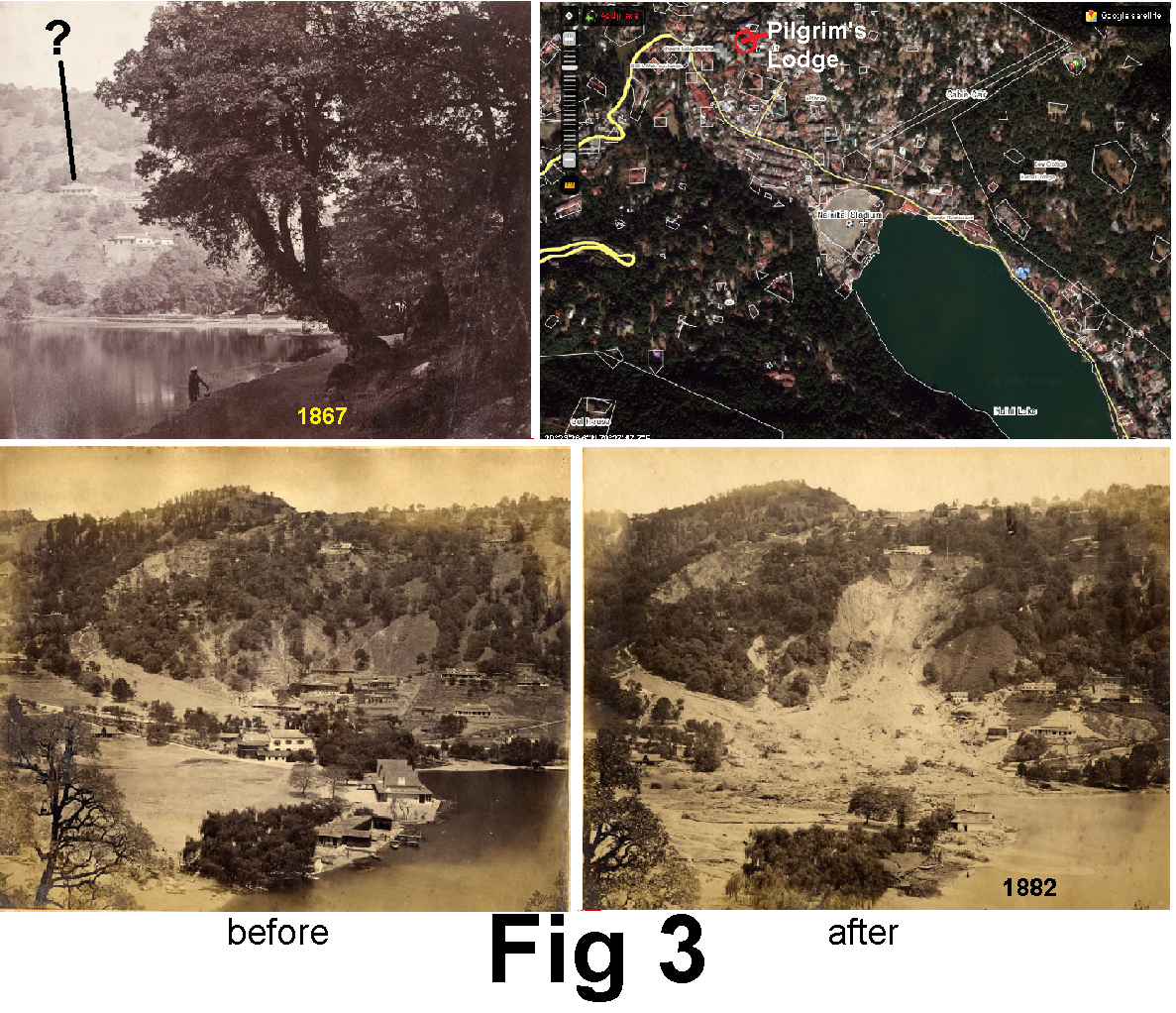
The early serenity of
the Nainital lake is perhaps captured in the 1867 figure on the top left of Fig
3. The question mark indicates asks whether the lodge on the hill could have
been Barron’s Pilgrim’s lodge. The satellite image of Nainital as it stands now
is shown on the top right of Fig 3. The Pilgrim’s Lodge compound (see circle in
red in the figure below) still stands on the top of the Nainital club.
In 1880 there was the
great Landslide in Nainital. This landslide occurred before Kipling wrote Kim.
A very often quoted description of this landslide in (http://www.oldindianphotos.in/2011/02/landslide-in-nainital-september-1880.html)
Is as follows:-
In September 1880 a landslide (the
Landslip of 1880) occurred at the north end of the town, burying 151 people.
The first known landslide had occurred in 1866, and in 1879 there was a larger
one at the same spot, Alma Hill, but "the great slip occurred in the
following year, on Saturday 18 September 1880." "Two days preceding
the slip there was heavy rain, ... 20 inches (508 millimetres) to 35 in (889
mm) fell during the 40 hours ending on Saturday morning, and the downpour still
lasted and continued for hours after the slip. This heavy fall naturally
brought down streams of water from the hill side, … At a quarter to two the
landslip occurred ,,, The total number of dead and missing were 108 Indian and
43 British nationals.
In
this landslide the old Naina Devi
temple was washed away.
The
photos before and after the landslide of 1880 is shown in the bottom of Fig 3.
The landslide washed away a path carved out of the hills. It is not clear
whether Barron’s Pilgrim lodge is the structure located on the top of the
landslide or whether the road that was washed away led to his house. There is
little doubt, however, that the construction of the path or the house or both
led to the landslide.
That could have been
Gaia’s revenge.
Ravindra Pande
(http://savethehills.blogspot.in/2012/04/nainital-landslide-town.html) has
recently (April 2012) described Nainital as a landslide town noting that
landslides continue to occur with three major ones occurring after 1880 which
were caused by ill-conceived urban growth with their being about 25 instability
incidences in 10 sq km area.
The landslides shown
in Fig 1 and almost in all other images in the internet of mountain landslides
may be clearly associated with road building. This aspect is what was asserted
by Sunderlal Bahuguna in his early Chipko movements. My wife and I once walked
with him --- we ended up walking all the way to Gangi --- along with an
assortment of then budding and now prominent environmentalists, who made
themselves comfortable in the luxury and hospitality of Sunderlalji’s Shilyara
ashram. They did not venture outside as they were warned of the dangers of wild
animals. My wife and I had come along more to see the Himalayas than to
environment. So we went with Sunderlalji’s daughter to the then virgin
rhododendron forests on the way to Gangi.
There were no
motor-able roads in these rhododendron forests; just walking paths. There was
also no landslide. Gaia was happy.
I should have
discussed what led to the flash floods of the 2013 disaster. For this, I
require a little more thought on the fragile nature of the ecosystem. I am
examining the sand-pile model where a fragile system may be sustained in a
self-organized critical state. In such a state a slight disturbance can lead to
long-range catastrophes that stabilizes the system but again to another
critical system.
Gaia and the Pilgrim’s Choice
Why the pilgrimage?
One could just say: “because
it is there”!
There used to be
times when only the brave, mainly those who trusted Gaia enough to be fearless,
even if they were poor in health and wealth, who would take the pilgrim’s route
to go to, what they thought, would be the abode of the gods. They undertook the
trek up the hills because their god had many a time answered their prayers.
The pilgrims walked
in those earlier days with their bundle on their heads. I have seen them. For a
little while I may have even walked with them. It is not easy for us plainsmen
to have walked on the hills. The pilgrims walked not because they had a choice,
but because they wanted to. There is no penance without working for it.
Or, maybe, May-June
is the time of the Dasar festival
when the new moon is the brightest, when the water in the rivers are full, and
they float lamps along the river. This is the time Ganga descends in mythology,
and the time that the monsoon opens up in meteorology. This is the pilgrim’s time
for a pilgrimage. It is not a pilgrimage to any particular god but perhaps to energy,
the goddess Shakti, and her obeying
consort, Shiva. Gaia could not be
happier!
Where men are gods?
It is good to
remember that the Uttarkhand area are not peopled by people from the plains.
They have Tibetan (Kipling would call them Esquimaux) or Khasi features. The
region around Nainital itself was called Khasi-desh. The Khasis still
constitute nearly 40-50 percent of the population (as Khasi Brahmins or
rajputs). These are people who are from the hills, who are used to the hills,
are comfortable in the hills. They would not require vehicles to travel
ten-twenty miles in a day. They do not require roads the way people from the
plains do.
Gaia, who looks after
all her people, would probably like the Hill-people to live on their own terms,
terms with which they have been born with and terms that know how to walk the
rugged terrain without leveling their paths.
Rudyard Kipling,
through the sensitivities of Kim (and Perhaps Tom Alter), a plainsman, would
make this distinction. I have been reading Kim lately, especially Chapter 14.
The part I am quoting from this chapter is quite long. It saves me the trouble
of being a fraction as clear. Kipling would write in Kim:-
Kim had
all a plainsman's affection for the well-trodden track, not six feet wide, that
snaked among the mountains; but the lama, being Tibetan, could not refrain from
short cuts over spurs and the rims of gravel-strewn slopes. As he explained to
his limping disciple, a man bred among mountains can prophesy the course of a
mountain-road, and though low-lying clouds might be a hindrance to a
short-cutting stranger, they made no earthly difference to a thoughtful man.
Thus, after long hours of what would be reckoned very fair mountaineering in
civilized countries, they would pant over a saddle-back, sidle past a few
landslips, and drop through forest at an angle of forty- five onto the road
again. Along their track lay the villages of the
hillfolk - mud and earth huts, timbers now and then rudely carved with an axe -
clinging like swallows' nests against the steeps, huddled on tiny flats
half-way down a three-thousand-foot glissade; jammed into a corner between
cliffs that funnelled and focused every wandering blast; or, for the sake of
summer pasture, cowering down on a neck that in winter would be ten feet deep
in snow. And the people - the sallow, greasy, duffle- clad people, with short
bare legs and faces almost Esquimaux - would flock out and adore. The Plains -
kindly and gentle - had treated the lama as a holy man among holy men. But the
Hills worshipped him as one in the confidence of all their devils. Theirs was
an almost obliterated Buddhism, overlaid with a nature-worship fantastic as their
own landscapes, elaborate as the terracing of their tiny fields; but they
recognized the big hat, the clicking rosary, and the rare Chinese texts for
great authority; and they respected the man beneath the hat.
Kipling would write
further:-
At last they entered a world
within a world - a valley of leagues where the high hills were fashioned of a
mere rubble and refuse from off the knees of the mountains. Here one day's
march carried them no farther, it seemed, than a dreamer's clogged pace bears
him in a nightmare. They skirted a shoulder painfully for hours, and, behold,
it was but an outlying boss in an outlying buttress of the main pile! A rounded
meadow revealed itself, when they had reached it, for a vast tableland running
far into the valley. Three days later, it was a dim fold in the earth to
southward.
'Surely the Gods live here!' said
Kim, beaten down by the silence and the appalling sweep and dispersal of the
cloud-shadows after rain. 'This is no place for men!'
Kipling must have meant the men from
the plains when he said “this is no place for men”. Gaia
protects them by landslides even if the mountain people may not like it that
way.
By all indications the early peopling
of the Himalayas were by hill people such as the bon people from Tibet who occupy Bhot-land at the border with Tibet. Some of the family names, such
as Bhotia and Bhutia are said to be derived from the bon people. In the lower Uttarakhand, like the Kumaon, the features
could be of the Khalsa kind. In the Figure 4 below the features of the people
from Kumaon (left, probably three generations of women) become closer to those
from the plains: those from Bhotland (Fig 4, right) have features closer to
Tibetans.

The gods of the
Uttarakhand are then those worshipped by the native mountain people of
Uttarakhand. If they are also the gods of some people from the plains, then
these people have memories of the Himalayas.
It is said that people from the plains fled to the hills to escape
the Muslims. There does not seem to be ancient Muslim shrines in the
Uttarakhand.
Maybe the hill people benefitted (or thought so) by the visit from
the planes. My recent internet reading informs me that the Bahugunas are
Bannerjees who came there 800 years ago and helped the local king to solve his
problems. They became known as Bahugunas because of their wisdom in many areas.
Despite their 800 years or so in the hills, I have a suspicion that they have
the mentality of plainsmen.
Uttarkhand also does not seem to be an important place in our
mythologies such as Ramayana except, perhaps,
for Hanuman and the Sanjeevani episode. The Himalayas are more the abode
of Shiva/Shakti worshippers. After all, the Dusshera festival of worship of Durga
and her family in October-November --- when rivers freeze, farming ceases, and families
reunite --- is most widely observed in Nepal and Bengal. The hill shrines of
the Himalayas close.
Temple of the Gods
A little bit may be learnt from the style of the Himalayan
temples. It is said that Shankaracharya built these temples. Little is known
with certainty about Shankaracharya’s life. I discount these tales. If at all,
one may concede that he or his followers may have helped in installing the
yoni-lingam symbol there. Even those symbols seem to be fairly recent.
I may like to think instead that Shankaracharya’s philosophies or
those attributed to him originated from Tibet itself. I have little evidence
for that. It is said that some of our early yoga gurus learnt their
philosophies there.
It is a moot question to me now of whether the temple arcitcetures
also evolved from some of the Uttarakhand temples.

The temples in Uttaranchal were usually said to
be made in Nagara style of architecture or the Garhwali Style of architecture.
Some of the more popular panch-kedar temples are shown to the left of Fig 5. In
the inset of this figure, a late nine-teenth century painting of the Bhimeshwar
temple built on the edges of the Bhimtal lake in the Kumaon hills is shown. The
Nagara architectural style is simple but striking with its tall curvilinear
spire ‘Sikhara’ with an ‘Amalaka’ (capstone) on top of the spire. The Garhwal
temples do not usually have the Amalaka but have a tiled roof resting on
pillars. The function of this tiled roof is not clear to me. It could have been
a rest/bed room or a place to escape from when there is a flood or when there
are fear of marauders and wild animals, Sometimes the pillared structure on top
has no base (especially if the shikara is
small) and seems to be just placed on the stone shikara as in the Siva
temple at Lakhamandal (Fig 5, bottom right). This temple also seems to have an
an Amalaka typical of the classical Nagara style.
The original model for such temples could be the Mahasu
devta temple (Fig 5, top right) at Hanol village near Chakrata This temple
includes the room with a tapering roof in front of shikara at ground level. Such a structure is seen in almost all the
temples.
The
tapering brass kalash pinnacle is typical of all the -nath temples in Garhwal
as seen from Fig 5 (click to expand).
Wikipedia writes:-
Architecturally
Mahasu Devta Temple at Hanol is one of the rarest examples of perfect and
harmonious blend of stone and wooden structure to form one composite grand
edifice. The sanctum proper is a pure stone shikhara in classical naga (Nagara?) style. The whole wooden structure is covered with a
high pitched slated pent roof surmounted by a two-tiered conical canopy over it
on which a gracefully tapered kalash pinnacle stands.
The panch-kedar
temples, including Kedarnath, are therefore likely to be of hill- or tribal-
origin in style. They are supposed to be built around 8th-10th
century AD when stone technology to build temples was evolving. The earliest
Nagara style temples in Orissa started only around 8th century.
An early structure is the Lakhamandal
structure near Chakrota. The area where this temple is found is said to be a
tribal land where polyandry and polygamy is practiced. Following arguments which
seem to be obvious to some, if not to all, the Pandavas of Mahabharata followed
the same practice and therefore this should be Pandava land. The temples had to
be built by the Pandavas. Could these legends be the basis that the Garhwal
hills are associated with the Pandavas of Mahabharata?
It is also not clear when these temples became
Shiva-Shakti temples.
All this does not rule out the possibility that the
Pandavas were actually tribals of the Himalayas. It also does not rule out the
possibility that the colonization of Uttarakhand by people from the plains is a
recent phenomenon. Some say, it started with Brahmins fleeing from the moghul
invaders. Some will say that it started with the British who wanted a more
malleable populace rather than the proud hill-people. After the princely state
of the Garhwals was roundly thrashed by the Gorkhas from Nepal, they got back
their rule after ceding two-thirds of their earlier kingdom to the British. West
Garhwal became the Kingdom of Tehri and thus the legend that the kingdom of
Tehri always remained outside British colonial rule.
So when did the Garhwals become a pilgrimage spot
for the people from the plains?
I don’t think I could even attempt an answer to this.
It won’t stop me from attempting an answer, though.
The Tibetan bon-worshippers are all around the
Mansarovar lake, most sacred lake for Hindus. The pre-Buddhist Bon worship is
animistic which worship natural
elements with the tenet that there is life/spirit in everything
animate/inanimate --- heaven, earth, sun, moon, mountains, rivers, thunder,
lightning, hail, fog, birds, and animals.
All this is quite consistent with the Shiv, Shakti, Ardhanareshwar concepts. It
is therefore possible to think that the pilgrimage from the plains to the hills
must have been from the memories of prayers in their early Himalayan temples.
For such worship a symbolic rock is sufficient even if later worshippers should
have given symbolic shape by installing the man-women (Ardhanareshwar?) union in
a more familiar lingam-yoni symbols
in Shiva temples.
Epilogue. Death in
the Himalayas.
It is
difficult to think of Death in the Himalayas as part of the grander scheme of Ardhanareshwar or Gaia. It helps in resettling to the tragedy.
I have had a
personal loss in the Himalayas of May-June 1986. It snowed unexpectedly heavily
in Gangotri when I visited with my parents and my sister’s family. The first
snows were wonderful and enjoyed by my parents. The parents were extremely
happy with this experience (see photo below).

My wife,
Lalitha, had gone for a trek to Gangotri with her sister, Sharada’s, family. It
snowed more heavily after they left and there was no news from them for some
time. There were no mobiles at that time. We were worried. There were many
pilgrims. They walked in the snow in their thin saris and almost barefoot when
they ploughed through the snow in their flimsy slippers. We saw the pilgrims come
back with all the composure that we thought were reserved only for the gods. We
realized the power of the pilgrimage.
Looking back
at the pictures (below left) of Laltha’s return I noticed that the style of the
Gangotri temple to be the same as in Fig 5. I had not noticed this earlier. The
more frequented temple is adjacent to this structure (right of photo below). I
hope that future reconstruction of the Himalayan temples will not take the
Gangotri route.

The snow
continued for some time. We were stuck at Joshimath because of landslides for
another few days. My father felt the cold badly. He developed breathing
trouble. We made some logistic mistakes trying to get back. My father passed away in Shilyara
of, what we learnt later, an oedema of the heart.
My father
did not want to die there. Gaia helped us reconcile to his death if only
because we were told that that gods die there.
The Gods
also really require being listened to.
I don’t know
what collective wisdom the three heads of the Trimurti, Brahma, Visnu and
Siva will take when they look upon
the damage brought to the Earth they helped create and maintain. They do not
get enough appreciation from mankind. I am reminded of a cartoon from Ananth (http://www.hindu.com/lf/2004/11/19/stories/2004111913620200.htm,
for a review)


