One of the truisms that always brings out a chuckle even if you have heard it zillion times is “Giving up smoking is very easy, I have given it up several times”.
It reminds me of (I don’t know why; perhaps it could eventually find a place in this blog) what Lord Henry said in Oscar Wilde’s “Picture of Dorian Gray” :”Each time one loves is the only time one has ever loved, each time with increasing intensity” modifying a bit Lord Henry's addition “Difference of object does not alter singleness of passion. It merely intensifies it.” So when some one, say Bertram Wooster, professes love for someone and she says “you must have loved a million girls before” or something like that Bertram Wooster could have said “But Darling! The intensity of love is a million times more than that for my first love”. I do not know whether Wooster actually said it, but I would have loved to have said it to my favorite woman in my life if I had the opportunity?
What Lord Henry may have said now, after the recent upheavals due to threats of fasting unto death is perhaps “each time one fasts unto death is the only time one has fasted unto death each time with increasing intensity”.
The intensity of corruption in India (and elsewhere, I guess) is such that the intensity of fast undertaken against corruption by an individual has to promise a lot, the extreme being a fast unto death by somebody who has a believable reputation. It does not actually mean that the faster has to die, although that would be a spectacle that the public could secretly enjoy as they did, so they say, watching gladiators being killed when the thumb went down.
Its easier said than done?
Before Anna Hazare's movement took over this anti-corruption movement, the Gandhian Satyagraha Brigade (GSB) had started their own fasts-unto-death in January 2011 on a very small scale. The GSB consisisted of "true" (whatever that may mean) Gandhians and being mainly octagenrians and nonagenerians, all senior Gandhians compared to Anna Hazare.
This movement must have been extended (I wont say hijacked) to larger proportions within a period of a few months, by would-be saints such as Kiran Bedi (a TV reality show under her belt) and Swami Agnivesh who takes the effort to wear a dress that symbolises the fire that he says is within him, and who represents people who dont believe in a democratic character for their self-professed revolutions. Revolutionaries don't have to account to the public for their funding. They will never come under a Lok pal or a Lok ayukta or a Central Vigilance committee. Something like the Board of Control of Cricket of India.
These aspiring saints, such as Kiran Bedi or Agnivesh, prop up Anna Hazare with the help of desperate TRP-seeking TV channels to a fever demanding a Lok Pal who would be a protector of the people against corruption. They do not explain how the Lok Pal would function and under what authority. They claim the support of 1.2 billion people just like the cricket team. It may not seem even frivolous to some if Sachin Tendulkar was made a popular Lok Pal!
One of the less frivolous and certainly more dangerous signal from the Anna Hazare movement is their insistence that the representative democracy should be done away with. This is reminiscent of the Jaiprakash Narayan Movement of 1977, a movement that set the country back several years without raising its moral standards or even changing for long enough times the political leadership. Indeed, Indira Gandhi's re-election showed the futility of the JP movement even if it had a validity. The JP movement has so far provided only one genuine politically trustworthy leader, Nitish Kumar.
Believe it or not, one of the successes of the JP movement is the introduction of the Double-7 Cola, which was meant to fight the imperialism of Coca-Cola. Judging by the way Coca-Cola and Pepsi now dominate the Indian advertising landscape, they must thank Double 7.
It is difficult to imagine how one Lok Pal could bring out a corruption-free society by just passing a bill. It could only be a beginning, at best. There is a real danger in having unbridled janata rule that Anna Hazare said is required to replace representative democracy.
The Democratic State has now a great democratic weapon of mass media to exercise their Big Brother control, without the wasteful nuisance of a representative democracy. When democracy is used as a spontaneous conquering religious movement without the wisdom of a restraining parliament, one can easily self implode. One may imagine a Lok Pal unleashing a "Lok Pal" zouth brigade without taking extreme care that it would not degenerate into something like a Hitler Youth Brigade.
The television channels would love it to be a reality show sponsored by multinational companies and Coca Cola advertisements with contenders asking/answering questions and winners being declared based on number of SMSs without a genuine-ness guarantee and softwares that generate SMSs.
This new Indian Lok Pal reality show could chose a genuine leader by the sacrifice the candidate could make, excluding perhaps actual fasts unto deaths. This could generate more sincere activists. As Friedrich Wilhelm Nietzsche famously said "One never dives into the water to save a drowning man more eagerly than when there are others present who dare not take the risk."
"There is an old illusion - it is called good and evil." --- Nietzsche
While it is easy to point to corruption as an all pervasive evil, there does not seem to be a strict criterion as to what kind of corruption should be tackled at what level and who is to benefit from the elimination of corruption?
The so-called 2G scam is an example of confusion over what constitutes corruption. Kapil Sibal would argue that the 2G policy has benefited the common man and the loss of revenue is made up by the several increase in revenue by the increase in tele density. I think that is a perfectly valid argument.
The CAG like all banking clerks only looks at the revenues lost by not having an auction. They did not bother about the benefits of the aam aadmi. Thats not their concern´nor has it ever been.
One should always be aware of a Bank clerk, Lewis Carroll has probably experiEnced THIS when he writes in his poem "The Mad Gardner's song"
He thought he saw a Banker’s Clerk
Descending from the bus:
He looked again, and found it was
A Hippopotamus.
‘If this should stay to dine,’ he said,
‘There won’t be much for us!’
It is only now after the row between Kapil Sibal and the CAG that I really understood what was meant. The Banker's clerk like good orthodox people from Tanjore and elsewhere in the purely Academic communities follow rules strictly and leave nothing for experimentation.
We will not be worried about Anna Hazare's intentions. We do not know need to worry also whether he has Gandhi's sense of humour. We need to be worried about those who surround him. Two of the more conspicuous credit-baggers are Kiran Bedi and Swami Agnivesh. The latter will be dismissed because he has already committed himself to a non-representative parliamentary democracy and has championed an anarchic revolution of the people.
Kiran Bedi, who would have loved to have been nominated as a Chief Vigilance Commissioner, does not now leave Hazare's side exploiting all photo-opportunities. She must have loved being the only one jumping with as much joy she could put on for the cameras. She also literally forces a very uncomfortable and perhaps reluctant but very sweet little girl to give a glass of juice to Anna Hazare to break his fast (http://www.ndtv.com/video/player/news/anna-hazare-ends-fast-says-real-fight-begins-now/196091).
I happened to listen to Kiran Bedi on you tube speaking to a packed medium-sized Hall of middle class american women audience. The talk was full of self praise (http://www.youtube.com/watch?v=g_CSsL3it9Y&feature=related). It was the kind of talk that most impresses foreigners who would love to have one, who they can identify with, telling them the great things they have doen for a horrible country. She got the applause for giving the Prime Minsiter's car a parking ticket. She did not mention that Indira Gandhi was not in India and she did not mention how the car came to be parked wherever it was in the first place. Her taking credit for this incident is something like the donkey taking credit for chasing a tiger simply because the donkey happened to be running behind a running tiger.
She does not mention what others have done for prison workers.
It was all about her self.
A comment on the video would read: It's all about her, about how great she is, how couragious and smart she handles stuff.... I hear very little about the prisoners. They prayed and had lessons (and she became holy??) .
Kiran Bedi has the horrible mistinction (if that is the word describing the opposite of distinction) of being the host and TV judge of a TV series "Aapki Kacheri" (see, for instance, http://www.youtube.com/watch?v=7hZZcmk8HHo), broadcast on the Indian TV channel, Star Plus. One cannot imagine how a civilised country can have such a lady advising any one of who or what a Lok Pal should be!
More ominously, Kiran Bedi also predicted in this talk that she is working on an ombudsman bill against corruption about which they will hear a lot about. This was more than three months ago! "Daal mein kuch kaala hain?".
Just as an exercise I looked up the memebers of the India Against Corruption movement. It is a motley crowd including many so-called spiritual leaders with probably good management and marketing skills if they are not successful con men. The group is led by Swami Ramdev (Bharat Swahiman Trust; Akhada Parishad Baba Hat Yogi, said of the Swami: " A decade ago, Ramdev used to move on a bicycle. He even had to struggle to find money to fix his punctured cycle. Now he flies on a chopper. …." ) , Sri Sri Ravi Shankar (Art of Living: Sri Sri Ravi Shankar … has repackaged a well-known breathing technique and commercialized it. See http:// www.deeshaa.org/is-sri-sri-ravi-shankar-a-con-man/; see also The The great great Sri Sri NGO NGO scam scam --- http://churumuri.wordpress.com/2008/02/01/the-the-great-great-sri-sri-ngo-ngo-scam-scam/
see also ), Kiran Bedi (we know about her), Swami Agnivesh (Bonded Labour Liberation Front!!! among others), Anna Hazare (simple man), Arvind Kejriwalh (IIT Mechanical engineer, joined Indian Revenue Service with his eyes open) J. M. Lyngdoh (good man), Justice Tewatia (litigation for amount of pension he could receive since he was Chief Justice for only six months, this was crucial since he could call himself chief justice), Mallika Sarabhai (Peter Brooks fame), Facebook personalities Maulana Mufti Shamoom Kashmi and Maulana Kalbe Rizvi , Arch Bishop Vincent M Concessao (of Delhi wears wooden cross instead of silver cross to identify with poor), Prashant Bhushan (500 PILs) , Devinder Sharma (interviewed Dr Borlaug), Subhash Chandra Aggarwal (4000 letters to editors, guiness book of records), Pradeep Gupta (Pan IIT), B. D. Lall (could not find anything about him, a non-entity?) and Sunita Godara (marathon Arjuna award winner, ran 200 international marathons, Director with Population Control Society - an International NGO!!! how come?) among others.
It is possible that these "spiritual" leaders mobilised the support through facebook and the to make it look massive. The fast has exploited the polling exigencies well to achieve what it wanted to do:- to extract a promise from the Government. The real game will begin after the results are known.
One silver lining among this crowd of spiritual leaders is that they are not innocent and they must be having a good experience of corruption that has allowed them to become the leaders they have become.
Requirements for a Lokpal
The least important of the issues is perhaps what the Lok Pal would actually look like.
It has to be rememebered that the Lok Pal is based on the institute of the Swedish Ombudsman whose purpose was to look after the affiars of the king (Charles) when he was recovering from a military defeat in Turkey. The Ombudsman has different interpretations in different countries. The French have one who is supposed to be a protector of the people just as our Lok pal is supposed to be.
There is no ombudsman in USA at the national level. This is for the information of the vocal NRIs in USA in case they did not know.
The Ombudsman of Phillipines, a lady, has been impeached by parliament.
The actual function of the ombudsman is difficult to visualize and seemingly cannot be solved by an unilateral fast unto death by a public movement, if only because of different perceptions of corruption in different societies or different value systems.
As per a description on the net (see http://www.jstor.org/pss/3230819) "The classical ombudsman has to be (1) legally established, (2) functionally autonomous, (3) external to the administration, (4) operationally independent of both the legislature and the executive, (5) specialist, (6) expert, (7) nonpartisan, (8) normatively universalistic, (9) client-centred but not anti-administration, and (10) both popularly accessible and visible." That sort of disqualifies all those public figures we know for or against the Lok Pal?
The problem with ombudsmen is that they can investigate only government agencies.
A mischievous private body with adequate financial resources can easily make the function of the Lok Pal hopelessly innocuous and ineffective serving only the purpose of crippling the government.
We have enough of such mischievous men, especially with multinationals who really would like to handle the way we are corrupt for their advantage.
So we wait.
Saturday, April 9, 2011

Thursday, March 17, 2011
The (T)Ides of March, Falguni Poornima, and Conclave of India Today: The Bold, the Beautiful and the Ugly.
This March has been a tediously sad and overly long drawn month that has changed my world of the last seventy years very much. I have little hope to regain my confidence in the future or my faith in my past, not because I like to do so, but because the events of March ordain that I do so, because of the inevitability of it. It does not affect at all my joy of being alive and kicking in the present, even if it may be sometimes at the expense of those others.
I love the people of Japan very intuitively and for other reasons of affinity that I may describe in other blogs (if blogging survives twittering). I draw attention only to one video (http://www.flutrackers.com/forum/showthread.php?p=400598) when the earthquake struck. The water coming out of the pavement must have been a surprise for them. This video draws attention to the attitudes of Japanese people on the street (mainly women doing their shopping) during the earthquake. Their demeanor is a reflection of their boldness and their inner strength and their sanguinity which all of us would do well to emulate.
This blog has a large section on the earthquake of a geological nature. This discussion is more to highlight some features that a reader may have been interested in and also to bring a connection with the full moon of the season that came a week after the event. This falguni full moon is thought to be the most beautiful moon (Supermoon is a typical americanism, I guess) and heralds many folk celebrations all over the world. The last part of this blog is un-necessary perhaps. I included it just as an ugly contrast of the money-maker's reality.
The Earthquake
If, as an amateur, one is looking for causes for the recent earth-quake in Japan one could be able to directly associate it with the plate tectonics that is usually discussed. I found an article of Earthquake Disaster Mitigation Policy for Japan written in 2007 by Ikeuchi and Isago. (http://www.pwri.go.jp/eng/ujnr/joint/39/paper/42ikeuchi.pdf earthquake disaster mitigation policy). I have reproduced Figs 1 and 2 from their article below which shows the tectonic plates and troughs in Japan. The high earth-quake activity of Japan is usually associated with its complex crust structure where the Pacific Plate sinks under inland plate and Philippine Sea Plate at Chishima Trough, Japan Trough and Izu-Ogasawara Trough. In the Tokai and Nankai regions the last major earthquake took place more than 150 years ago.

Strong earthquakes due to build up of stress in the plates is expected from the year 2007 in the Tokai and in the Tonanaki Nankai regions pn the Nankai trough and is expected to hit Tokyo most. The Disaster Mitigation policy was mainly aimed towards Tokyo.A worst case scenario estimate for this disaster is estimated at approximately 18,000 deaths, of which about 8,600 may be attributable to tsunamis with a total damage of nearly 600 billion dollars with 360 thousand collapsed or burned houses. This same article (written in 2007) points out that major earthquakes in the Miyagi-ken area occurs nearly every forty year so that a major earthquake is anticipated in that area. They estimated an economic loss of nearly 150 billion dollars (by present rates) and gave measures for taking precautions against tsunami. The Japanese were prepared but the earth quaked much more than hey could have anticipated (since they were taught not to use their intuition?).
Among the major earthquake rehion involving plates is the one between plates. The earth 110311 earthquake would seem to be between the plates from the first impressions of the images below where the one on the right shows the number of earthquakes and after shocks (magnitude greater than 4) in the first week after 110311 as can be seen in the right below and the one on the left shows the boundary of the pacific plate. The size of the circles gives the magnitude, with those in pink being more than 6 in the Richter scale.

The number of earth quakes for the same seven days around the Pacific region for the same seven days are shown below.

The outline of the quakes around the pacific ocean coincides roughly with the edges of the continental plates as shown below.

There are also earthquakes in what are called back-arc basins (BAB) which are characteristic of sea-floor spreading and is different from that involving plates.
http://upload.wikimedia.org/wikipedia/en/f/fe/BAB_of_the_World_-Converted-.jpg

The BAB maps of earthquakes (see above) seems to me to be showing earthquakes close to that of the plates. BAB earthquakes may be associated with sea-floor spreading near the plate edges.
A closer look at the map of earthquakes after 110311 seem to suggest that the majority of the quakes was in the region between the pacific plate and the main plate so that part of the activity could be due to sea-floor spreading towards the continental plate. The main earthquake was about 130 km from Sendai which is about half way from the mainland to the edge of the continental plate.
The actual reason for the large magnitude is unknown and therefore unexpected. If the earthquake is due to the motion of the Pacific plate (~ 8 cm or 3.5" per year under the Hinshu plate) then over the last forty fifty years where there was no major earthquake in the region one would have expected the plate to have moved 3 to four metres. Coincidentally this is very close to the extent of increase of the width of the land mass of portions of Japan near Sendai towards north America. The pacific plate itself is said to have moved in the opposite direction, westwards towards the mainland of Japan, by nearly 40 metres which is not expected.
The break in the fault line as a result of the quake was only (according to experts) tens of kilometres long instead of the nearly 500 kilometres linear rupture length anticipated for a quake of 9.0 magnitude. Because of the curved plate boundary in this region the magnitude of earthquake is not expected to exceed 8.5 in these models and is therefore a surprise to seismologists; so I read. I do not know what is the requirement in the sea-floor-spreading BAB model for an earthquake magnitude of this size.
There have been other earthquakes, of course, near Sendai. The epicentre of a 7.4 magnitude Miyagiken-Oki earthquake in 1978 near (38.1N and 122.2E; 120 km away and 40 km deep) Sendai was very close to the 110311 Tohoku-Chiho Taiheiyo-Oki earthquake (38.3 N and 143.3E) near Sendai. There was no tsunami in 1978. The death toll was 27; 10,000 were injured and 60,000 houses damaged. One interesting finding was that the number of wooden houses that were totally damaged in the 1978 earthquake was four times more when built on artificial filling than those built on natural slopes.
An interest analysis from the Harvard Seismology Group (see figure below)has suggested that an independent event such as the 7.2 magnitude Sanriku-Oki earthquake on March 9, 2011 (not a foreshock, they say) triggered the main earthquake. Subsequently, the main 110311 Tohoku-Chiho Taiheiyo-Oki earthquake may have triggered (after shock) the Ibaraki-Oki earthquake of 6.8 magnitude. The group suggests that these events are not foreshocks or aftershocks that happened about half an hour after the main event may not be an aftershock since they occur in regions of energy dissipation not covered by the main earthquake. They rather think that it is a "cascading failure of different segments of the plate interface" which moves toward Alaska(?). The propagation of the rupture front is in the opposite direction to that from the foreshock to the aftershock. It could suggest that there was a sining of the seafloor and the rupture front moved in the direction of sinking.

One wonders what a subsidence or elevation of the sea-floor would do. There is the perfectly valid but neverthelss surprising argument that an increase in the earths circumference by six feet would mean a local change in height by nearly one foot. If there is a local increase in width of Japan by six metres, can one expect changes in local heights by a metre or so?
Is the amount of relative subsidence of the sea coast due to a continental-shelf spreading? Or vice versa, a sea-floor spreading, because I always get my calculations with signs opposite to the correct one.
Is the unusual Tsunami due to such unusual changes.
Since the earth's rotation period has decreased by a few microseconds after the earthquake, has the earth's diameter reduced, just as a ballerina increases her speed of rotation by bringing her hands down?
One of the natural approaches to theories of complex behavior that leads to natural disasters must be the catastrophe theory in which there is sudden shifts
(http://gillesdaniel.com/papers/1995.Horgan.From_Complexity_to_Perplexity.pdf)
in behavior arising from small changes in one parameter. Thus, a harmless critical comment on a partner's life style could lead to a divorce, a bifurcation from a married state to two separated states with memories that sustain the separation. Phil Anderson, my favourite Nobel laureate, would comment that the hierarchical structure of reality has at every step levels above and below, which determine the cascading of events which can be catastrophic at some stage. To interpret this, we may think of stocks of cans piled up in a stable pyramid in a supermarket until an unattended curious child takes a fancy to them and picks up one from the bottom; or, pieces of wood and stones piled up by fishermen or beavers in a river during the previous rains to dam water in a river to catch fish would dry to a loose pile that is not able to dam water as effectively and would result in a dam burst and a flash flood in the next season. A happy unsuspecting enthusiastic skier new to thrills of skiing would guide his ski to a fresh track of new snow and cause a huge avalanche. A boyhood memory of mine is a scene from the 1954 movie "Seven Brides for Seven Brothers" when the seven brothers stop the screaming of seven girls they have carried away as they go past a valley of snow-covered hill since they think it would cause an avalanche. After they have safely crossed the hill the brothers shoot off their guns to cause the avalanche (http://video.google.com/videoplay?docid=6604707406622364321#) the effect of which is quite disproportionate to the sound from the gun.
When small shifts make catastrophic changes who knows what the phase of a moon, or the launching of a rocket, or the flutter of a butterfly wings would do. There is a always a small change on going from one stable state to another. The change is usually imperceptibly small but when the bifurcation involves, say the child and the pile of cans the change can from a gravity-stabilized pile of cans to a gravity-driven heap of cans the change is dramatic.
When the Moon Hits Your Eyes
The month of March should not have been so.
March is a glorious month for many of us Indians who live our life the way we think we should live our lives as we think we have lived in our past lives in this part of the world, so proximate to Tibet.
It is usually the month of the Falguni full moon. The moon on this day is called the super-moon in recent times obsessed as we are with super-things in a genuinely superficial way. Like all good things seem to be, this full moon is associated with Buddha as the day when relatives are to meet. By all accounts the Buddhist influence was strong in Bengal and continued to be strong near Chittagong, the port which connected the Arab world to China for their silk trade. It is through Chittagong that the Islamic religion spread in Bengal before the Moghul invasion. It is also likely that the thoughts and practice of the people who gave Buddha must have spread to the western world through the contacts with the arabs. One did not need the Arabs, of course, to spread the enlightened Buddha thoughts in India and the eastern world, where it may have pre-existed Buddha, such as in the Shinto religion of Japan and elsewhere.

March is the month of many festivals all over the northern hemisphere of our earth, not only because it has the shortest day in the year nor because it is the month before spring. It is the month of falguna which, when it comes, cannot have vasant with its glorious moon. It is the season when love with lust is sown and spring is born later, as Shakespeare, among many others, must have known. It is this faith in offsprings that is symbolized right from early times in Bengal when red abir colours of passion and falguni were sprayed from bamboo syringes by the followers (the abhir s or yadavs or the cattle-herds) of their amorous local god whom they named as Krishna (who could also have been called Herakles or Hercules in some Greek connections).
I really dont know what falguni means. Falguna is a double (purva- and uttara-) pattern of stars that together represents (suggestively?) a fig tree or a bed? Falguni is one born in this month.
Since Buddhists were later accepted into the vaishnavite fold, it is likely that vishnu festivals are actually of Buddhist origin. It is also an interesting possibility that the buddhist originators of the holi spirit would have looked amusedly at the severe penances of shiva followers. Thus they must have found Shiva ignoring Parvati and paying more attention to his meditation a sheer waste of time. Kamadeva, the god of love must have been bathed in falguni spirits when he shot his arrow to disrupt Shiva's meditations and helped Parvati to become Shiva's wife. It is another story that Shiva turned Kamadeva to ashes and later turned his physical lusting intentions to probably less reproductive but more spiritual and tender loving thoughts.
As a bengali, Falguni is one of my favourite words because it evokes so many of my fondest memories. A Tagore song that evokes tender emotions has the lines "Ektuku chhoa lagey, ektuku kotha shuni, Tayi diye monay monay rochi momo Falguni" which has a delicate sensibility that could translate in English (the wrong language) to "with a tender touch, a few whispered words in my ear, I weave my mind's romances" which could be the right translation if the reader only knew what I had in my mind when I translated it; or what Tagore had in mind when he wrote it. The multimedia world have their own commercially profitable you-tube interpretation that must be the most suitable (see http://www.youtube.com/watch?v=nToLNJRjNk0&feature=related for instance) for probably those of the sans reproductive lust, sans committed tenderness, and spin(e)-less non-directional youth.
It must have been this spontaneous, primitive and primeval spirit of lust and love that made falguni poornima an auspicious occasion for all our gods and all the regions of this country and elsewhere. In the Tamil calendar, the last month is Panguni which coincides with the month of falguni. It is on the full-moon day of Panguni Uthiram that weddings between godly people take place. Shiva and Parvathi, Murugan and Deivanai, Ranganayaki and Ranganathar,were married on this day. It is the day of Mahalakshmi Jayanthi when Lakshmi was born after the churning of the seas. This is also the full moon day when Ayyappan was born. When Parvathi as Gowri marries Siva, it is Gowri Kalyanam (wedding). Without knowing it at the time I got a panel of this wedding for our living room (see below).

At the Murugan temples an important aspect is the kavadi which can be quite impresseive (see http://www.youtube.com/watch?v=6WrB7k7NAH). The kavadis containing materials (milk, rose water, curd, water, sandalwood paste, flower) used for abiskhekam to the temple.
An important festival on 15 February in early Roman periods is the Lupercalia festival in honour of Lupercus, a pastoral god (shades of Krishna?) of fertility, at the Lupercal cave on the Palatine Hill of Romulus-and-Remus and the wolf (Lupe) fame. Animals with strong sexual instincts such as the goat and the dog were sacrificed on that day. Naked young men wearing loincloths made from the skin of the sacrificed animals would run around town touching maidens with a stick. That was supposed to increase the fertility of the maidens that were suppressed in the winter months. It was this festival that Mark Antony, master of the Luperci college of priests, offered the crown to Julius Ceasar in 44 BC.
It turns out that many of the much-celebrated Christian festivals of Europe are what they term as pagan festivals. The term pagan is applied to religions which do not think that other religions require to be changed or other religious believers to be converted or proselytized since they depend only on their own living mythology which cannot be changed. The festivals of these living mythologies are therefore necessarily ancient. One of these pagan festivals that the church frowned down upon without any effect is the Carnavale of Venice. While researching the internet for this blog I learnt that carnavale is derived from the Latin term "carnem levare" which means to avoid meat, which is a very Buddhist or Jain approach. This abstention from meat follows the long celebrations of March and precedes the fasting and penances of the Lent period in April. The day of the gatari amavasya of Maharashtra (see my blog "Gnostic Embrace of Warkaris in the Monsoon Season around Pune: Part III Kanifnath, Kanoba, and Syncretism") is celebrated in an opposite way as the last day of indulgence when one is expected to drink and feast on meat till one drops into a gutter before one begins fasting in the month of shravan near August.
The Venice carnival followed up perhaps from the Lupercalia festival, which, like the holi festival, was a licentious festival and much anticipated because of that. Venetian masks were used to hide the identity of the participants, especially from the upper class. The month of falguna became the month of love magic and ancient Pagan sex rituals. The church did not like their flock to be pagan and secular. So they built or encouraged a story around a St. Valentine. The Shiv Sena, after all, may have been perfectly right in finding St. Valentine's day so alien to our culture. We have ours, not for roses, but for the abir of the bamboo syringes. They are much more fun!
Try as they might the Popes of that could not influence any change in the Venice carnival even if they licenced a shortened period of celebration (which could be six months or more in Venice) from the twelfth night (from Christmas) to Mardi Gras, the last Tuesday before lent which begins with Ash Wednesday.
Since I consider the Japanese people to be of the pre-Gautam-Buddha Nepali/Tibet origin it is satisfying to me that they have spread their influence throughout the world through the full moon of March. They, the Japanese, will only have their enlightened haiku poetry for the effects during the moon of March that draws world's attention to them.
The Bane of India Today
What prompted me to start this article today (18th March 2011) is that I happened to be with Bella, my pup, when she was ignoring as usual the television program on the screen usually preferring to sit on the bed and chewing the newspaper instead. On this particular day she thought that she would prefer to chew on one of my scientific publications I had left around. I sat down to educate her on the import of my paper when my attention was drawn to the programme on Headline Today TV Channel on India Today Conclave. What I saw reflected very sadly on the goings on in the minds of one set of Indian visible class who consider themselves to be intellectuals especially when they are taught that the style of glossy multimedia is sufficient for the exercise of their intellect. It was so much in contrast with the upsetting events set up by the tides of March! The TV part has to be got over with straightaway.
The seemingly politically naive Prime Minister Manmohan Singh had been fooled by the editor/proprietor Aroon Purie to accept being the keynote speaker. Manmohan spoke with his usual remarkably self effacing monotone did not speak on things on which he he should have spoken on because the Parliament session was on. Purie, as chairman of the session, had no such compunctions and he let loose obviously selected persons from his channels and his circles for making TRP ratings and political rain-checks with the opposition. After all, BJP gave him his padma bhushan. Purie allowed the office of the Prime Minister to be hit with as many below-the-belt punches that could be included until he the PM was allowed to leave.
Credit must be given to the Prime Minister to walk away politely but pointedly refusing to take the token of appreciation from the organizers even though Poorie was seen pleading with the PM behind the stage. Kudos, and plenty of Kudos, to the Prime Minister on this point.
Aroon Purie is no great journalist nor a statesman. He got caught for lifting a paragraüh on Rajnikanth and sloppily defended himself by shamelessly placing the blame for the goof-up to his juniors. This is normal among Indians even at highest academic levels. Thia ia normal for India Today, if one reads the blogger, NIranjana. Purie had started India Today to use up the facilities in his Thomson Press, modelling it on proven Time/Newsweek styles in both its language and its politics. He copied well like many other successful Indians in academics or business. He gave over the reins of his office to his son, like many other powerful Indians.
I personally think that the high point of India Today (1985-1996) was when Niranjan Das was its graphic editor. Niranjan Das left for better positions
The decline of India Today magazine coincided with the departure of Niranjan Das. The magazine soon targeted the young and upwardly mobile ans focused on lifestyle, travel, health and Bollywood. Since the upwardly mobile prefer not to read on these matters, the total readership of India today has shrunk by one third from nearly 30 million to nearly 20 million in the last three-four years itself. The present present managing director of India Today, Ankoor Poorie, son of Arun Poorie naturally, has more interest in DadA electronic music of Zurich with little interest in reading.
There is a money-crunch in the Purie family coffers and some public gaze is necessary for the fortunes of the poor family members. Aroon Purie's 31 year old daughter, Koel Purie, failed to make it as an actress and got an opening on India Today TV channel with the (obviously meant to be titillating) "On the Couch with Koel". She also got to interview Sarah Palin during which Koel managed the near impossible of coming second to the ex-Presidential candidate in a one-to-one interview.
The India Today Conclave thought it financially prudent to get Shah Rukh Khan ---the Bollywood Star second in frivolity to Salman Khan --- to be the second speaker after the Prime Minister and prop up the India Today coffers through advertisement opportunities from increased TRP. Its like getting Sylvester Stallone to speak after Jimmy Carter. Shah Rukh Khan is a self-confessed shameless mercenary artist doing things only for money, such as dancing for the guests at fat weddings. SRK was perhaps chosen (by Ankoor and Koel Purie?). Koel Purie got to chair the session.
My pup lost interest in the session and I had to amuse her for some time.
When I came back Koel Purie was telling the audience that she knew that the audience had other things in mind since their bladders were full (she actually said that!!!) but she was sure that SRK would be happy to answer any question. The last question was obviously a planted one. A lady asked SRK if he still has his six-pack muscles, much to the thrill of Koel Purie and without leaving SRK embarrassed. Without any hesitation SRK promptly obliged. He pulled out his shirt and showed off his bare stomach mumbling something like it a four-pack now. The audience was thrilled!. I could not get the video at that time, but because of its TRP power, they showed it several times during the day. One of these repeat broadcasts is given below:
What can one say!
Is this public display of stupidity in any way in sync with the aspirations of a common man or the intelligence of Indians who should be influential in thoughts that would shape a future.
It is bad enough to see our parliamentarians creating havoc in parliament by their very unparliamentary ways under the approving eyes of opposition leaders.
Did India Today have to put SRK as the person following the Prime Minister just to get the daughter of Aroon Poorie some prominence?
During deadly serious scenes of Tsunami, and nuclear disasters that inundated us did we have to come out to breathe the repelling India Today air?
Where have all the flowers gone... when will they ever learn. This is a song that I sang happily in my youth imagining all the girls I failed to attract as girls that had gone. The lady singer Mary Travers has passed away and the Peter Paul and Mary rendition (http://www.youtube.com/watch?v=pYii6nxhvUk) of the song was a little sad to see, in a way. The falguni moon from their early days (http://www.youtube.com/watch?v=3t4g_1VoGw4&feature=related) still remains as bright as the spirit of the Japanese people will remain.
The spirit of the ordinary Indian has remained bright and colourful as abir on holi.
When holi comes on 190311, and spring begins on 200311 rang-panchami comes with all its colours today 230311.
We learn from the tide that has come in our affairs.
I love the people of Japan very intuitively and for other reasons of affinity that I may describe in other blogs (if blogging survives twittering). I draw attention only to one video (http://www.flutrackers.com/forum/showthread.php?p=400598) when the earthquake struck. The water coming out of the pavement must have been a surprise for them. This video draws attention to the attitudes of Japanese people on the street (mainly women doing their shopping) during the earthquake. Their demeanor is a reflection of their boldness and their inner strength and their sanguinity which all of us would do well to emulate.
This blog has a large section on the earthquake of a geological nature. This discussion is more to highlight some features that a reader may have been interested in and also to bring a connection with the full moon of the season that came a week after the event. This falguni full moon is thought to be the most beautiful moon (Supermoon is a typical americanism, I guess) and heralds many folk celebrations all over the world. The last part of this blog is un-necessary perhaps. I included it just as an ugly contrast of the money-maker's reality.
The Earthquake
If, as an amateur, one is looking for causes for the recent earth-quake in Japan one could be able to directly associate it with the plate tectonics that is usually discussed. I found an article of Earthquake Disaster Mitigation Policy for Japan written in 2007 by Ikeuchi and Isago. (http://www.pwri.go.jp/eng/ujnr/joint/39/paper/42ikeuchi.pdf earthquake disaster mitigation policy). I have reproduced Figs 1 and 2 from their article below which shows the tectonic plates and troughs in Japan. The high earth-quake activity of Japan is usually associated with its complex crust structure where the Pacific Plate sinks under inland plate and Philippine Sea Plate at Chishima Trough, Japan Trough and Izu-Ogasawara Trough. In the Tokai and Nankai regions the last major earthquake took place more than 150 years ago.

Strong earthquakes due to build up of stress in the plates is expected from the year 2007 in the Tokai and in the Tonanaki Nankai regions pn the Nankai trough and is expected to hit Tokyo most. The Disaster Mitigation policy was mainly aimed towards Tokyo.A worst case scenario estimate for this disaster is estimated at approximately 18,000 deaths, of which about 8,600 may be attributable to tsunamis with a total damage of nearly 600 billion dollars with 360 thousand collapsed or burned houses. This same article (written in 2007) points out that major earthquakes in the Miyagi-ken area occurs nearly every forty year so that a major earthquake is anticipated in that area. They estimated an economic loss of nearly 150 billion dollars (by present rates) and gave measures for taking precautions against tsunami. The Japanese were prepared but the earth quaked much more than hey could have anticipated (since they were taught not to use their intuition?).
Among the major earthquake rehion involving plates is the one between plates. The earth 110311 earthquake would seem to be between the plates from the first impressions of the images below where the one on the right shows the number of earthquakes and after shocks (magnitude greater than 4) in the first week after 110311 as can be seen in the right below and the one on the left shows the boundary of the pacific plate. The size of the circles gives the magnitude, with those in pink being more than 6 in the Richter scale.

The number of earth quakes for the same seven days around the Pacific region for the same seven days are shown below.

The outline of the quakes around the pacific ocean coincides roughly with the edges of the continental plates as shown below.

There are also earthquakes in what are called back-arc basins (BAB) which are characteristic of sea-floor spreading and is different from that involving plates.
http://upload.wikimedia.org/wikipedia/en/f/fe/BAB_of_the_World_-Converted-.jpg

The BAB maps of earthquakes (see above) seems to me to be showing earthquakes close to that of the plates. BAB earthquakes may be associated with sea-floor spreading near the plate edges.
A closer look at the map of earthquakes after 110311 seem to suggest that the majority of the quakes was in the region between the pacific plate and the main plate so that part of the activity could be due to sea-floor spreading towards the continental plate. The main earthquake was about 130 km from Sendai which is about half way from the mainland to the edge of the continental plate.
The actual reason for the large magnitude is unknown and therefore unexpected. If the earthquake is due to the motion of the Pacific plate (~ 8 cm or 3.5" per year under the Hinshu plate) then over the last forty fifty years where there was no major earthquake in the region one would have expected the plate to have moved 3 to four metres. Coincidentally this is very close to the extent of increase of the width of the land mass of portions of Japan near Sendai towards north America. The pacific plate itself is said to have moved in the opposite direction, westwards towards the mainland of Japan, by nearly 40 metres which is not expected.
The break in the fault line as a result of the quake was only (according to experts) tens of kilometres long instead of the nearly 500 kilometres linear rupture length anticipated for a quake of 9.0 magnitude. Because of the curved plate boundary in this region the magnitude of earthquake is not expected to exceed 8.5 in these models and is therefore a surprise to seismologists; so I read. I do not know what is the requirement in the sea-floor-spreading BAB model for an earthquake magnitude of this size.
There have been other earthquakes, of course, near Sendai. The epicentre of a 7.4 magnitude Miyagiken-Oki earthquake in 1978 near (38.1N and 122.2E; 120 km away and 40 km deep) Sendai was very close to the 110311 Tohoku-Chiho Taiheiyo-Oki earthquake (38.3 N and 143.3E) near Sendai. There was no tsunami in 1978. The death toll was 27; 10,000 were injured and 60,000 houses damaged. One interesting finding was that the number of wooden houses that were totally damaged in the 1978 earthquake was four times more when built on artificial filling than those built on natural slopes.
An interest analysis from the Harvard Seismology Group (see figure below)has suggested that an independent event such as the 7.2 magnitude Sanriku-Oki earthquake on March 9, 2011 (not a foreshock, they say) triggered the main earthquake. Subsequently, the main 110311 Tohoku-Chiho Taiheiyo-Oki earthquake may have triggered (after shock) the Ibaraki-Oki earthquake of 6.8 magnitude. The group suggests that these events are not foreshocks or aftershocks that happened about half an hour after the main event may not be an aftershock since they occur in regions of energy dissipation not covered by the main earthquake. They rather think that it is a "cascading failure of different segments of the plate interface" which moves toward Alaska(?). The propagation of the rupture front is in the opposite direction to that from the foreshock to the aftershock. It could suggest that there was a sining of the seafloor and the rupture front moved in the direction of sinking.

One wonders what a subsidence or elevation of the sea-floor would do. There is the perfectly valid but neverthelss surprising argument that an increase in the earths circumference by six feet would mean a local change in height by nearly one foot. If there is a local increase in width of Japan by six metres, can one expect changes in local heights by a metre or so?
Is the amount of relative subsidence of the sea coast due to a continental-shelf spreading? Or vice versa, a sea-floor spreading, because I always get my calculations with signs opposite to the correct one.
Is the unusual Tsunami due to such unusual changes.
Since the earth's rotation period has decreased by a few microseconds after the earthquake, has the earth's diameter reduced, just as a ballerina increases her speed of rotation by bringing her hands down?
One of the natural approaches to theories of complex behavior that leads to natural disasters must be the catastrophe theory in which there is sudden shifts
(http://gillesdaniel.com/papers/1995.Horgan.From_Complexity_to_Perplexity.pdf)
in behavior arising from small changes in one parameter. Thus, a harmless critical comment on a partner's life style could lead to a divorce, a bifurcation from a married state to two separated states with memories that sustain the separation. Phil Anderson, my favourite Nobel laureate, would comment that the hierarchical structure of reality has at every step levels above and below, which determine the cascading of events which can be catastrophic at some stage. To interpret this, we may think of stocks of cans piled up in a stable pyramid in a supermarket until an unattended curious child takes a fancy to them and picks up one from the bottom; or, pieces of wood and stones piled up by fishermen or beavers in a river during the previous rains to dam water in a river to catch fish would dry to a loose pile that is not able to dam water as effectively and would result in a dam burst and a flash flood in the next season. A happy unsuspecting enthusiastic skier new to thrills of skiing would guide his ski to a fresh track of new snow and cause a huge avalanche. A boyhood memory of mine is a scene from the 1954 movie "Seven Brides for Seven Brothers" when the seven brothers stop the screaming of seven girls they have carried away as they go past a valley of snow-covered hill since they think it would cause an avalanche. After they have safely crossed the hill the brothers shoot off their guns to cause the avalanche (http://video.google.com/videoplay?docid=6604707406622364321#) the effect of which is quite disproportionate to the sound from the gun.
When small shifts make catastrophic changes who knows what the phase of a moon, or the launching of a rocket, or the flutter of a butterfly wings would do. There is a always a small change on going from one stable state to another. The change is usually imperceptibly small but when the bifurcation involves, say the child and the pile of cans the change can from a gravity-stabilized pile of cans to a gravity-driven heap of cans the change is dramatic.
When the Moon Hits Your Eyes
The month of March should not have been so.
March is a glorious month for many of us Indians who live our life the way we think we should live our lives as we think we have lived in our past lives in this part of the world, so proximate to Tibet.
It is usually the month of the Falguni full moon. The moon on this day is called the super-moon in recent times obsessed as we are with super-things in a genuinely superficial way. Like all good things seem to be, this full moon is associated with Buddha as the day when relatives are to meet. By all accounts the Buddhist influence was strong in Bengal and continued to be strong near Chittagong, the port which connected the Arab world to China for their silk trade. It is through Chittagong that the Islamic religion spread in Bengal before the Moghul invasion. It is also likely that the thoughts and practice of the people who gave Buddha must have spread to the western world through the contacts with the arabs. One did not need the Arabs, of course, to spread the enlightened Buddha thoughts in India and the eastern world, where it may have pre-existed Buddha, such as in the Shinto religion of Japan and elsewhere.

March is the month of many festivals all over the northern hemisphere of our earth, not only because it has the shortest day in the year nor because it is the month before spring. It is the month of falguna which, when it comes, cannot have vasant with its glorious moon. It is the season when love with lust is sown and spring is born later, as Shakespeare, among many others, must have known. It is this faith in offsprings that is symbolized right from early times in Bengal when red abir colours of passion and falguni were sprayed from bamboo syringes by the followers (the abhir s or yadavs or the cattle-herds) of their amorous local god whom they named as Krishna (who could also have been called Herakles or Hercules in some Greek connections).
I really dont know what falguni means. Falguna is a double (purva- and uttara-) pattern of stars that together represents (suggestively?) a fig tree or a bed? Falguni is one born in this month.
Since Buddhists were later accepted into the vaishnavite fold, it is likely that vishnu festivals are actually of Buddhist origin. It is also an interesting possibility that the buddhist originators of the holi spirit would have looked amusedly at the severe penances of shiva followers. Thus they must have found Shiva ignoring Parvati and paying more attention to his meditation a sheer waste of time. Kamadeva, the god of love must have been bathed in falguni spirits when he shot his arrow to disrupt Shiva's meditations and helped Parvati to become Shiva's wife. It is another story that Shiva turned Kamadeva to ashes and later turned his physical lusting intentions to probably less reproductive but more spiritual and tender loving thoughts.
As a bengali, Falguni is one of my favourite words because it evokes so many of my fondest memories. A Tagore song that evokes tender emotions has the lines "Ektuku chhoa lagey, ektuku kotha shuni, Tayi diye monay monay rochi momo Falguni" which has a delicate sensibility that could translate in English (the wrong language) to "with a tender touch, a few whispered words in my ear, I weave my mind's romances" which could be the right translation if the reader only knew what I had in my mind when I translated it; or what Tagore had in mind when he wrote it. The multimedia world have their own commercially profitable you-tube interpretation that must be the most suitable (see http://www.youtube.com/watch?v=nToLNJRjNk0&feature=related for instance) for probably those of the sans reproductive lust, sans committed tenderness, and spin(e)-less non-directional youth.
It must have been this spontaneous, primitive and primeval spirit of lust and love that made falguni poornima an auspicious occasion for all our gods and all the regions of this country and elsewhere. In the Tamil calendar, the last month is Panguni which coincides with the month of falguni. It is on the full-moon day of Panguni Uthiram that weddings between godly people take place. Shiva and Parvathi, Murugan and Deivanai, Ranganayaki and Ranganathar,were married on this day. It is the day of Mahalakshmi Jayanthi when Lakshmi was born after the churning of the seas. This is also the full moon day when Ayyappan was born. When Parvathi as Gowri marries Siva, it is Gowri Kalyanam (wedding). Without knowing it at the time I got a panel of this wedding for our living room (see below).

At the Murugan temples an important aspect is the kavadi which can be quite impresseive (see http://www.youtube.com/watch?v=6WrB7k7NAH). The kavadis containing materials (milk, rose water, curd, water, sandalwood paste, flower) used for abiskhekam to the temple.
An important festival on 15 February in early Roman periods is the Lupercalia festival in honour of Lupercus, a pastoral god (shades of Krishna?) of fertility, at the Lupercal cave on the Palatine Hill of Romulus-and-Remus and the wolf (Lupe) fame. Animals with strong sexual instincts such as the goat and the dog were sacrificed on that day. Naked young men wearing loincloths made from the skin of the sacrificed animals would run around town touching maidens with a stick. That was supposed to increase the fertility of the maidens that were suppressed in the winter months. It was this festival that Mark Antony, master of the Luperci college of priests, offered the crown to Julius Ceasar in 44 BC.
It turns out that many of the much-celebrated Christian festivals of Europe are what they term as pagan festivals. The term pagan is applied to religions which do not think that other religions require to be changed or other religious believers to be converted or proselytized since they depend only on their own living mythology which cannot be changed. The festivals of these living mythologies are therefore necessarily ancient. One of these pagan festivals that the church frowned down upon without any effect is the Carnavale of Venice. While researching the internet for this blog I learnt that carnavale is derived from the Latin term "carnem levare" which means to avoid meat, which is a very Buddhist or Jain approach. This abstention from meat follows the long celebrations of March and precedes the fasting and penances of the Lent period in April. The day of the gatari amavasya of Maharashtra (see my blog "Gnostic Embrace of Warkaris in the Monsoon Season around Pune: Part III Kanifnath, Kanoba, and Syncretism") is celebrated in an opposite way as the last day of indulgence when one is expected to drink and feast on meat till one drops into a gutter before one begins fasting in the month of shravan near August.
The Venice carnival followed up perhaps from the Lupercalia festival, which, like the holi festival, was a licentious festival and much anticipated because of that. Venetian masks were used to hide the identity of the participants, especially from the upper class. The month of falguna became the month of love magic and ancient Pagan sex rituals. The church did not like their flock to be pagan and secular. So they built or encouraged a story around a St. Valentine. The Shiv Sena, after all, may have been perfectly right in finding St. Valentine's day so alien to our culture. We have ours, not for roses, but for the abir of the bamboo syringes. They are much more fun!
Try as they might the Popes of that could not influence any change in the Venice carnival even if they licenced a shortened period of celebration (which could be six months or more in Venice) from the twelfth night (from Christmas) to Mardi Gras, the last Tuesday before lent which begins with Ash Wednesday.
Since I consider the Japanese people to be of the pre-Gautam-Buddha Nepali/Tibet origin it is satisfying to me that they have spread their influence throughout the world through the full moon of March. They, the Japanese, will only have their enlightened haiku poetry for the effects during the moon of March that draws world's attention to them.
The Bane of India Today
What prompted me to start this article today (18th March 2011) is that I happened to be with Bella, my pup, when she was ignoring as usual the television program on the screen usually preferring to sit on the bed and chewing the newspaper instead. On this particular day she thought that she would prefer to chew on one of my scientific publications I had left around. I sat down to educate her on the import of my paper when my attention was drawn to the programme on Headline Today TV Channel on India Today Conclave. What I saw reflected very sadly on the goings on in the minds of one set of Indian visible class who consider themselves to be intellectuals especially when they are taught that the style of glossy multimedia is sufficient for the exercise of their intellect. It was so much in contrast with the upsetting events set up by the tides of March! The TV part has to be got over with straightaway.
The seemingly politically naive Prime Minister Manmohan Singh had been fooled by the editor/proprietor Aroon Purie to accept being the keynote speaker. Manmohan spoke with his usual remarkably self effacing monotone did not speak on things on which he he should have spoken on because the Parliament session was on. Purie, as chairman of the session, had no such compunctions and he let loose obviously selected persons from his channels and his circles for making TRP ratings and political rain-checks with the opposition. After all, BJP gave him his padma bhushan. Purie allowed the office of the Prime Minister to be hit with as many below-the-belt punches that could be included until he the PM was allowed to leave.
Credit must be given to the Prime Minister to walk away politely but pointedly refusing to take the token of appreciation from the organizers even though Poorie was seen pleading with the PM behind the stage. Kudos, and plenty of Kudos, to the Prime Minister on this point.
Aroon Purie is no great journalist nor a statesman. He got caught for lifting a paragraüh on Rajnikanth and sloppily defended himself by shamelessly placing the blame for the goof-up to his juniors. This is normal among Indians even at highest academic levels. Thia ia normal for India Today, if one reads the blogger, NIranjana. Purie had started India Today to use up the facilities in his Thomson Press, modelling it on proven Time/Newsweek styles in both its language and its politics. He copied well like many other successful Indians in academics or business. He gave over the reins of his office to his son, like many other powerful Indians.
I personally think that the high point of India Today (1985-1996) was when Niranjan Das was its graphic editor. Niranjan Das left for better positions
The decline of India Today magazine coincided with the departure of Niranjan Das. The magazine soon targeted the young and upwardly mobile ans focused on lifestyle, travel, health and Bollywood. Since the upwardly mobile prefer not to read on these matters, the total readership of India today has shrunk by one third from nearly 30 million to nearly 20 million in the last three-four years itself. The present present managing director of India Today, Ankoor Poorie, son of Arun Poorie naturally, has more interest in DadA electronic music of Zurich with little interest in reading.
There is a money-crunch in the Purie family coffers and some public gaze is necessary for the fortunes of the poor family members. Aroon Purie's 31 year old daughter, Koel Purie, failed to make it as an actress and got an opening on India Today TV channel with the (obviously meant to be titillating) "On the Couch with Koel". She also got to interview Sarah Palin during which Koel managed the near impossible of coming second to the ex-Presidential candidate in a one-to-one interview.
The India Today Conclave thought it financially prudent to get Shah Rukh Khan ---the Bollywood Star second in frivolity to Salman Khan --- to be the second speaker after the Prime Minister and prop up the India Today coffers through advertisement opportunities from increased TRP. Its like getting Sylvester Stallone to speak after Jimmy Carter. Shah Rukh Khan is a self-confessed shameless mercenary artist doing things only for money, such as dancing for the guests at fat weddings. SRK was perhaps chosen (by Ankoor and Koel Purie?). Koel Purie got to chair the session.
My pup lost interest in the session and I had to amuse her for some time.
When I came back Koel Purie was telling the audience that she knew that the audience had other things in mind since their bladders were full (she actually said that!!!) but she was sure that SRK would be happy to answer any question. The last question was obviously a planted one. A lady asked SRK if he still has his six-pack muscles, much to the thrill of Koel Purie and without leaving SRK embarrassed. Without any hesitation SRK promptly obliged. He pulled out his shirt and showed off his bare stomach mumbling something like it a four-pack now. The audience was thrilled!. I could not get the video at that time, but because of its TRP power, they showed it several times during the day. One of these repeat broadcasts is given below:
What can one say!
Is this public display of stupidity in any way in sync with the aspirations of a common man or the intelligence of Indians who should be influential in thoughts that would shape a future.
It is bad enough to see our parliamentarians creating havoc in parliament by their very unparliamentary ways under the approving eyes of opposition leaders.
Did India Today have to put SRK as the person following the Prime Minister just to get the daughter of Aroon Poorie some prominence?
During deadly serious scenes of Tsunami, and nuclear disasters that inundated us did we have to come out to breathe the repelling India Today air?
Where have all the flowers gone... when will they ever learn. This is a song that I sang happily in my youth imagining all the girls I failed to attract as girls that had gone. The lady singer Mary Travers has passed away and the Peter Paul and Mary rendition (http://www.youtube.com/watch?v=pYii6nxhvUk) of the song was a little sad to see, in a way. The falguni moon from their early days (http://www.youtube.com/watch?v=3t4g_1VoGw4&feature=related) still remains as bright as the spirit of the Japanese people will remain.
The spirit of the ordinary Indian has remained bright and colourful as abir on holi.
When holi comes on 190311, and spring begins on 200311 rang-panchami comes with all its colours today 230311.
We learn from the tide that has come in our affairs.
Friday, February 11, 2011
Just Pontification 4: Science of Small Things
I may acknowledge the obvious borrowing of the title of this Blog from Arundhati Roy's best seller titled "God of Small Things". I have not read the book though I held it in my hand several times, including an indonesian version in Roman script from Google Books. I can only guess therefore how that book is related to what I have to write on the Science of Small Things. According to one review, Roy's book "... is a description of how the small things in life build up, translate into people's behavior and affect their lives."
This blog and all our human yesterdays will take that last statement as obviously given. It may have escaped the attention of our (desi) tomorrow's and yesterday's budding/budded scientists who (except J C Bose notably, and few others) try to be clones of other (non-desi) exalted scientists. Originality is not usually our forte.
The role of the scientist in the western world has always emphasized its part in the conquest of harsh nature as in their winter months. It is the drudgery of their winters that led them to the printed novels and music scores, and room lighting and central heating, and radios and televisions for their recorded home entertainment, all of which followed and helped build their science culture and their precision.
The value systems of these scientists are good for their society and produce their essential and probably vital things which seem unique and even desirable even if they may be unnecessary to us.
We have our own weather, our long history of having our own social systems for living and amusement, and dealing with our weather and their attendant complications and health problems. We have analyzed them and have formulated ways to handle them and the long-term benefits of this analysis has survived 5000 years of civilized living.
Do we need to follow the objectives of the recent science of the western world?
I would think not --- even if I think so belatedly. My views in this blog may not be the prevailing view of Indian scientist. Science is universal they would say. So it is. The objectives of science to an inquisitive mind require being shaped (and is usually shaped) by one's real environment and not by one's images of a different picture on travel brochures or advertisement billboards or even by the editorials of science periodicals.
After sixty years of independence, when the newly independent people have retired with their mindsets, it is time for the new generation to take over as truly independent minds. I do not think that this new generation, now in their twenties, is as much worried about a western hand that feeds and nurtures their scientific curiosity. Thanks to many modern young men --- and I would include A R Rahman and Ashoke Sen and Saina Nehwal and even Rahul Gandhi --- of a truly original tribology (science of interacting surface; interacting and interfacing is essential) one may visualize the beginnings of a new day in Indian Science.
In the past sixty years efforts are made to remove the so-called small irritants in a scientist's (usually trained abroad) life, that is thought to prevent him from practicing his science (of relevance to life abroad) in an unperturbed (which really means with all the western comforts) manner. I think that all that is now dismissed as droppings of a bull. Perhaps this post Egypt era can actually be an opportunity to rediscover oneself with respect to one's environment and benefit from this understanding and from this rediscovery.
The term rediscovery does imply that we had known about our environment earlier but it has been obscured and buried under our present modes of "learning" from western "gods".
It also stems from the belief that luxury breeds more and more luxury so insatiably that all the small things in life have to be trampled and buried without ever savoring their essence although they always will remain the essentials.
It is time we thought back on our value systems.
Howsoever, as they say, as a pre-independence man, I think it is my prerogative to rediscover and re-preach.
It should also be my duty to have practiced what I now preach. I plead guilty that I may not have done so ... but then, I may say, I did not preach as much when I was practicing.
I have included some old poetry in lieu of my preaching for old poetry never dies.
That is why this blog is a pontification blog?
However, I warn, that my future blogs (at least three) will attempt to point direction of what kind of science of small things that we can do. I will put my head on the block to be chopped off then, even if that will not be my purpose.
We (my siblings) were brought up with as children with family values that shunned the pursuit of material gain of the chalaak and caused much avoidable un-naturalness and asthma and cancer. I cannot find a particular reason why we should have been so. I now think that it was mainly influenced by the buddhist sack-cloth-and-ashes attitudes of my mother which seemed to so easily fit into the history and culture of resident bengalis (see my blog "The Bon of the Bongs, Part I: East or West, East is the Best (Sometimes)" of November 7, 2008) or indeed the resident Indians from any place.It is this attitude that makes people sympathetic to concerns about social injustice as also to love nature and to desire it as a sufficient enough luxury.
Oliver Goldsmith (http://www.freefictionbooks.org/books/o/19565-oliver-goldsmith-by-e-s-lang-buckland?start=3)must have been one of these kinds. One of my earliest literary impressions has been his poem "The Deserted Village" which, it seems from Wikipedia, was the pangs he felt when an ancient village was being demolished to make a garden for an wealthy man. This was in the middle of the eighteenth century. Such demolitions persist even today. Those of us who live in Pune know how a garden city has been converted to a concfrete jungle.
I still remember the voice of the English teacher reciting the first lines from this poem (not only because of the strange word 'swain'):
Sweet Auburn! loveliest village of the plain,
Where health and plenty cheered the laboring swain,
The lines that impressed us most (perhaps because of my mother's subconscious buddhist leanings --- she was born in Burma and her family lived long in Burma --- and also because we were averagely poor) were
O, luxury! thou curst by Heaven's decree,
How ill exchanged are things like these for thee!
How do thy potions, with insidious joy,
Diffuse their pleasures only to destroy!
Kingdoms by thee, to sickly greatness grown,
Boast of a florid vigor not their own:
---- ---- ----
Till, sapp'd their strength, and every part unsound,
Down, down they sink, and spread a ruin round.
Tagore's "Dui Bigha jomi" had a similar theme (see http://drishtighuri.wordpress.com/2009/11/13/103/) although the beauty of the poem is always lost in its transliteration:-
Of my land only a little remained, the rest having been mortgaged away.
The zamidar (landlord) said one day, “Know what Upen? This too should come my way”.
I said, “O Lord, countless are the plots of land you already own,
But consider --–I only have land enough to bury me when I’m gone!’
The zamindar brushed me aside saying, “Upen, I’m building a garden,
Your half-acre will allow me to design for it a lovely fountain–
You’ll have to sell it to me!” ……. I replied, tears in my eyes,
and hands on my heart, “Spare this poor man’s land, or else he dies!
For seven generations we’ve tilled this plot and it’s everything to me,
Selling it will be like selling my mother because of poverty!”
Tagore's poem would go on to reflect the mindset of the Indian rich which does not seem to have changed since the time he wrote it more than a hundred years ago:
In six weeks I was forced out of my ancestral land and into the road
By a court decree. Falsely, it said I had defaulted on a loan and owed
The zamindar the whole lot! Alas, in this world those who have most want all
Even the king won’t stop until he has grabbed everything–big or small!
I think (Shiva's Dance and the Stock Market: Creative Destruction, October 26, 2008) Goldsmith's the "down, down sinking" part in recent times came with the stock-market crash of 2008 the repercussions of which is manifesting in several ways. The not least of these is the Egypt phenomenon which would require another blog.
Tagore's "dui bigha jomi" must find its equivalence in the several new SEZs (Special Economic Zone (SEZ) is a geographical region that has economic and other laws that are more free-market-oriented than a country's typical or national laws ... to enable a private sector developer to obtain a reasonable rate of return (20%!!!, emphasis mine) --- Wikipedia).
Both of these poems show that those who have the wealth use it many time for their trivial conspicuous consumption. Those who have nature's wealth and are content to live by it end up as losers, increasingly so in this modern world.
This trend requires to be reversed, hopefully bloodlessly.
The science of small things (SOST) should be concerned with the way this reversal can be brought about.
This blog will not consciously be on Schumacher's theme of Small is Beautiful though I agree almost instantaneously with his almost opening statements:
"They may disagree on many things but they all agree that the problem of production has been solved; that mankind has at last come of age. For the rich countries,they say, the most important task now is 'education for leisure' and, for the poor countries. the 'transfer of technology'.
"That things are not going as well as they ought to be going must be due to human wickedness. We must therefore construct a political system so perfect that human wickedness disappears and everybody behaves well, no matter how much wickedness there may be in him or her.
Schumacher finds these assumptions to be erroneous. "The arising of this error, so egregious and so firmly rooted. is closely connected with the philosophical, not to say religious, changes during the last three or four centuries in man's attitude to nature. ... since the whole world is now in a process of westernisation, ... modern man does not experience himself as a part of nature but as an outside force destined to dominate and conquer it. He even talks of a battle with nature, forgetting that, if he won the battle, he would find himself on the losing side.
"... illusion of having solved the problem of production ... is based on the failure to distinguish between income and ... the irreplaceable capital which man had not made, but simply found, and without which he can do nothing."
The "irreplaceable capital" must include "Sweet Auburn" and "dui bigha jomi".
Schumacher quotes Keynes as saying '...For at least another hundred years we must pretend to ourselves and to every one that fair is foul and foul is fair,; for foul is useful and fair is not. Avarice and usury and precaution must be our gods for a little longer still. For only they can lead us out of the tunnel of economic necessity into daylight.’.
The Science of Big Funding may unconsciously be aimed at supporting the gods of "avarice and usury" towards the utopia of an universal well being.
This must be the thoughts of our (strictly non-original and therefore non-Indian) economists like World-Bank-serving Manmohan Singh and his much more presentable and much more wily clone Montek Singh Ahluwalia, who would have petrol taxes be reduced and diesel subsidies removed.
There are statements such as "The road to peace, it is argued, is to follow the road to riches." "The dominant modern belief is that the soundest foundation of peace would be universal prosperity."
Every tranquil lake of equality will inevitably and spontaneously make a wave from a fluctuation or an external disturbance. The wave of inequality cannot be suppressed and will propagate unless there are different cultures that do not recognize the wave.
Universal difference-less prosperity is not the road to permanence in relationships but the cliche unity in diversity is likely to be. The Science of Small Things (SOST) may require providing social science inputs that makes social differences (perhaps including caste differences) stigma-less without pandering to the masses of conspicuously consuming invasion of tourists; it will also require suppressing differences that serve only the purposes of profit-making commercial advertisements.
The sharpest and most adventurous Indian minds are now busy making copies for advertisements and scripts for mass-entertainment. Would that they could use it for SOST.
The question to ask is whether the world would have been a better place, say, without the glamour of the Shah Rukh Khans or Amitabh Bachans or NDTV for saving the Tiger.
The Tiger and the Elephant and the woodchucker would have certainly not preferred their tinsel attention.
The Science of Small Things (SOST) must bear in mind the obvious (Schumacher) 'Nothing makes economic sense unless its ontinuance for a long time can be projected without running into absurdities'.
In the absence of these absurdities there will be no inflation. SOST must help in pointing out the absurdities.
Inflation-less permanence is "incompatible with a predatory attitude of conspicuous consumption which rejoices in the fact that what were luxuries for our fathers have become necessities for us', ... a "taxation which the public find hardest to evade" (Keynes)
Permanence is a virtue that must assert itself without succumbing to the delusions of change. There is enough change in nature that can be amusing for one's lifetime especially if this change includes changes in watching one's creation grow.
... It is more than likely, as Gandhi said, that 'Earth provides enough to satisfy~ every man's need, but not for every man's greed'. Modifying Gandhi one may add 'the people of the world cannot be helped by mass production, only by production by the people'
It is nice to have a refined taste by sampling and tasting to one's refinements various food and wines than to have built up a stock of fine wines based on the gloss of some baron or castle or (more likely) some glossy advertisement print even if it features the singularly featureless Vijay Mallaya and his very imitating calendar girls.
Although we may not have realized it ourself, Schumacher points out that Gandhi had said 'Every machine that helps every individual has a place, but there should be no place for machines that concentrate power in a few hands and turn the masses into mere machine minders, if indeed they do not make them unemployed.'
SOST could train its mind on machine-busting than machine minding.
Happiness is, of course, no use to economists as there is no way to quantify happiness. It is not certain, for example, which one is the more happier. Is it the man in his Audi caught in busy traffic (Fig below left) the children playing on the kerb at the same point (Fig below, middle) or the old lady in the old building (figure below right) on the old Lakshmi Road of Pune? (click to expand)

One of the favourite tools of economists is the Gross Domestic Product (GDP) which is a measure of long term economic growth even if the more important stock-market profits of parasites comes from short-term business cycles. Ignoring the modern trend of stocks-and-shares parasitology of the upwardly mobile and inwardly insecure, SOST may still ask what the GDP means in terms of permanence. By permanence we will use the Schumacher approach of idenifying permanence with the permanence of our natural resources, our natural capital.

If one takes a GDP as a measure of a nation's luxury quotient,LQ, one naturally assumes that if luxury is a wasteful expenditure then the energy-luxury quotient, ELQ (ELQ = Energy/GDP) will increase with time --- all else being the same. In the Figure below the energy used by Japan and its GDP is plotted for various years starting from 1958 (data from Wikipedia). The S-type plot for GDP may be interpreted in terms of kinetics of phase transformation from a GDP-low to a GDP-high phase. The low GDP initially may be attributed to a low life-style contrast that does not motivate the population. In the intermediate rapid growth phase old frugal habits die and new spending sprees grow with the intentto produce more to aquire more for wasteful expenditure. In the latter stages this transformation is either completed (every body is wasting) or draws to an end because the cost of energy becomes prohibitive.
On the other hand, it is seen from the graph that the ELQ shows a (what one can call) a "mrror-reflected S-shape curve" where the ELQ is high in 1958 and tapers down to a constant value towards the year 2000. If one were to normalize the purchasing power (PP) of the dollar over this time (the dollar value is reduced) the plot of ELQ(PP normalized) or ELQpp vs time would be rather flat since the purchasing power of the dollar was from about (http://hubpages.com/hub/US-Dollar-Purchasing-Power) $6 in 1958 if the purchasing power in 2000 is taken as 1$.
In terms of this dollar normalized sense we may look at the ELQ by some other standards. Assuming one trillion to be 10^12 1$ to be 100 yen then an ELQ of neaqrly 1 exaJ/100trillion yen works out to be ~ 1 million calories per dollar of GDP.The energy required to boil one liter of water is nearly 6.5 x 10^5 calories so that an increase of 1$ in GDP is equivalent to the energy used to boil one and a half litres of water per year. An Indian per capita GDP of 1000$ is equivalent to boiling 1500 litres of water per year or nearly four litres of water per day per person in India. To burn petrol it is nearly 10,000 calories per g or 8x10^6 calories per litre. A GDP of 1000$ is equivalent to burning about 300 ml of petrol per person per day.
This seems reasonable.
To achieve an US GDP of 40,000$ we will require burning 12 litres of petrol per day per person or boil 160 litres (16 buckets) of water per day per person.
This certainly seems unreasonable!
But still there could be hope. The curves are flattening out and saturating in the above figure. The Energy used may slow down and start decreasing as population stabilizes and energy use becomes more efficient. Will GDP become less as population decreases in some foreseeable future?
One view (http://www.aei.org/outlook/21588) is the following:
"The population bomb and its resource-scarcity corollaries have a quaint ring now, like bellbottoms, gas lines, Jimmy Carter’s grin, and other totems of 1970s sensibility. It is this kind of ecoapocalypticism that Bjørn Lomborg called “The Litany”:
We are all familiar with the Litany: the environment is in poor shape here in Earth. Our resources are running out. The population is ever growing, leaving less and less to eat. The air and water are becoming ever more polluted. The planet’s species are becoming extinct in vast numbers--we kill off more than 40,000 each year. The forests are disappearing, fish stocks are collapsing, and the coral reefs are dying. We are defiling our Earth, the fertile topsoil is disappearing; we are paving over nature, destroying the wilderness, decimating the biosphere, and will end up killing ourselves in the process. The world’s ecosystem is breaking down. We are fast approaching the absolute limit of viability, and the limits of growth are becoming apparent."
At the same time the article cited above goes on to add
"Gus Speth, author of Red Sky at Dawn, is currently dean at the Yale School of Forestry and Environmental Studies and was chairman of the President’s Council on Environmental Quality under President Jimmy Carter, where he was the driving force behind The Global 2000 Report to the President. Global 2000 had the misfortune of offering specific predictions for the year 2000, such as $100-a-barrel oil, a 40-percent loss of forestland in developing nations, and a 20-percent increase in desertification. Some of these predictions were not just wrong; they were wrong by an order of magnitude."
From the hindsight of 2011, Gus Speth was not all that wrong. Changes due to the economic policies incorporated in Globalization that unexpectedly made China and India and so many other poor rich was not taken into account.
On top of it, changes due to the freedom of expression brought about by the power of the internet, has not been factored in. The exploitation of Oil sources has now unseen future because of the unforeseen political changes.
SOST will require answers to these questions... more importantly it will require framing questions. ... Ahluwalia's planning commission will certainly not do it.
Goldmsith said what is known through ages
"Teach erring man to spurn the rage of gain;
Teach him, that states of native strength possess'd,
Though very poor, may still be very blessed;
That trade's proud empire hastes to swift decay,
As ocean sweeps the labor'd mole away;
While self-dependent power can time defy,
As rocks resist the billows and the sky".
Among the ancient civilization, Iraq could not resist the billows and the sky. China and India have not learnt to spurn the rage of gain. The hope lies in Egypt's "self-dependent power".
Science of Small Things can make a beginning in true self-dependence and freedom into which Tagore (for another reason perhaps) would want us to awake.
This blog and all our human yesterdays will take that last statement as obviously given. It may have escaped the attention of our (desi) tomorrow's and yesterday's budding/budded scientists who (except J C Bose notably, and few others) try to be clones of other (non-desi) exalted scientists. Originality is not usually our forte.
The role of the scientist in the western world has always emphasized its part in the conquest of harsh nature as in their winter months. It is the drudgery of their winters that led them to the printed novels and music scores, and room lighting and central heating, and radios and televisions for their recorded home entertainment, all of which followed and helped build their science culture and their precision.
The value systems of these scientists are good for their society and produce their essential and probably vital things which seem unique and even desirable even if they may be unnecessary to us.
We have our own weather, our long history of having our own social systems for living and amusement, and dealing with our weather and their attendant complications and health problems. We have analyzed them and have formulated ways to handle them and the long-term benefits of this analysis has survived 5000 years of civilized living.
Do we need to follow the objectives of the recent science of the western world?
I would think not --- even if I think so belatedly. My views in this blog may not be the prevailing view of Indian scientist. Science is universal they would say. So it is. The objectives of science to an inquisitive mind require being shaped (and is usually shaped) by one's real environment and not by one's images of a different picture on travel brochures or advertisement billboards or even by the editorials of science periodicals.
After sixty years of independence, when the newly independent people have retired with their mindsets, it is time for the new generation to take over as truly independent minds. I do not think that this new generation, now in their twenties, is as much worried about a western hand that feeds and nurtures their scientific curiosity. Thanks to many modern young men --- and I would include A R Rahman and Ashoke Sen and Saina Nehwal and even Rahul Gandhi --- of a truly original tribology (science of interacting surface; interacting and interfacing is essential) one may visualize the beginnings of a new day in Indian Science.
In the past sixty years efforts are made to remove the so-called small irritants in a scientist's (usually trained abroad) life, that is thought to prevent him from practicing his science (of relevance to life abroad) in an unperturbed (which really means with all the western comforts) manner. I think that all that is now dismissed as droppings of a bull. Perhaps this post Egypt era can actually be an opportunity to rediscover oneself with respect to one's environment and benefit from this understanding and from this rediscovery.
The term rediscovery does imply that we had known about our environment earlier but it has been obscured and buried under our present modes of "learning" from western "gods".
It also stems from the belief that luxury breeds more and more luxury so insatiably that all the small things in life have to be trampled and buried without ever savoring their essence although they always will remain the essentials.
It is time we thought back on our value systems.
Howsoever, as they say, as a pre-independence man, I think it is my prerogative to rediscover and re-preach.
It should also be my duty to have practiced what I now preach. I plead guilty that I may not have done so ... but then, I may say, I did not preach as much when I was practicing.
I have included some old poetry in lieu of my preaching for old poetry never dies.
That is why this blog is a pontification blog?
However, I warn, that my future blogs (at least three) will attempt to point direction of what kind of science of small things that we can do. I will put my head on the block to be chopped off then, even if that will not be my purpose.
We (my siblings) were brought up with as children with family values that shunned the pursuit of material gain of the chalaak and caused much avoidable un-naturalness and asthma and cancer. I cannot find a particular reason why we should have been so. I now think that it was mainly influenced by the buddhist sack-cloth-and-ashes attitudes of my mother which seemed to so easily fit into the history and culture of resident bengalis (see my blog "The Bon of the Bongs, Part I: East or West, East is the Best (Sometimes)" of November 7, 2008) or indeed the resident Indians from any place.It is this attitude that makes people sympathetic to concerns about social injustice as also to love nature and to desire it as a sufficient enough luxury.
Oliver Goldsmith (http://www.freefictionbooks.org/books/o/19565-oliver-goldsmith-by-e-s-lang-buckland?start=3)must have been one of these kinds. One of my earliest literary impressions has been his poem "The Deserted Village" which, it seems from Wikipedia, was the pangs he felt when an ancient village was being demolished to make a garden for an wealthy man. This was in the middle of the eighteenth century. Such demolitions persist even today. Those of us who live in Pune know how a garden city has been converted to a concfrete jungle.
I still remember the voice of the English teacher reciting the first lines from this poem (not only because of the strange word 'swain'):
Sweet Auburn! loveliest village of the plain,
Where health and plenty cheered the laboring swain,
The lines that impressed us most (perhaps because of my mother's subconscious buddhist leanings --- she was born in Burma and her family lived long in Burma --- and also because we were averagely poor) were
O, luxury! thou curst by Heaven's decree,
How ill exchanged are things like these for thee!
How do thy potions, with insidious joy,
Diffuse their pleasures only to destroy!
Kingdoms by thee, to sickly greatness grown,
Boast of a florid vigor not their own:
---- ---- ----
Till, sapp'd their strength, and every part unsound,
Down, down they sink, and spread a ruin round.
Tagore's "Dui Bigha jomi" had a similar theme (see http://drishtighuri.wordpress.com/2009/11/13/103/) although the beauty of the poem is always lost in its transliteration:-
Of my land only a little remained, the rest having been mortgaged away.
The zamidar (landlord) said one day, “Know what Upen? This too should come my way”.
I said, “O Lord, countless are the plots of land you already own,
But consider --–I only have land enough to bury me when I’m gone!’
The zamindar brushed me aside saying, “Upen, I’m building a garden,
Your half-acre will allow me to design for it a lovely fountain–
You’ll have to sell it to me!” ……. I replied, tears in my eyes,
and hands on my heart, “Spare this poor man’s land, or else he dies!
For seven generations we’ve tilled this plot and it’s everything to me,
Selling it will be like selling my mother because of poverty!”
Tagore's poem would go on to reflect the mindset of the Indian rich which does not seem to have changed since the time he wrote it more than a hundred years ago:
In six weeks I was forced out of my ancestral land and into the road
By a court decree. Falsely, it said I had defaulted on a loan and owed
The zamindar the whole lot! Alas, in this world those who have most want all
Even the king won’t stop until he has grabbed everything–big or small!
I think (Shiva's Dance and the Stock Market: Creative Destruction, October 26, 2008) Goldsmith's the "down, down sinking" part in recent times came with the stock-market crash of 2008 the repercussions of which is manifesting in several ways. The not least of these is the Egypt phenomenon which would require another blog.
Tagore's "dui bigha jomi" must find its equivalence in the several new SEZs (Special Economic Zone (SEZ) is a geographical region that has economic and other laws that are more free-market-oriented than a country's typical or national laws ... to enable a private sector developer to obtain a reasonable rate of return (20%!!!, emphasis mine) --- Wikipedia).
Both of these poems show that those who have the wealth use it many time for their trivial conspicuous consumption. Those who have nature's wealth and are content to live by it end up as losers, increasingly so in this modern world.
This trend requires to be reversed, hopefully bloodlessly.
The science of small things (SOST) should be concerned with the way this reversal can be brought about.
This blog will not consciously be on Schumacher's theme of Small is Beautiful though I agree almost instantaneously with his almost opening statements:
"They may disagree on many things but they all agree that the problem of production has been solved; that mankind has at last come of age. For the rich countries,they say, the most important task now is 'education for leisure' and, for the poor countries. the 'transfer of technology'.
"That things are not going as well as they ought to be going must be due to human wickedness. We must therefore construct a political system so perfect that human wickedness disappears and everybody behaves well, no matter how much wickedness there may be in him or her.
Schumacher finds these assumptions to be erroneous. "The arising of this error, so egregious and so firmly rooted. is closely connected with the philosophical, not to say religious, changes during the last three or four centuries in man's attitude to nature. ... since the whole world is now in a process of westernisation, ... modern man does not experience himself as a part of nature but as an outside force destined to dominate and conquer it. He even talks of a battle with nature, forgetting that, if he won the battle, he would find himself on the losing side.
"... illusion of having solved the problem of production ... is based on the failure to distinguish between income and ... the irreplaceable capital which man had not made, but simply found, and without which he can do nothing."
The "irreplaceable capital" must include "Sweet Auburn" and "dui bigha jomi".
Schumacher quotes Keynes as saying '...For at least another hundred years we must pretend to ourselves and to every one that fair is foul and foul is fair,; for foul is useful and fair is not. Avarice and usury and precaution must be our gods for a little longer still. For only they can lead us out of the tunnel of economic necessity into daylight.’.
The Science of Big Funding may unconsciously be aimed at supporting the gods of "avarice and usury" towards the utopia of an universal well being.
This must be the thoughts of our (strictly non-original and therefore non-Indian) economists like World-Bank-serving Manmohan Singh and his much more presentable and much more wily clone Montek Singh Ahluwalia, who would have petrol taxes be reduced and diesel subsidies removed.
There are statements such as "The road to peace, it is argued, is to follow the road to riches." "The dominant modern belief is that the soundest foundation of peace would be universal prosperity."
Every tranquil lake of equality will inevitably and spontaneously make a wave from a fluctuation or an external disturbance. The wave of inequality cannot be suppressed and will propagate unless there are different cultures that do not recognize the wave.
Universal difference-less prosperity is not the road to permanence in relationships but the cliche unity in diversity is likely to be. The Science of Small Things (SOST) may require providing social science inputs that makes social differences (perhaps including caste differences) stigma-less without pandering to the masses of conspicuously consuming invasion of tourists; it will also require suppressing differences that serve only the purposes of profit-making commercial advertisements.
The sharpest and most adventurous Indian minds are now busy making copies for advertisements and scripts for mass-entertainment. Would that they could use it for SOST.
The question to ask is whether the world would have been a better place, say, without the glamour of the Shah Rukh Khans or Amitabh Bachans or NDTV for saving the Tiger.
The Tiger and the Elephant and the woodchucker would have certainly not preferred their tinsel attention.
The Science of Small Things (SOST) must bear in mind the obvious (Schumacher) 'Nothing makes economic sense unless its ontinuance for a long time can be projected without running into absurdities'.
In the absence of these absurdities there will be no inflation. SOST must help in pointing out the absurdities.
Inflation-less permanence is "incompatible with a predatory attitude of conspicuous consumption which rejoices in the fact that what were luxuries for our fathers have become necessities for us', ... a "taxation which the public find hardest to evade" (Keynes)
Permanence is a virtue that must assert itself without succumbing to the delusions of change. There is enough change in nature that can be amusing for one's lifetime especially if this change includes changes in watching one's creation grow.
... It is more than likely, as Gandhi said, that 'Earth provides enough to satisfy~ every man's need, but not for every man's greed'. Modifying Gandhi one may add 'the people of the world cannot be helped by mass production, only by production by the people'
It is nice to have a refined taste by sampling and tasting to one's refinements various food and wines than to have built up a stock of fine wines based on the gloss of some baron or castle or (more likely) some glossy advertisement print even if it features the singularly featureless Vijay Mallaya and his very imitating calendar girls.
Although we may not have realized it ourself, Schumacher points out that Gandhi had said 'Every machine that helps every individual has a place, but there should be no place for machines that concentrate power in a few hands and turn the masses into mere machine minders, if indeed they do not make them unemployed.'
SOST could train its mind on machine-busting than machine minding.
Happiness is, of course, no use to economists as there is no way to quantify happiness. It is not certain, for example, which one is the more happier. Is it the man in his Audi caught in busy traffic (Fig below left) the children playing on the kerb at the same point (Fig below, middle) or the old lady in the old building (figure below right) on the old Lakshmi Road of Pune? (click to expand)

One of the favourite tools of economists is the Gross Domestic Product (GDP) which is a measure of long term economic growth even if the more important stock-market profits of parasites comes from short-term business cycles. Ignoring the modern trend of stocks-and-shares parasitology of the upwardly mobile and inwardly insecure, SOST may still ask what the GDP means in terms of permanence. By permanence we will use the Schumacher approach of idenifying permanence with the permanence of our natural resources, our natural capital.

If one takes a GDP as a measure of a nation's luxury quotient,LQ, one naturally assumes that if luxury is a wasteful expenditure then the energy-luxury quotient, ELQ (ELQ = Energy/GDP) will increase with time --- all else being the same. In the Figure below the energy used by Japan and its GDP is plotted for various years starting from 1958 (data from Wikipedia). The S-type plot for GDP may be interpreted in terms of kinetics of phase transformation from a GDP-low to a GDP-high phase. The low GDP initially may be attributed to a low life-style contrast that does not motivate the population. In the intermediate rapid growth phase old frugal habits die and new spending sprees grow with the intentto produce more to aquire more for wasteful expenditure. In the latter stages this transformation is either completed (every body is wasting) or draws to an end because the cost of energy becomes prohibitive.
On the other hand, it is seen from the graph that the ELQ shows a (what one can call) a "mrror-reflected S-shape curve" where the ELQ is high in 1958 and tapers down to a constant value towards the year 2000. If one were to normalize the purchasing power (PP) of the dollar over this time (the dollar value is reduced) the plot of ELQ(PP normalized) or ELQpp vs time would be rather flat since the purchasing power of the dollar was from about (http://hubpages.com/hub/US-Dollar-Purchasing-Power) $6 in 1958 if the purchasing power in 2000 is taken as 1$.
In terms of this dollar normalized sense we may look at the ELQ by some other standards. Assuming one trillion to be 10^12 1$ to be 100 yen then an ELQ of neaqrly 1 exaJ/100trillion yen works out to be ~ 1 million calories per dollar of GDP.The energy required to boil one liter of water is nearly 6.5 x 10^5 calories so that an increase of 1$ in GDP is equivalent to the energy used to boil one and a half litres of water per year. An Indian per capita GDP of 1000$ is equivalent to boiling 1500 litres of water per year or nearly four litres of water per day per person in India. To burn petrol it is nearly 10,000 calories per g or 8x10^6 calories per litre. A GDP of 1000$ is equivalent to burning about 300 ml of petrol per person per day.
This seems reasonable.
To achieve an US GDP of 40,000$ we will require burning 12 litres of petrol per day per person or boil 160 litres (16 buckets) of water per day per person.
This certainly seems unreasonable!
But still there could be hope. The curves are flattening out and saturating in the above figure. The Energy used may slow down and start decreasing as population stabilizes and energy use becomes more efficient. Will GDP become less as population decreases in some foreseeable future?
One view (http://www.aei.org/outlook/21588) is the following:
"The population bomb and its resource-scarcity corollaries have a quaint ring now, like bellbottoms, gas lines, Jimmy Carter’s grin, and other totems of 1970s sensibility. It is this kind of ecoapocalypticism that Bjørn Lomborg called “The Litany”:
We are all familiar with the Litany: the environment is in poor shape here in Earth. Our resources are running out. The population is ever growing, leaving less and less to eat. The air and water are becoming ever more polluted. The planet’s species are becoming extinct in vast numbers--we kill off more than 40,000 each year. The forests are disappearing, fish stocks are collapsing, and the coral reefs are dying. We are defiling our Earth, the fertile topsoil is disappearing; we are paving over nature, destroying the wilderness, decimating the biosphere, and will end up killing ourselves in the process. The world’s ecosystem is breaking down. We are fast approaching the absolute limit of viability, and the limits of growth are becoming apparent."
At the same time the article cited above goes on to add
"Gus Speth, author of Red Sky at Dawn, is currently dean at the Yale School of Forestry and Environmental Studies and was chairman of the President’s Council on Environmental Quality under President Jimmy Carter, where he was the driving force behind The Global 2000 Report to the President. Global 2000 had the misfortune of offering specific predictions for the year 2000, such as $100-a-barrel oil, a 40-percent loss of forestland in developing nations, and a 20-percent increase in desertification. Some of these predictions were not just wrong; they were wrong by an order of magnitude."
From the hindsight of 2011, Gus Speth was not all that wrong. Changes due to the economic policies incorporated in Globalization that unexpectedly made China and India and so many other poor rich was not taken into account.
On top of it, changes due to the freedom of expression brought about by the power of the internet, has not been factored in. The exploitation of Oil sources has now unseen future because of the unforeseen political changes.
SOST will require answers to these questions... more importantly it will require framing questions. ... Ahluwalia's planning commission will certainly not do it.
Goldmsith said what is known through ages
"Teach erring man to spurn the rage of gain;
Teach him, that states of native strength possess'd,
Though very poor, may still be very blessed;
That trade's proud empire hastes to swift decay,
As ocean sweeps the labor'd mole away;
While self-dependent power can time defy,
As rocks resist the billows and the sky".
Among the ancient civilization, Iraq could not resist the billows and the sky. China and India have not learnt to spurn the rage of gain. The hope lies in Egypt's "self-dependent power".
Science of Small Things can make a beginning in true self-dependence and freedom into which Tagore (for another reason perhaps) would want us to awake.
Wednesday, February 2, 2011
Pune Street Scene VII: Pashan’s (Very) Old Hanuman Idol and (Very) Old Bakul Tree
When I first landed in Pune more than twenty years ago, I was recommended to do my fresh vegetable shopping at Pashan Gaon’s vegetable market that was held on the streets of the Pashan Gaon. Pashan was still considered a village (Gaon) at that time. For that matter, the centre of Pune city is still considered to be Pune gaon to the older residents.
This blog will be about some of the wonders of Pashan which seems to have been ignored and which can ill afford to be ignored any longer. Indeed, Pashan's claim to glory may be as old as Puneshwar (which may be true even if I say so myself) and certainly older than the glory brought by the Peshwas.
I did not know this till I started on this blog. The story certainly does not end with this blog. Some of my surprises concerning Pashan is given here. The blog, needless to say is long like other blogs; I was biding my time between difficult to publish scientific papers.
Click on images to expand for a better viewpoint.
Pashan and some of its history.

Pashan which means stone in Marathi/Sanskrit could have been named after the rock quarries on its hills (such as tekdi behind the bungalow quarters of the National Chemical Laboratory) which produce the rare fluorine-containing apophyllite among its more exotic gemstones. I have not found any early (before 1700) reference to Pashan as a quarry, although there have been early European interest in locating quarries where Indian gemstones are found. Pashan is the only quarry in the world to produce the beautiful mesolite crystals especially those growing on apophyllite (see figure above) which is perhaps the closest that one can get to an image of a crystallized metasatable superbeing. This is probably because of the peculiar and uniques geological history of the Deccan trap in which Pune is located. Mesolite and apophyllite grow from a watery solution when in contact with ancient lava flows. These crystals are a consequence perhaps of the cosmic accident that led to the separation of the Deccan region from its African mother.
A few years ago, while researching for a blog, I came across a Gazetteer of the Bombay Presidency, Volume XVIII, Part II, Poona, printed at the Government Central Press, 1885. There is mention of Pashan as a village on a feeder (Ramnadi) to the Mula river six miles west of Poona. At the time I first came to Pune, Pashan was famous for its Lake which the Gazetteer informs me was a reservoir made in 1867-68 built at a cost of ₤16,700 ( when it was Rs 10 to a ₤; at independence Rs 13.3 was a ₤; today it is Rs 73.7 for a ₤!). The water from this reservoir was sent to the (Gun?) Powder Works in Kirkee and must have been of tremendous use to the British for maintaing their authority. The improved supply of water to Pashan must have improved their prosperity because of which the Pashan farmer paid the highest tax for channeled water. In Part III of the above-mentioned Gazetteer it is mentioned that Pashan had a population of 913 in 1885.
The important aspect of the above information as far as the blog is concedrned is the bund on the river Ramnadi which played perhaps a much more vital role for the history of Pashan. Of particular interest is the building of a Someshwar mandir on the banks of this Ramnadi.
I was researching on Buddhist influences on Indian religion and I was impressed by the possibility that the idol at Tirupathi was a Buddhist idol. The idol at Tirupati was found on an ant-hill. It was on searching the net for idols and ant-hills that I came across the Gazetteer and its contents. The Gazetteer writes “The (Pashan) village is pleasantly placed in a beautiful grove on a feeder (Ramnadi) of the Mula river. The common story of the cowherd watching his milk-less cow and finding it feeding a serpent who lived in an ant-hill is told of Pashan. The cowherd dug the ant-hill, and finding five lings, built a shrine, called it Someshvar, and became its ministrant. The village of Pashan was built near the shrine and a temple was built by the mother of Shahu (1708-1749).”
The Shahu referred to here is Chatrapati Shahu, the grandson of Shivaji, the truly great Maratha warrior as far as a people’s acknowledgment is concerned. The mother of Shahu is Yesu bai, wife of Sambhaji who succeeded Shivaji.
As it turns out --- for at least a phonetic connection to the Ganguly name --- Shahu was born in the Gangoli fort at Konkan.
The biography Life and times of Shivaji II: Chatrapati Shahu, 1680-1749 A.D by Mukund Wamanrao Burway would portray Sambhaji as a villainous drunkard and Chatrapati Shahu as a godsend to restore the family pride of Shivaji’s Bhonsle family.
In a small way, because of Yesubai, the Someshwar shrine has a historic link with the establishment of the Peshwas of Pune.
As far as Poona is concerned it was Balaji Viswanath, the Peshwa of Shahu, who was instrumental in running the Marathi state for Shahu. Shahu ran his state from Satara and the Peshwa made Pune effectively the (Advanced study in the history of modern India 1707-1813 by J. L. Mehta) headquarters of the Maratha state for all practical purposes. “After establishing himself at Poona, (Balaji Vishwanath) went out on a whirlwind tour of the Maratha dominions, restoring order and adopting measures for the consolidation of Shahu’s power. When Balaji Vishwanath died suddenly, Shahu declared that Baji Rao, the eldest son of Balaji Vishwanath would be come the next Peshwa and senapati.”
Why Yesubai visited the Someshwar shrine at Pashan is not clear to ordinary mortals like me. Yesubai must have had a remarkable life to have her husband decapitated by Aurangazeb's men and then to have been imprisoned with Aurangazeb's family for twenty years or so; to see her son brought up by Aurangazeb's daughter whom her husband Sambhaji would marry as a pre-condition for surrender; because of which this daughter would lovingly bring up the son and call him Shahu; and who influenced in the decision making that would make Shahu a king of the Marathas, a Chatrapati.
Why after all this did Yesubai visit Pashan? Was it because of the cool grove of trees by the river where she could have peace of mind? So which was the more important historical incident --- the visit of Yesubai and her attendant lords? or was the beautiful tree grove that attracted Yesubai? Was the important historical fact a consequence of the shrine which was linked to the worry of the cowherd about his milkless cow feeding the serpents on an anthill by a river?
Did Yesubai's visit establish Pashan as a village or a gaon?
Before the temple took up its present form in 1780 the fourth Peshwa, Madhavrav (1761 - 1772) , would hire Brahmins to pray for water at the spot. When the Brahmins succeeded (the Gazetteer writes) he made a grant of £330 (Rs. 3300) which is still (at least in 1885) continued with the Brahmins being chosen in batches from Pune every eleventh day to offer prayers every morning and evening, each being paid an handsome amount of £16 4s. (Rs. 162).
Bliss was it at that Peshwa dawn to be a praying Brahmin!
The Mahadev or Someshwar Mandir at Pashan.
The temple, which is enclosed by a high wall, is a heavy sombre-looking square structure built of stone with a brick roof. Two verandas and halls or mandaps were added to the main building by one Shivram Bhau about 1780 and the building now measures 36' x 17' X 31'. In front is a bull or Nandi and a lamp-pillar or dipmal. A flight of steps leads from the temple to the river bed where is a square bathing place called chakratirth with steps on four sides. In a year of threatened drought the fourth Peshwa Madhavrav (1761-1772) engaged Brahmans to offer prayers at the temple, and when their prayers were heard, he made a grant of a sum of £330 (Rs. 3300) which is still continued. The Brahmans, who are chosen in batches every eleventh day in Poona, besides board and lodging receive each £16 4s. (Rs. 162). They offer prayers from morning to eleven and again in the afternoon. The permanent staff consists of a cook, a clerk, a storekeeper, a Ramoshi, a watchman, and a Kamathi. This could account for the living quarters within the mandir complex.
There is no other mention I could find in the net on whether Yesubai visited the same spot where the temple is located and whether she built a temple there or in, what is now, Pashan gaon.
The milk-less cow feeding serpents in an ant-hill is not a story that seems to be now remembered in Pashan.
Nevertheless the temple complex of yore must have been a “beautiful grove” which one visited and was charmed enough to build shrines there or nearby. Pictures of a temple complex are not much changed and there are rather extensive photographs taken of the spot in the blog by Abhijit Rajadhakshya in http://travelogueunlimited.blogspot.com/2010/11/someshwar-temple-pune-photo-feature.html and in http://rahultravels.blogspot.com/2009/03/14-mar-2009-someshwar-temple-pashan.html.
The purpose of this blog is not o describe the temple complex as it now stands. It will require a few more visits and research.
What seems to be more important to me is to speculate on what it might have been. Whe I asked someone who obviously lived there, he said that it is 900 years old. He did not say 800 to 1000 years old.
Maruti of Pashan
When I walked down the steps into the temple complex among the first thing I saw was a man worshipping at the feet of a figure which was painted hideously/shabbily with what could have been thought of as a saffron colour. It was that of a typical hanuman or so I thought at first glance. It was huge, being about seven feet tall and four to five feet wide. It was the figure of Hanuman.

Quite coincidentally there was a newspaper item at this time regarding a discovery of a 6' by 3.5' idol of Hanuman in the bed of the Muthaq river near Sangam bridge. The discovered figure had a bell on its tail, carried a conch, had a dagger at its waist ("which meant it was worshiped by warriors").It is thought to be 250 years old. According to this newspaper report there are six hanuman figures of this size in Pune including those in Nanapeth, Chaturshringhi hill and Pashan's Someshwar mandir.
The Pashan Someshwar Hanuman (Wikimapia calls it Mahadev Mandir) has no conch, no dagger and no bell on its tail. Hanumanji is also quite unlike the hanuman images normally seen elsewhere when the mouth is closed. The images of hanuman in south-eastern countries have their mouths usually open as if they are laughing or mocking or being aggressive.

I am not familiar with the figure of Hanuman that I saw in this mandir. Some of the typical hanuman images on stone that I have seen are shown in figure. A tail can probably be seen hanging docilely in the 11th century figure on the left. The one in the middle, from Belur, possibly of recent vintage and is of vishnu origin judging from the namaam on its forehead. It should be of the warrior type looking at the bell at the end of its tail. The hanuman on the right is of shiva origin considewring the horizontal bibhuti marks all over its body. The last has the typical twisted tuft of hair (kudumi) of an orthdox brahmin; it also has, typical of a happy monkey, what looks like a bunch of bananas at the end of its tail. All the monkeys from India have a loin cloth for their modesty.

I must say, that in my first limited search and with my limited knowledge, I could not find one on the net a hanuman iconography similar to the one in Pashan, with its open mouth, and two fingers clasping a flower over its chest, and its right hand holding up its tail over it head. I found even an image of hanuman in an uncommon buddha-like padmasana pose within six-corenered star yantra in the Yantroddhara (after yantra) Anjaneya (another name for Hanuman) Temple at Hampi which would suggest an early Buddhist connection to the image and a probable vsishnavite subversion of a buddha image unless the original buddha was hanuman.
Anything is possible in India?
I searched for anjaneya, son of anjana a beauty from the monkey people and vayu the wind god. I could not find any iconography for anjaneya that matched the image at Pashan.

A search for maruti was made next. It slowly turned out to be the more successful. The initial hits showed human like figures with a long tail. The one at Sajjenagar near Satara showed the figure carrying a mace with his left leg on a prostrate human figure. The one at Zendewadi off Saswad road near Divey had maruti with a Vishnu symbol trampling a lying human figure with folded hands and shaivite symbols. The one at Chaphal (Satara) shows a figure similar to that at Pashan and trampling a human figure crouching with folded hands and with shaivite marking on the forehead.
I guess this is where the vaishnavites started showing their supremacy over shaivites by their symbols on hanuman --- at least in the area around Satara in Maharashtra.
These caste marks could not be found on the Pashan figure, so that one could expect the pashan image to be created before the vaishnavite-shaivite conflicts.

A more exhaustive search of the net led me to http://vhp.org/dharmacharya-sampark-vibhag/ which gave me many more images derived from hanuman as maruti. All of them have the vaishnavite symbol on their forehead which they must now do if the followers of Ram Mandir are to maintain their history-based stand and especially if these followers are to be appeased. The Pashan hanuman is probably before these times. He was probably installed when the human image of a god was not the main source of income for sustaining temples of worship or to sustain a god-credibility.
One could nevertheless ask "When was the hanuman image positioned in Pashan?" The Hanuman image, two nandis and the shivling are in a straight line. This is unusual but there are records fr such an alignment as in the Ramnagiri hills on the waz from Chennai to Tirupati *http://relijournal.com/hinduism/a-beautiful-hill-temple/). What makes the Pashan mandir unique perhaps is that there are two nandis in the straight line between Hanuman and the shivling.
Why?
I dont know if anyone knows.
The cowherd had discovered a panchalinga. There does not seem to be any indicator of the panchalinga_here. Maybe the original nandi was placed before the original panchalinga. This original lingam got lost or was placed in another temple? When Yesubai visited the place and a new shrine made was the second nandi and the new, conventional (mono) lingam installed?.
One cannot guess which came first, the hanuman or the shivling, in the present complex?
My guess is the Hanuman came earlier than the present shivling.
So how old is the hanuman?
There is another Someshwar mandir in Raviwar peth which is considered to be one of the older temples of Pune. There is also an image of hanuman (fig below middle). This image is much smaller than that in Pashan. I could not quite make out what was at the end of its tail. The head-priest informed me that the hanuman image is the only one of its kind in its iconography. Not surprising since we Indians, bz our nature, do not care about being consistent unless one is a law abiding ram bhakt (perhaps).

On going through some photos of the chennakesava temple in Belur, I noticed on one of its front walls (fig on top, left) a laughing monkey with its tail over its head (see enlarged view inset). I dont know whether this monkey is supposed to be hanuman. But it seems to be a rare open-mouthed monkey. This open-mouthed image(http://www.pazhs.com/gallery/Belur.htm), different from the one referred to above, has no bell on its tail and has Buddha-like curls of hair. I guess it is on what I call the "remnant" wall of Belur where fragments of various lateral layers of temple architecture and sculpture can be found (see my previous blog. There are no caste marks on this hanuman and the figure is not trampling anybody, so, I guess again, that this figure is the older of the two hanuman figures from Belur in this blog. Since the Chennakesava temple started more than 900 years ago one could conclude that the Hanuman at the Pashan mandir could be from that time ...
The resident of the Pashan mandir could have been right when he told me that the temple was 900 years old, even if he may not be convinced about it himself.
An old Bakul Tree
Before I go to the old Bakul tree at the Pashan mandir I must point out an old tamarind tree that seems to have been not noticed in the net.
Pashan village proper has a central part in which there is a place where people gather for their prayers and their village ceremonies; there is an old house built on a platform of huge (by modern standards) hand-cut stones on which stands an obvious old house built with what seems to be unbaked clay brick stones.
Next to this old house is a huge tamarind tree which must have marked the centre of the village for I do not how many years. The diameter of this tree (as the picture below would indicate) is easily close to or greater than 2.5 meteres or eight feet.
Tamarind trees are usually kept outside a village boundary in some places because of the belief that ghosts live in it. This old tamarind tree seems to be benign in this matter. The tree and its platforrm is used in several ways by the people of Pashan village.

Old tamarind trees figure frequently on the net. Some of the pictures from the net of such trees are given below.A two-hundred-year-old tamarind tree from Thailand (now associated with a restaurant) is shown on the top left. On the bottom left is a five-hundred year old tamarind tree (from carbon dating) in Surola village of Chapal Nawabganjin Bengal, while a painting of a 400 year old Tamarind tree near the Sangam at Allahabad is shown at bottom left of the picture below (see http://www.harekrsna.com/sun/features/08-10/features1816.htm).

By these standards the tamarind tree in Pashan would be more than three hundred years old in which case it will predate Yeasubai's visit.
I did look around for signs of an old tree that could be associated with the temple. There was a banyan (vad; it looked to me to be a cluster fig tree or ficus racemosa) tree with signs of tying thread around it (see Figure below left) as married ladies do 108 times during vad purnima in May-June. Behind this tree is the living quarters associated with the middle of the eighteenth century (see earlier).

There was another huge tree (Fig above, middle) which at first glance I thought was a tamarind tree similar to the one in the centre of Pashan gaon. The stem of the tree was much larger than the spread of an average man (fig above, left inset). A closer examination of the tree showed it to be different from the tamarind tree. A man there said that it was a bakul tree. The very sound of bakul stirs the cockles (cockles is the wrong word for a bengali who does not really care for sea food; I guess the good equivalent is ilish maacher jhaal) of a bengali's heart or the womb, say, under the shade of the bakul tree. My favourite verse, of course, is from tagore's kalmrigya simply because I was blessed by two happy sisters and two happy brothers. You cannot translate the songs into English. One transliteration (http://www.fipa.org.uk/repertory/more_fatalhunt_script.htm) has a part that reads like this
... come and look brother!
Run to me and look at our bokul trees …
like a row of smiles,
How many flowers have blossomed !
The flowers rolling under these trees,
Come to me, run to me … but do take care not to bruise them under your feet.

The bokul tree can last very long and can be strong enough to be called bullet-wood tree. It probably lives very long because of this strength. A very old bakul tree (fig below top left)is a tourist attraction in antpur (Hooghly district, where I was born: bengalis have a nasal intonation when they say aat for eight) so that antpur means eight villages. There is a tree (called the siddha bakul tree, This tree is believed (among believers) to have been planted by Sri Chaitanya Mahaprabhu (15th century) in Jagannath Puri which is now venerated (Fig below middle and right) as a spiritual tree.
Pashan has suddenly come alive for me. The new high´-rise buildings have crushed the rare stones that probably gave Pashan its name. The river which now has a name had brooks and groves that have long since gone. So have the cowherds. So have most of the trees. The cows have to fend for themselves and in rainy weather sit on the new roads which are the only dry places they have.
These roads carry moneyed soul-less soles working for the yankee dollar and rootless in their homes.
With every long funeral procession of a Pashan villager, one more link to older root ends.
This blog will be about some of the wonders of Pashan which seems to have been ignored and which can ill afford to be ignored any longer. Indeed, Pashan's claim to glory may be as old as Puneshwar (which may be true even if I say so myself) and certainly older than the glory brought by the Peshwas.
I did not know this till I started on this blog. The story certainly does not end with this blog. Some of my surprises concerning Pashan is given here. The blog, needless to say is long like other blogs; I was biding my time between difficult to publish scientific papers.
Click on images to expand for a better viewpoint.
Pashan and some of its history.

Pashan which means stone in Marathi/Sanskrit could have been named after the rock quarries on its hills (such as tekdi behind the bungalow quarters of the National Chemical Laboratory) which produce the rare fluorine-containing apophyllite among its more exotic gemstones. I have not found any early (before 1700) reference to Pashan as a quarry, although there have been early European interest in locating quarries where Indian gemstones are found. Pashan is the only quarry in the world to produce the beautiful mesolite crystals especially those growing on apophyllite (see figure above) which is perhaps the closest that one can get to an image of a crystallized metasatable superbeing. This is probably because of the peculiar and uniques geological history of the Deccan trap in which Pune is located. Mesolite and apophyllite grow from a watery solution when in contact with ancient lava flows. These crystals are a consequence perhaps of the cosmic accident that led to the separation of the Deccan region from its African mother.
A few years ago, while researching for a blog, I came across a Gazetteer of the Bombay Presidency, Volume XVIII, Part II, Poona, printed at the Government Central Press, 1885. There is mention of Pashan as a village on a feeder (Ramnadi) to the Mula river six miles west of Poona. At the time I first came to Pune, Pashan was famous for its Lake which the Gazetteer informs me was a reservoir made in 1867-68 built at a cost of ₤16,700 ( when it was Rs 10 to a ₤; at independence Rs 13.3 was a ₤; today it is Rs 73.7 for a ₤!). The water from this reservoir was sent to the (Gun?) Powder Works in Kirkee and must have been of tremendous use to the British for maintaing their authority. The improved supply of water to Pashan must have improved their prosperity because of which the Pashan farmer paid the highest tax for channeled water. In Part III of the above-mentioned Gazetteer it is mentioned that Pashan had a population of 913 in 1885.
The important aspect of the above information as far as the blog is concedrned is the bund on the river Ramnadi which played perhaps a much more vital role for the history of Pashan. Of particular interest is the building of a Someshwar mandir on the banks of this Ramnadi.
I was researching on Buddhist influences on Indian religion and I was impressed by the possibility that the idol at Tirupathi was a Buddhist idol. The idol at Tirupati was found on an ant-hill. It was on searching the net for idols and ant-hills that I came across the Gazetteer and its contents. The Gazetteer writes “The (Pashan) village is pleasantly placed in a beautiful grove on a feeder (Ramnadi) of the Mula river. The common story of the cowherd watching his milk-less cow and finding it feeding a serpent who lived in an ant-hill is told of Pashan. The cowherd dug the ant-hill, and finding five lings, built a shrine, called it Someshvar, and became its ministrant. The village of Pashan was built near the shrine and a temple was built by the mother of Shahu (1708-1749).”
The Shahu referred to here is Chatrapati Shahu, the grandson of Shivaji, the truly great Maratha warrior as far as a people’s acknowledgment is concerned. The mother of Shahu is Yesu bai, wife of Sambhaji who succeeded Shivaji.
As it turns out --- for at least a phonetic connection to the Ganguly name --- Shahu was born in the Gangoli fort at Konkan.
The biography Life and times of Shivaji II: Chatrapati Shahu, 1680-1749 A.D by Mukund Wamanrao Burway would portray Sambhaji as a villainous drunkard and Chatrapati Shahu as a godsend to restore the family pride of Shivaji’s Bhonsle family.
In a small way, because of Yesubai, the Someshwar shrine has a historic link with the establishment of the Peshwas of Pune.
As far as Poona is concerned it was Balaji Viswanath, the Peshwa of Shahu, who was instrumental in running the Marathi state for Shahu. Shahu ran his state from Satara and the Peshwa made Pune effectively the (Advanced study in the history of modern India 1707-1813 by J. L. Mehta) headquarters of the Maratha state for all practical purposes. “After establishing himself at Poona, (Balaji Vishwanath) went out on a whirlwind tour of the Maratha dominions, restoring order and adopting measures for the consolidation of Shahu’s power. When Balaji Vishwanath died suddenly, Shahu declared that Baji Rao, the eldest son of Balaji Vishwanath would be come the next Peshwa and senapati.”
Why Yesubai visited the Someshwar shrine at Pashan is not clear to ordinary mortals like me. Yesubai must have had a remarkable life to have her husband decapitated by Aurangazeb's men and then to have been imprisoned with Aurangazeb's family for twenty years or so; to see her son brought up by Aurangazeb's daughter whom her husband Sambhaji would marry as a pre-condition for surrender; because of which this daughter would lovingly bring up the son and call him Shahu; and who influenced in the decision making that would make Shahu a king of the Marathas, a Chatrapati.
Why after all this did Yesubai visit Pashan? Was it because of the cool grove of trees by the river where she could have peace of mind? So which was the more important historical incident --- the visit of Yesubai and her attendant lords? or was the beautiful tree grove that attracted Yesubai? Was the important historical fact a consequence of the shrine which was linked to the worry of the cowherd about his milkless cow feeding the serpents on an anthill by a river?
Did Yesubai's visit establish Pashan as a village or a gaon?
Before the temple took up its present form in 1780 the fourth Peshwa, Madhavrav (1761 - 1772) , would hire Brahmins to pray for water at the spot. When the Brahmins succeeded (the Gazetteer writes) he made a grant of £330 (Rs. 3300) which is still (at least in 1885) continued with the Brahmins being chosen in batches from Pune every eleventh day to offer prayers every morning and evening, each being paid an handsome amount of £16 4s. (Rs. 162).
Bliss was it at that Peshwa dawn to be a praying Brahmin!
The Mahadev or Someshwar Mandir at Pashan.
The temple, which is enclosed by a high wall, is a heavy sombre-looking square structure built of stone with a brick roof. Two verandas and halls or mandaps were added to the main building by one Shivram Bhau about 1780 and the building now measures 36' x 17' X 31'. In front is a bull or Nandi and a lamp-pillar or dipmal. A flight of steps leads from the temple to the river bed where is a square bathing place called chakratirth with steps on four sides. In a year of threatened drought the fourth Peshwa Madhavrav (1761-1772) engaged Brahmans to offer prayers at the temple, and when their prayers were heard, he made a grant of a sum of £330 (Rs. 3300) which is still continued. The Brahmans, who are chosen in batches every eleventh day in Poona, besides board and lodging receive each £16 4s. (Rs. 162). They offer prayers from morning to eleven and again in the afternoon. The permanent staff consists of a cook, a clerk, a storekeeper, a Ramoshi, a watchman, and a Kamathi. This could account for the living quarters within the mandir complex.
There is no other mention I could find in the net on whether Yesubai visited the same spot where the temple is located and whether she built a temple there or in, what is now, Pashan gaon.
The milk-less cow feeding serpents in an ant-hill is not a story that seems to be now remembered in Pashan.
Nevertheless the temple complex of yore must have been a “beautiful grove” which one visited and was charmed enough to build shrines there or nearby. Pictures of a temple complex are not much changed and there are rather extensive photographs taken of the spot in the blog by Abhijit Rajadhakshya in http://travelogueunlimited.blogspot.com/2010/11/someshwar-temple-pune-photo-feature.html and in http://rahultravels.blogspot.com/2009/03/14-mar-2009-someshwar-temple-pashan.html.
The purpose of this blog is not o describe the temple complex as it now stands. It will require a few more visits and research.
What seems to be more important to me is to speculate on what it might have been. Whe I asked someone who obviously lived there, he said that it is 900 years old. He did not say 800 to 1000 years old.
Maruti of Pashan
When I walked down the steps into the temple complex among the first thing I saw was a man worshipping at the feet of a figure which was painted hideously/shabbily with what could have been thought of as a saffron colour. It was that of a typical hanuman or so I thought at first glance. It was huge, being about seven feet tall and four to five feet wide. It was the figure of Hanuman.

Quite coincidentally there was a newspaper item at this time regarding a discovery of a 6' by 3.5' idol of Hanuman in the bed of the Muthaq river near Sangam bridge. The discovered figure had a bell on its tail, carried a conch, had a dagger at its waist ("which meant it was worshiped by warriors").It is thought to be 250 years old. According to this newspaper report there are six hanuman figures of this size in Pune including those in Nanapeth, Chaturshringhi hill and Pashan's Someshwar mandir.
The Pashan Someshwar Hanuman (Wikimapia calls it Mahadev Mandir) has no conch, no dagger and no bell on its tail. Hanumanji is also quite unlike the hanuman images normally seen elsewhere when the mouth is closed. The images of hanuman in south-eastern countries have their mouths usually open as if they are laughing or mocking or being aggressive.

I am not familiar with the figure of Hanuman that I saw in this mandir. Some of the typical hanuman images on stone that I have seen are shown in figure. A tail can probably be seen hanging docilely in the 11th century figure on the left. The one in the middle, from Belur, possibly of recent vintage and is of vishnu origin judging from the namaam on its forehead. It should be of the warrior type looking at the bell at the end of its tail. The hanuman on the right is of shiva origin considewring the horizontal bibhuti marks all over its body. The last has the typical twisted tuft of hair (kudumi) of an orthdox brahmin; it also has, typical of a happy monkey, what looks like a bunch of bananas at the end of its tail. All the monkeys from India have a loin cloth for their modesty.

I must say, that in my first limited search and with my limited knowledge, I could not find one on the net a hanuman iconography similar to the one in Pashan, with its open mouth, and two fingers clasping a flower over its chest, and its right hand holding up its tail over it head. I found even an image of hanuman in an uncommon buddha-like padmasana pose within six-corenered star yantra in the Yantroddhara (after yantra) Anjaneya (another name for Hanuman) Temple at Hampi which would suggest an early Buddhist connection to the image and a probable vsishnavite subversion of a buddha image unless the original buddha was hanuman.
Anything is possible in India?
I searched for anjaneya, son of anjana a beauty from the monkey people and vayu the wind god. I could not find any iconography for anjaneya that matched the image at Pashan.

A search for maruti was made next. It slowly turned out to be the more successful. The initial hits showed human like figures with a long tail. The one at Sajjenagar near Satara showed the figure carrying a mace with his left leg on a prostrate human figure. The one at Zendewadi off Saswad road near Divey had maruti with a Vishnu symbol trampling a lying human figure with folded hands and shaivite symbols. The one at Chaphal (Satara) shows a figure similar to that at Pashan and trampling a human figure crouching with folded hands and with shaivite marking on the forehead.
I guess this is where the vaishnavites started showing their supremacy over shaivites by their symbols on hanuman --- at least in the area around Satara in Maharashtra.
These caste marks could not be found on the Pashan figure, so that one could expect the pashan image to be created before the vaishnavite-shaivite conflicts.

A more exhaustive search of the net led me to http://vhp.org/dharmacharya-sampark-vibhag/ which gave me many more images derived from hanuman as maruti. All of them have the vaishnavite symbol on their forehead which they must now do if the followers of Ram Mandir are to maintain their history-based stand and especially if these followers are to be appeased. The Pashan hanuman is probably before these times. He was probably installed when the human image of a god was not the main source of income for sustaining temples of worship or to sustain a god-credibility.
One could nevertheless ask "When was the hanuman image positioned in Pashan?" The Hanuman image, two nandis and the shivling are in a straight line. This is unusual but there are records fr such an alignment as in the Ramnagiri hills on the waz from Chennai to Tirupati *http://relijournal.com/hinduism/a-beautiful-hill-temple/). What makes the Pashan mandir unique perhaps is that there are two nandis in the straight line between Hanuman and the shivling.
Why?
I dont know if anyone knows.
The cowherd had discovered a panchalinga. There does not seem to be any indicator of the panchalinga_here. Maybe the original nandi was placed before the original panchalinga. This original lingam got lost or was placed in another temple? When Yesubai visited the place and a new shrine made was the second nandi and the new, conventional (mono) lingam installed?.
One cannot guess which came first, the hanuman or the shivling, in the present complex?
My guess is the Hanuman came earlier than the present shivling.
So how old is the hanuman?
There is another Someshwar mandir in Raviwar peth which is considered to be one of the older temples of Pune. There is also an image of hanuman (fig below middle). This image is much smaller than that in Pashan. I could not quite make out what was at the end of its tail. The head-priest informed me that the hanuman image is the only one of its kind in its iconography. Not surprising since we Indians, bz our nature, do not care about being consistent unless one is a law abiding ram bhakt (perhaps).
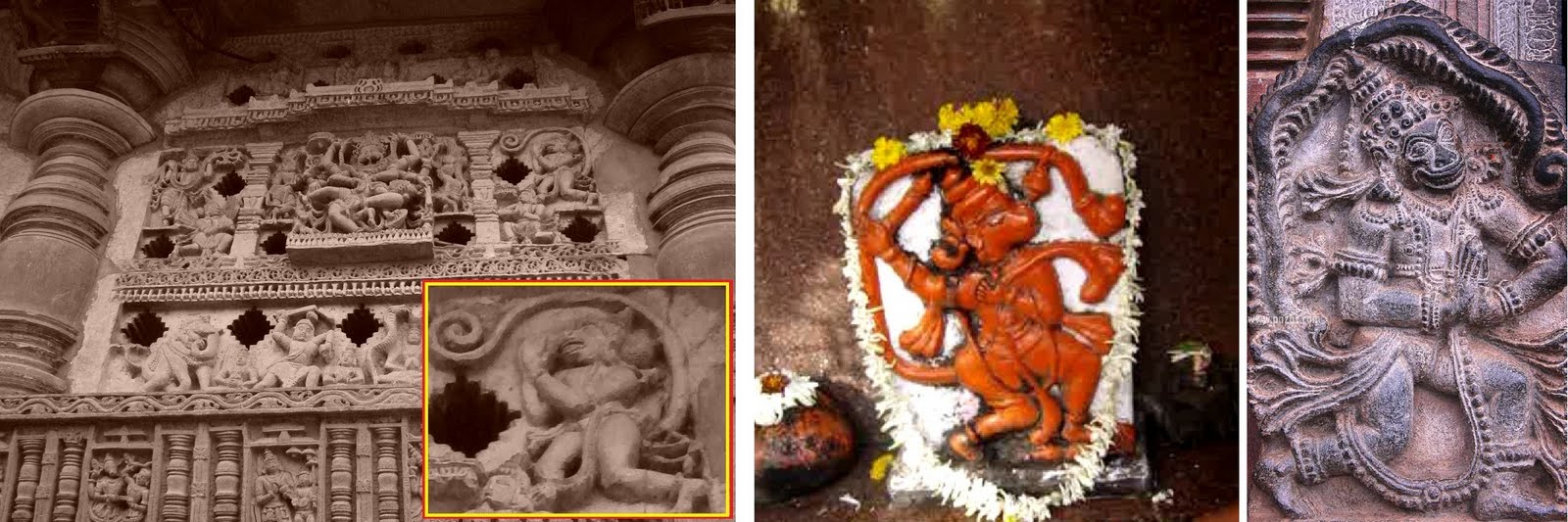
On going through some photos of the chennakesava temple in Belur, I noticed on one of its front walls (fig on top, left) a laughing monkey with its tail over its head (see enlarged view inset). I dont know whether this monkey is supposed to be hanuman. But it seems to be a rare open-mouthed monkey. This open-mouthed image(http://www.pazhs.com/gallery/Belur.htm), different from the one referred to above, has no bell on its tail and has Buddha-like curls of hair. I guess it is on what I call the "remnant" wall of Belur where fragments of various lateral layers of temple architecture and sculpture can be found (see my previous blog. There are no caste marks on this hanuman and the figure is not trampling anybody, so, I guess again, that this figure is the older of the two hanuman figures from Belur in this blog. Since the Chennakesava temple started more than 900 years ago one could conclude that the Hanuman at the Pashan mandir could be from that time ...
The resident of the Pashan mandir could have been right when he told me that the temple was 900 years old, even if he may not be convinced about it himself.
An old Bakul Tree
Before I go to the old Bakul tree at the Pashan mandir I must point out an old tamarind tree that seems to have been not noticed in the net.
Pashan village proper has a central part in which there is a place where people gather for their prayers and their village ceremonies; there is an old house built on a platform of huge (by modern standards) hand-cut stones on which stands an obvious old house built with what seems to be unbaked clay brick stones.
Next to this old house is a huge tamarind tree which must have marked the centre of the village for I do not how many years. The diameter of this tree (as the picture below would indicate) is easily close to or greater than 2.5 meteres or eight feet.
Tamarind trees are usually kept outside a village boundary in some places because of the belief that ghosts live in it. This old tamarind tree seems to be benign in this matter. The tree and its platforrm is used in several ways by the people of Pashan village.

Old tamarind trees figure frequently on the net. Some of the pictures from the net of such trees are given below.A two-hundred-year-old tamarind tree from Thailand (now associated with a restaurant) is shown on the top left. On the bottom left is a five-hundred year old tamarind tree (from carbon dating) in Surola village of Chapal Nawabganjin Bengal, while a painting of a 400 year old Tamarind tree near the Sangam at Allahabad is shown at bottom left of the picture below (see http://www.harekrsna.com/sun/features/08-10/features1816.htm).

By these standards the tamarind tree in Pashan would be more than three hundred years old in which case it will predate Yeasubai's visit.
I did look around for signs of an old tree that could be associated with the temple. There was a banyan (vad; it looked to me to be a cluster fig tree or ficus racemosa) tree with signs of tying thread around it (see Figure below left) as married ladies do 108 times during vad purnima in May-June. Behind this tree is the living quarters associated with the middle of the eighteenth century (see earlier).

There was another huge tree (Fig above, middle) which at first glance I thought was a tamarind tree similar to the one in the centre of Pashan gaon. The stem of the tree was much larger than the spread of an average man (fig above, left inset). A closer examination of the tree showed it to be different from the tamarind tree. A man there said that it was a bakul tree. The very sound of bakul stirs the cockles (cockles is the wrong word for a bengali who does not really care for sea food; I guess the good equivalent is ilish maacher jhaal) of a bengali's heart or the womb, say, under the shade of the bakul tree. My favourite verse, of course, is from tagore's kalmrigya simply because I was blessed by two happy sisters and two happy brothers. You cannot translate the songs into English. One transliteration (http://www.fipa.org.uk/repertory/more_fatalhunt_script.htm) has a part that reads like this
... come and look brother!
Run to me and look at our bokul trees …
like a row of smiles,
How many flowers have blossomed !
The flowers rolling under these trees,
Come to me, run to me … but do take care not to bruise them under your feet.

The bokul tree can last very long and can be strong enough to be called bullet-wood tree. It probably lives very long because of this strength. A very old bakul tree (fig below top left)is a tourist attraction in antpur (Hooghly district, where I was born: bengalis have a nasal intonation when they say aat for eight) so that antpur means eight villages. There is a tree (called the siddha bakul tree, This tree is believed (among believers) to have been planted by Sri Chaitanya Mahaprabhu (15th century) in Jagannath Puri which is now venerated (Fig below middle and right) as a spiritual tree.
Pashan has suddenly come alive for me. The new high´-rise buildings have crushed the rare stones that probably gave Pashan its name. The river which now has a name had brooks and groves that have long since gone. So have the cowherds. So have most of the trees. The cows have to fend for themselves and in rainy weather sit on the new roads which are the only dry places they have.
These roads carry moneyed soul-less soles working for the yankee dollar and rootless in their homes.
With every long funeral procession of a Pashan villager, one more link to older root ends.
Subscribe to:
Posts (Atom)