Saturday, September 29, 2012

King Arthur as President of Simple folks of America? Marx, Engels, Snark and Boojum.

There is always the wish in the mind of the ordinary simple folks that they could be ruled by a benevolent figure like King Arthur or his equivalent, It would be better still for the world if the most powerful country in the world, say America, had such a leader.

It is easy to pose the question in the title of this blog. One looks at the presidential candidates or presidents or important public figures of USA, The answer would be very easily a simple “no” … not even if you were allowed to consider Che Guevara!

The rub comes if we can think of “yes” as an answer. Then we have to pose some more questions. Therefore this blog?

It will be somewhat out of character if this blog is not as long as it is. Unfortunately, it could have become longer simply because there are so many things I have to learn through blogging... and there may be little time left?

The last time I started on a blog was more than four months ago. I thought I would write on Labour day, trace its origins, come to Chicago, find an Obama-connection and then argue about why Obama’s strong Chicasgo influence makes him use an altruist’s concern for the poor for his own selfish ends of remaining in power and bank-rolling his life style at the expense of the American people. We in India know about the qualities of our recent day politicians too well and need not be disappointed with the behavior of any politician, least of all any recent American president. All this I will leave to a later blog.

Obama is no King Arthur nor was meant to be. Obama, as an individual or as a president has seemingly (at least to somebody like me) has made little positive contribution of any kind to an original, typically American, philosophy that could improve the quality of the life of the ordinary American, regardless of colour or wealth or religion or education.

As world citizens, however, we were really hoping that a man such as Obama with an “ordinary” upbringing could come out of his middle-class-ness and rid the world of its petite bourgeoisie mentality of undeserved and unreasonable self-enhancement. We had also hoped that a benevolent American President, would take up global concerns that affect the life of the simple folk.

The danger is that the hunt for a King Arthur may be like the hunting of a Snark when all we have is the Boojum

Who are the simple folks?

They celebrate the May festival.

I will spend some time with the origins of May Day because this day has its roots in the earliest spontaneous folk festival which did not require a sanction from authority. To be a benevolent leader one could ask, like White’s “Once And Future King” Arthur asks of his queen Guinevere in the film version of Lerner and Lowe’s Camelot (just in case you have not seen the movie several times),

What do the simple folk do?
To help them escape when they're blue?
The shepard who is ailing, the milkmaid who is glum
The cobbler who is wailing from nailing his thumb
When they're beset and besieged
The folk not noblessly obliged

To which Guinevere guesses

… They must have a system or two
They obviously outshine us at turning tears to mirth
Have tricks a royal highness is minus from birth …


Guinevere, so lustily enacted by the very charming Vanessa Redgrave, would look forward to the month of May

… That lovely month when ev'ryone goes
Blissfully astray.
Tra la! It's here!
That shocking time of year
When tons of wicked little thoughts
Merrily appear!


It is this general acceptance in Europe of May being a lovely month that led to the celebration of May Day. This festival, it seems, is really from a pre-christian Celtic paganistic festival pronounced something like Beltane. This festival has some similarities to our own Holi festival especially in the way they light bonfires to mark the festival. Beltane also refers to the god of fire/light. This ancient pagan (relating to an ancient religion that had many gods and praised nature.. my computer tells me) festival is also associated with the Maypole festivities of Whitsun which is thought to be related to lingam worship (see “The Sacred Fire: The Story of Sex in Religion” By Ben Zion Goldberg) and a licence for free sex, as it is (or was, perhaps, before internet and virtuality came in) supposed to be in our Holi festival.

My father was born in the first of May. As children, we five siblings within twelve years of each other, have celebrated May 1 as my father’s birthday. As a six-year old or so, I concluded --- as usual wrongly --- that the public holiday on May 1 was part of celebration of my father’s birthday by the workers of the small factory where my father was chief engineer. As my innocent world expanded with age I was impressed by the number of other factory workers celebrating our father’s birthday.

We looked forward to that May-day holiday when we would picnic in My Ladye’s Garden (did not understand at that time why “lady” became “ladye”) before or after we went to the (now shifted) Madras zoo. Labour day was indeed a day of family celebration. Even if summer was not the best time the sea breeze was most cooling in the summer evenings when the typical madrasi male would roll up his lungi to ventilate his inners.

In the context of the May festival , it has to be mentioned that My Ladye’s garden was initiated by Charles Trevelyan in 1859 when he became a Governor of Madras (now Chennai) for a brief period. Trevelyan did it as a People’s Park which ended in a place that is now called Park town. So our family’s may day was somewhat in touch with the “pagan” spirit of May Day in a “holi”-day sense.

A more people-unfriendly view of Trevelyan is that of one who was put in charge for relief during the Irish famine in the mid 1900s when nearly a million people died. Trevelyan failed to bring the famine under control, He is supposed to have written (according to Wikipedia) "The judgement of God sent the calamity to teach the Irish a lesson, that calamity must not be too much mitigated... The real evil with which we have to contend is not the physical evil of the Famine, but the moral evil of the selfish, perverse and turbulent character of the people." Maybe Trevelyan made the people’s park for the Indian people as a penance for his Irish crime, ... or was it for for his ladye who “... remained in London for the sake of the children.” (Florence Nightingale’s letter in 1859).

Simple folks and the Proletariat Caste: A Loss of Innocence.

Our communist labour-union-leading relatives traced its origin for us to the workers’ revolution in which Marx and Engels and Lenin and Trotsky figured. The workers, they said, revolted against the richness of the rich who profited from the wealth of the workers’ labours. This was how the class-distinction between workers and rich factory owners crept into our minds at our young impressionable age.

Marx and Engels had just entered manhood when they voiced their philosophies. Engels wrote Engels would write his book “The Condition of the Working Class in England” in 1845 when he was twenty four years old! That is the age when one is not afraid As a preface to the 1891 English Edition of his book, Engels would write

The book, an English translation of which is here republished, was first issued in Germany in 1845. The author, at that time, was young, twenty-four years of age, and his production bears thestamp of his youth with its good and its faulty features, of neither of which he feels ashamed.

Youth is never a problem for original thought and action. Einstein was 26 in the year when he published his works on Brownian motion, special relativity, and the equivalence of matter and energy, S N Bose’s work that led to the concept of bosons --- as in the so-called god particle Higgs boson --- was also that age when he finished his work. Enrico Fermi was twenty two when he realized the possibility of enormous nuclear potential energy in Einstein’s E = mc2 equation. Alexander was twenty two when he invaded Persia minor.

The immaturity of youth is a problem, however, when it comes to social issues since age does temper the impetuosity of youth, with the arrival of children and grandchildren and with the simple joys of running a family.

The loss of innocence of Camelot’s “simple folks” all over the developed/developing world is one of the more important consequences of the influence of the philosophies of Marx-Engels. The simple folks became the proletariat caste (Roman term, as we ought to know, for those whose children are their wealth because they perform manual services for the Roman empire that the aristocrats cannot). Engels would write “…The first proletarians were connected with manufacture, were engendered by it, and accordingly, those employed in manufacture, in the working up of raw materials …

Since that time, the middle of the nineteenth century, the aim to be come a so-called class-less society, has seen instead a new hierarchy of caste systems within the salaried class. As Engels noted, “… the degree of intelligence of the various workers is in direct proportion to their relation to manufacture; and that the factory-hands are most enlightened as to their own interests, the miners somewhat less so, the agricultural labourers scarcely at all … .

In the context of this article, it was the misery of the Irish workers in Manchester that led to Engels’ Die Lage der arbeitenden Klasse in England in 1845 that eventually led to the workers’ revolution and to the amelioration of the conditions of the factory workers. The credibility of this revolution led eventually to the monopoly-like power of labour leaders. This revolution was destroyed by the Communist party of the Soviet union and re-phrased by the (now capitalist) Communist party of China. Both of these developments left the communist parties all over the world rudderless. With it, the theme of “upliftment of the proletariat” --- so common in the mid twentieth century --- vanished from political usage.

The salvation of the so-called poor, sadly it seems, can never come from the poor simply because the poor think themselves to be poor because of conspicuous images that drive them to want to be conspicuously rich also.

Their actual salvation seems to come from people who have been healthily and wealthy for several generations. These saviours are able to be generous without being conscious (say by tax concessions) about it.

The saviour has to be something like King Arthur in his Camelot.

Marx and Engels and King Arthur --- men with beards

A king such as King Arthur had to rule based on a philosophy on which he must have been advised on. Let us say that his advisor was Merlin the magician. Merlin may have been a magician to King Arthur, because Merlin’s advice worked like magic since he would not have understood the philosophy in its full context.

Let us also say that Marx-Engels to a modern ruler would be somthing like a Merlin.

Both Marx and Engels belonged to an affluent class which pu them, like a Buddha, to be in position to feel the sufferings of the poor from their truly privileged position. Because of their privileged position they could also be heard by people of consequence. Engels would write in the preface of his book on the conditions of the working class in England,

... I am both glad and proud of having done so. Glad, because thus I was induced to spend many a happy hour in obtaining a knowledge of the realities of life -- many an hour, which else would have been wasted in fashionable talk and tiresome etiquette; proud, because thus I got an opportunity of doing justice to an oppressed and calumniated class of men who with all their faults and under all the disadvantages of their situation, yet command the respect of everyone but an English money-monger...
The images of Marx and Engels above, presumably working on the conditions of the working class, show them in quite comfortable conditions. These conditions naturally made them appreciate the misery of the working class. Marx would seem to be the more convinced. Engels was probably more steet smart. He would publish his “authorised version” of an English Translation in America, hoping as usual to make some money.

When Engels made his classification of workers based on the degree of intelligence, he was, of course, like all non-proletariat intellectuals, unaware of the amount of intelligence used by an organic farmer because of his experience. In any sensible society of simple folks, this organic farmer, who cannot be thought of as part of a petite-bourgeois salaried class, should head any labour hierarchy simply because of the essential food he provides. Instead, in the modern world, the hierarchy of labour is headed by programmes generated by computers.These programmed machines of manufacture are in the hands of environmentally de-sensitized, conspicuously consuming, clerk-people. The conditions of these workers are naturally unstable since they become redundant when more efficient labour unfriendly programmes increase worker redundancy.

Engels and Marx become relevant in modern times because of the philosophy of their ideas, even if they rephrased old philosophies in terms of what was contenporart for their times, Their analyses do not depend (I think) on the actual working condition of a salaried class, Their importance came from their unorthodox views which they could sustain because of their affluence.
The images of Marx and Engels that we are familiar with are those with long beards. Fig 1 is taken from the internet, pens and relative positions of the two have changed. Engels in a woollen coat may have been visiting Marxr. A portrait on the wall behind (;eft of Fig 1) suggests an affluence associated with Marx in his earlier days. It is their beard which gave American politicians their phobia of people with long beards (Castro, Osama, holy muslims, Sikhs).

The growing of a beard could suggest a non-necessity to spend time shaving one’s self purely for the purpose of conforming. The series of photographs in the top row of Fig 2 shows Engels growing up from a cocky young lad of the upper classes, through an uncertain angry young man who has made his first protest, then basking in the comforts of his recognition till finally becoming a wise old man, a little uncertain and perhaps forgiving himself for some of his early inaccuracies.

Not all men with beard are associated with blood-spilling bolshevikism (say, Jesus Christ or Gabby Hayes --- he was the sidekick that provided the negative space that made heroes out of cowboy legends such as Hopalong Cassidy, Roy Rogers, Gene Autry)., Cricketing revolutionaty W G Grace (played cricket from age 17 to 61) was famous for his bird nest beard. Tendulkar by this example could break another record by playing till 2035, sharing as he does Grace’s financial acumen. I don’t think Tendulkar is hairy enough to grow a Grace-ly beard.

Marx’s Philosophical Problem

Karl Marx did not start his non-conforming life with a beard. He had the air of a confident young man, because of which perhaps he engaged in a difficult doctoral thesis on the difference between Democritean (from Democritus’ theory of atomos or indivisible) and Epicurian philosophy in Nature. Karl Marx’s dilemma was the following:-

Two philosophers teach exactly the same science, in exactly the same way, but — how inconsistent! — they stand diametrically opposed in all that concerns truth, certainty, application of this science, and all that refers to the relationship between thought and reality in general. I say that they stand diametrically opposed, and I shall now try to prove it.

Some of Marx’s statements (http://www.marxists.org/archive/marx/works/1841/dr-theses/ch03.htm) are quite simple

... while Democritus turns the sensuous world into subjective semblance, Epicurus turns it into objective appearance... ;
... Democritus, dissatisfied with philosophy, throws himself into the arms of empirical knowledge, Epicurus has nothing but contempt for the positive sciences, since in his opinion they contribute nothing to true perfection. ...
"

Such contests between the philosophical and the empirical comes up in all aspects of life ... The philosophical aspects are most often imbibed by the deprived while the empirical or practical aspects are best suitable for the ordinary (non-monsanto?) farmer who has the more difficult task of understanding nature and drawing from her resources without upsetting her rhythm.

When Marx and Engels started their collaboration, they were perhaps guided by the Democritean approach. They required an analytical basis, not unlike aspiring scholars of that time. Just like the laws of motion in physics, they came up with “ … dialectics, or the laws of motion of nature, human society and human thought …” (most of the comments on dielectics in what follows immediately will be based on Robert Sewell’s “What is dialectical materialism? - A study guide with questions, extracts and suggested reading” http://www.marxist.com/what-is-dialectical-materialism.htm).

Dielectics (a method of argument for resolving contradictions or disagreement) is primarily meant by Marx and Engels (I think) to provide the required philosophy for the working class (producers of wealth) to understand the conflict in their relationship with the capitalist class (hoarders of wealth). Once this is understood it can be used as their most effective weapon in their fight against their exploitation by the capitalist class,

One important aspect of such a dielectic, that is to Hegel in western philosophy, is that for every thesis one seeks an antithesis and one makes progress by a synthesis that removes the contradiction till another antithesis is found.. and so on. This is a dynamic theory which changes with change. Change it must as the environment of the universe changes with time independent of the direction it goes.

Within the limited lifetime of interest in philosophy that is available to a human mind such changes become slow to grasp after a certain time. The synthesis becomes static and reaches a steady state in which contradictions are not perceived to exist. One then writes a textbook or a treatise that is used as a guide. This may be thought to be a crystallization of ideas but is actually a petrification. Outside such a fossilization of a living mind, however, change continues relentlessly, A given synthesis or treatise becomes erroneous and therefore obsolete with time. The dialectical process of thesis, antithesis and synthesis continues but any synthesis during a finite period of time remains incomplete.

The requirement for the fulfilment of this dialectical process is infinite time which is impossible for the ordinary human. In this case one requires an authoritative statement from one who has experienced infinite time (in any direction). This becomes the dogma of a doctrine or a revelation in religion.

One may conclude, as a corollary, that since one does not have infinite time in one life, such doctrine must come from another world where time has reached infinity (godliness) and no change in time is possible. This could provide the basis for a “god-given” treatise such as the Vedas. The following of the Vedas will then necessarily have to be ritualistic since we cannot know truth in our finite life time. On the other hand, those who live in a dynamic sense and perceive change, the time-dependent dynamic dialectical method of perception and inference are the only source of knowledge, with little interest in its end. It provides the philosophy for action in life. In the context of awareness of the Vedas, this is the interpretation of the Mimamsa philosophy.

The essential feature, at this point of my understanding, is that at every point of one’s life the essence of any experience (forward in time) at any instant of time is registered only because of its negative or contradictory memories (backward in time). We learn how to walk on two legs because of our memory that we fall if we move forward without walking properly. This we do instinctively, even if we do not realize that we fall because our centre of gravity falls outside our base of support and we can prevent ourselves from falling if we move our base of support of our centre of gravity before the time it would have taken to fall. The quicker we do it, the steadier our gait is. This is so in all aspects of our walk through life. This is an irreversible process. We cannot unlearn it simply we cannot un-experience it. Just as a fallen stone will not climb up.

Dielectical materialists are those who believe that matter always existed but the consciousness of the existence of matter came only from the mind of evolved species such as that in mankind. But if life is a reaction to change, then all changes must be considered as a life process. The requirement for change is a requirement to remove differences in potential that appears due to such a change. This does not require a cognitive mind. The notion that there is change even when there is no mind to perceive the changes suggests that time is independent of its perception by the mind and that there would be no existence in the absence of time or change.

Dialectical Materialism as applied to mankind (Historical Materialism) refers to the events in History that was created by man’s consciousness and has been applied to the role of man in his economic order and the contradictions that arise within. The class of mankind that controls production of wealth is in contradiction with the other classes. Historical materialism predicts the synthesis of such contradictions.

Because of its very contradictions, Marx”s conclusions derived in the early 19th century cannot be expected to be valid in the early twenty-first century.

The dialectical method --- not necessarily that of Marx --- will still be relevant.

The Snark of a Story teller

The storyteller has many times perhaps little use for the empirical or the philosophical sciences. His successes depend on the acceptability/gullibility of his readers and their own private biases of their life-experiences.

One of the more attractive storytellers must be Lewis Carroll, which is the pen-name of Charles Dodgson (the same name as his father, his grandfather, his great grandfather). Lewis Carroll did not grow a beard, probably because he stammered. One of his poems on “The Hunting of a Snark” had a bearded Bellman captaining his ship who lands his crew on a beach hunting for a Snark. The Bellman (second from tight in the bottom row of Fig 2)who was trusted so well as the Captain “... had only one notion for crossing the ocean, And that was to tingle his bell ... .”. Henry Holiday’s sketch of the bellman has quite a resemblance to Charles Darwin.

The poem begins thus
“Just the place for a Snark!” the Bellman cried,
As he landed his crew with care; 
Supporting each man on the top of the tide
By a finger entwined in his hair. 
“Just the place for a Snark! I have said it twice:
That alone should encourage the crew. 
Just the place for a Snark! I have said it thrice:
What I tell you three times is true.
” 
There are some who identify the bearded bellman with Charles Darwin and the crew with the crew of Darwin’s ship Beagle. Martens’ 1934 etching of Darwin’s Beagle landing ashore (Fig 3 left) at the port of Santa Cruz in the Tenerite Island of the Canary islands, has been assembled (Fig 3 right, in modern terms it would be called morphing, I guess;) together with Henry Holiday’s illustration of bellman, banker and beaver that accompanied Caroll’s poem (see http://www.flickr.com/photos/bonnetmaker/7789617292/). To be fair, Holiday may have just used Darwin as a model. Other similarities have been noticed, however, (http://www.flickr.com/photos/bonnetmaker/6072739203/) between the drawing of a weed and Darwin’s sketch on the tree of life.

Once one makes this connection, it is easy to see that for the empirical scientist, repeating an observation of a previously unidentified object is sufficient proof of its existence. The corollary to this is that the first reasonable hypothesis for finding a previously unidentified object is assumed to be true if the hypothesis is also repeated three times. Thus, the phrase “What I tell you three times is true” is suggestive of the utterings of a (creative) research supervisor urging his assistants to deliver. Darwin would fit this description.

Lewis Carroll being a mathematician (as Dodgson) may have been a Democritean and rejected evidence that did not have a mathematical proof. As a Democritean he did not have mathematical proof (based on what he knew at that time) that the probability that a monkey could be trained to intelligently type a phrase from, say, Shakespeare. So he would have been uncomfortable when Darwin (as an Epicurean?) proposed his empirical theory of natural selection. Caroll may have identified this theory with the Snark?

The Snark and the Boojum

The Snark has to be distinguished from the Boojum

The characteristic of the snark “… a peculiar creature, that won't Be caught in a commonplace way. …”. Is that there are some which may be Boojums: “ and beware of the day,If your Snark be a Boojum! For then You will softly and suddenly vanish away, And never be met with again! …” The Boojum is not an antithesis of you because there is no synthesis with the Boojum. The Boojum may not even be an antimatter if no light or information is given out as you vanish.

In a remonstrative but well-cited (> 350 citations) article titled “The Snark and the Boojum” (American Psychologist 1950) and delivered as a Presidential Address, before a collections of Experimental Psychologists, Frank Beach compared the research on Animal Behaviour by Comparative Psychologists as the Hunting of a Snark because of the subsequent vanishing of the Comparative Psychologists. Beach’s analysis had as its first chart (Fig 4) a comparison with the number of articles published with time with the number of species studied during this time.
The tailing off the number of species studied came about because of the narrowing down of animals being studied to white rats. As noted by Beach “…rattus norvegicus soon came to be accepted as a substitute for Homosapiens …” because they “…are cheap, easy to rear, and well adapted to a laboratory existenxe… “ and “… because of certain resemblance between the associateive learning of rats and human beings…” Beach continues that “… the average graduate student who intends to do a thesis problem with animals turns automatically to the white rate as his experimental subject ...”. The consequences are that “…We insist that our students become well vested in experimental design. We drill them in objective and quantitative methods. We do everything to make them first rate experimentalists. And then we give them so narrow a view of the field of behaviour that they are satisfied to work on the same kind of problems ... “.

Beach then predicts that instead of the Pied piper ridding a town of rats with the magic of his flute that leads them to the river to be drowned, the rattus norvegicus (the Boojums) now play the tune and lead comparative Psychologists to their extinction (Fig 5)

The Snark as a Democracy.

Democracy is very difficult notion to understand in detail, but is extremely simple when phrased in, say, Lincoln’s words that all men are created equal. One is never very clear, though, about what one means by being born equal. It may mean that we are born with equal statistical averages of our advantages and disadvantages that are necessarily judged by very different subjective criteria. This is especially true in racially and historically mixed people such as in what is called the United States of America and our own Republic of India.

It is, of course, the riches that America promises that attracts immigrants, with the promise of freedom. Here freedom must men freedom from the feudalism of European society from which most immigrants fled..

American democracy is, like the snark, very difficult to understand because of the assertion that all men are created equal and the excessive rights to freedom that they allow (see my blog “Should America be afraid of G. K. Chesterton?”). The difficulty of this snark is the assumption that all men are, of course, not equal in different fields.

One of the easiest freedoms that is defended by Americans is the freedom (the Boojum) to make money, no matter how. This is their freedom to make a livelihood.

This is the equality that gives one voter one vote --- in theory. In practice, there is a swarm intelligence in which a swarm of voters go by social signals emanating from the visible. It is the hype of the swarm that sways public opinion.

The sentences below are taken from Israel Zangwill’s play “The Melting Pot” where he defines the American, writes
“America is God’s Crucible, the great Melting‐Pot where all the races of Europe are melting and re‐forming! Here you stand, good folk, here you stand in your fifty groups, with your fifty languages and histories, and your fifty blood hatreds and rivalries. ... A fig for your feuds and vendettas! Germans and Frenchmen, Irishmen and Englishmen, Jews and Russians—into the Crucible with you all! God is making the American!”. Theodore Roosevelt, who applauded Zangwil’s play on opening night in 1907 would write later when decrying the hyphenated American

... a hyphenated American is not an American at all ... the man who puts “native” before the hyphen as of the man who puts German or Irish or English or French before the hyphen. ... Our allegiance must be purely to the United States. We must unsparingly condemn any man who holds any other allegiance. But if he is heartily and singly loyal to this Republic, then no matter where he was born, he is just as good an American as any one else.

This outcry against hyphenated Americanism by melting-pot protagonists has the dangers of nationalism (see Randolph Bourne,“Trans‐National America,” 1916) that drove Europe into their world wars. It is in this nationalistic garb of protectors of the democratic faith, that American occupation forces are now seen to be imposing their beliefs on the rest of the world. They may therefore now be seen to be doing unto others what was done unto them before they came to the land of the free.

This freedom is very mono-dimensional and has little tolerance for the hyphenated freedom lover.

The snark of democracy is in danger of becoming a Boojum.

The theatre programme (Fig 6) for Zangwill’s play has the different people entering the melting with the insignia of USA. In an uncanny way this illustration has a similarity to Beach’s illustration of the rodent in Fig 5. It is not difficult to see how seemingly different visualizations of different aspects of sociology lead to the same picture even though figure 6 is not consciously intended to resemble events in the pied piper of Hamlin.

So! Can King Arthur be President of America?

Asking a philosophical question about King Arthur poses the problem that King Arthur exists. Since our perception about King Arthur is not complete, we can accept that the myth exists and so he exists along with his virtues as imagined, say, in Lerner and Lowe’s Camelot However, this myth does not mention King Arthur’s attitude to democracy. He was advised by Merlin who was a magician,to King Arthur.

How will King Arthur persuade the folks of America to vote for him.

We wont tie ourselves into a Gordian knot with this but go ahead regardless --- as Alexander would have done without untying the knot but slashing through it philosophically, perhaps using Ockham’s razor. .

The question is whether one can elect the President of a Nation by the majority of votes made by individuals. This is especially so when these individuals cannot make, by their own inclination, a serious choice that would be important in their decision making after an in-depth examination of all issues.

Therefore tutoring is required. It is usually in the form of an election campaign.

King Arthur would have to know his constituency and postulate on promises that would be appealing.

This reminds me one of Bertrand Russell’s (Introduction to Mathematical Philosophy, 1919) famous quotes: “The method of 'postulating' what we want has many advantages ; they are the same as the advantages of theft over honest toil. Let us leave them to others and proceed with our honest toil ...” Russell was referring to the use of postulates for “ ... fundamental objects of mathematics such as the Peano axioms (e.g., 0 is a natural number) for the natural numbers ,,,

In order to be President of America the King of Camelot should explain his virtues by postulates that would satisfy the modern American citizen so much that they would vote for him.

One may take the traditional false postulate route.

This campaign is run by a group of advisors, appointed or anointed by those who finance the campaign.

Their power of influencing voters would depend on the amount of money they make an on-beat policeman.or a vendor.If one goes by the popularity scale on Youtube sex video are seen ordinarily by tens to hundreds of millions while the highest views of a physics lecture (Leonard Susskind’s General theory of Relativity) or a lecture on DNA lreplication is ~ 750,000. On the other hand a Mark Hamilton’s Neothink Society’s highly dubious lecture to get rid of poverty by becoming a hard core (http://www.youtube.com/user/neothinksociety?v=OkxjnnBL7V8&feature=pyv) libertarian has more than three million viewership!.

By this token, sex worker (even if she calls herself a prostitute) or an internet entrepreneur hosting sexually explicit sites, or an actor of perversion is equated in society with an academic professor, or a salvation army worker, or the vendor of inventions.

Obama perhaps even sees more political advantage of having the promise from Madonna (not mother of Christ) to strip nude should he win. One is not sure whether Romney would encourage such a trip because of the potential of a visual disaster making voters shy away from Obama’s win.

Obama plays the image game fully as a seasoned President would do... He is nowhere as honest as Jimmy Carter. Obama’s image of walking into a beer bar to be picked up by a folksy white man is part of this strategy, especially at a time when the Caucasian American (> 75 % of voters) is thought to be almost completely polarized against him.

One may as well ask whether viewership of youtube videos reflects the attitude of different sections of the population towards the different activities of society. One could then ask whether the language of candidates in a presidential election should be closer to the language and idioms as reflected on youtube (for example).

In this buzz of the swarm intelligence, differences and similarities between people are smoothened out into an acceptable paradigm for selecting presidents. There does not seem to be any synthesis of real contradictions in this swarm from the melting pot which has “... distinctive qualities ... washed out into a tasteless, colorless fluid of uniformity. “

At the same time in the usual election campaign, there seems to be only an antithesis for every thesis at the most black-and-white, rich-and-poor, christian-and-terrorist, gay-and-glum levels. Such contained differences provide the high temperatures of the melting point that describes the mixing of American people.

King arthur may find advantage in taking the more folksy or pagan route.

There is little chance of finding self-less folksy advisers in modern times. However, there needs to be every chance that the advice is plain and simple with not only folksy images --- the picking up of babies, shaking of hands, kissing of sweet old ladies or getting bear-hugged by a hard hat --- not also folksy idioms

What should King Arthur honestly postulate to win the votes of Americans? Will he have to subscribe to the notion that he is Christian of true Norman blood that fought the crusades against Muslims and claim advantage as a sworn antiterrorist in modern America? Or, will he claim his Welsh pagan lineage? (There are not many American Presidents who claim Welsh lineage proudly).

Claiming a pagan lineage could be advantageous to King Arthur, since the percentage of American citizens now being born to non-Caucasian parents is more than 50 percent and by 2030 they will have the power to vote.

If the ordinary folks would like to live their lives in the way that make May festivals attractive, their lives would necessary have to be one in which they work hard to run their daily life. Not so long ago, say, in the Norman Rockwell times, one could have had an idyllic picture. The middle-class workers’ lives involved non-automated skill which they were proud of. Their gadget-less housewives uncomplainingly spent their time working for their home with all the responsibilities that come from their pride in their family. In such a case a few days of merriment in a year would have been especially welcome, and provided the faith to work on their daily life till the next festival.

In this scenario the governance that is required is primarily that from the family itself, and the role of a government is to facilitate this daily life of self-governance and self-sustained good health, No self-respecting man wants charity even if it is the form of financially motivated health care scheme.

Most important of all is that by claiming a pagan lineage he gets rid of all the Christian mumbo jumbo. He can then set pagan life as the desirable life of the American that comes out of the melting pot.

He will also have the advantage of not knowing about all the divisive religious elements. He would believe in simple truths which are now gospel.

"You have heard that it was said, 'Eye for eye, and tooth for tooth.' But I tell you, Do not resist an evil person. If someone strikes you on the right cheek, turn to him the other also. And if someone wants to sue you and take your tunic, let him have your cloak as well."
-Matthew 5:38-40

"Why do you look at the speck of sawdust in your brother's eye and pay no attention to the plank in your own eye? How can you say to your brother, 'Let me take the speck out of your eye,' when all the time there is a plank in your own eye? You hypocrite, first take the plank out of your own eye, and then you will see clearly to remove the speck from your brother's eye."
-Matthew 7:3-5

Do not murder, do not commit adultery, do not steal, do not give false testimony, honor your father and mother, and love your neighbor as yourself."
-Matthew 19:19

The America with these ideals could become the future Camelot over which King Arthur would easily reign over. This will be an interpretation of Israel Zangwill’s David continuing with his melting-point dialogue with

... the real American has not yet arrived. He is only in the Crucible, I tell you—he will be the fusion of all races, perhaps the coming superman. Ah, what a glorious Finale for my symphony—if I can only write it.

After all, Israel Zangwill has also been credited (in his book “The Grandchildren of the Ghetto”) with the quote “Scratch the Christian and you find the pagan - spoiled.” Somewhere in the internet it has also been said “scratch the pagan and you will find the shaman” ... the spirit of the holy ghost.

Zangwill also goes on about the Jews
The Hebrew view of life is too one-sided. The Bible is a literature without a laugh in it.”. This view is probably applicable to severely mono-theistic religions such as Islam and Judaism.

If the American Democracy becomes too severely de-hyphenated it could acquire the third characteristic of the snark:

... its slowness in taking a jest.
Should you happen to venture on one, 
It will sigh like a thing that is deeply distressed:
And it always looks grave at a pun.


The only snag would be Lancelot!


Friday, April 6, 2012

Thought of Food 9: Making gluten-free multi-grain bread --- the idli way

I have been busy dealing with my science: so I am not writing blogs on general subjects, even if I may get the impression from Indian news avenues that there are so many things going wrong that I can blog about. It is futile bitching about the state of affairs when that is all that we seem to be good at. In any case, I do not think my blogs help in bucking the trend.

What I am worried about is my sugar level which is at an unhealthy high. My rather unsuccessful pursuit of my science gives me high blood pressure. I cannot eat the way I like. I am plus seventy and it really should not matter. Yet, I am continuously thinking of food.

This blog is a continuation of my earlier efforts (Thought of Food 3: A "Maharashtrian" Bread; Thought of Food 5: Multi-Grain Bread for Desis) to make a healthy breadThe blog may be a little long (which is not unexpected). If one has to cut a long story short, the final gluten-free bread that I made is shown below.

When commencing this blog I searched the net for gluten-free bread. The trouble with many gluten-free bread recipes is that the breads do not conform easily to images of ordinary bread that we have trained ourselves to use for working up an appetite. I came across a well thought out blog which nicely gives some of the hurdles in making a worthy gluten-free bread (GFB). This blog also gave a recipe which seemed to be as close to what giving a bread that is desirable (http://glutenfreegoddess.blogspot.in/2009/02/delicious-gluten-free-bread.html). The recipe here uses egg, tapioca or potato starch, and a gum (Xanthan, which increases the viscosity of the dough). As one can see the effort is to add things that would not make the GFB soggy as it actually is most of the time.

The recipe
After a little bit of experimenting, I think I have come up with a recipe for bread that is easily adaptable to Indian cuisine, especially the South-Indian ones who make idlis as their regular food. I use all the healthy grains except wheat and the ordinary rice used for making idli. I have been making the bread for the last three months and I have survived for the better with apparent (from the way I feel) loss of blood pressure, better sleep, no stomach disorder and very little pumpern (see Epilogue)

The recipe that I give below is eggless, gum-less, starch-less, and (essentially) flour-less, starting only with whole grains. The making of the dough is, in a way, similar to the making of our good old idli dough.

The traditional ingredients idli dough has two essential components, urad dal (black gram or Vigna mungo without its black skin ) and parboiled rice which helps to make the dough gelatinous and starchy.
One can always use whole Urad with the black skin. The only problem is cosmetics due to black fragments left after it is ground. Decorticated whole Urad is preferred.

The two grains are soaked in water for a few hours and ground in an idli grinder usually mae out of stone. A version of the traditional grinder that we were used to as children is shown in the left of Fig 1. It may be looked upon perhaps as the first portable version of the water-mill or the flour mill, though it can be hardly called the lap-top kind. It is usually kept outside the house which usually has a garden fed by the local drainage and kitchen and other waste. The person grinding the dough (usually a grand old lady of the house) has the grinder placed between two stretched feet while squatting on the ground, pours the soaked dough in the cavity rotates the inner stone with one hand pushing back the dough into the cavity of the idly grinder with the other. In the process considerable amount of air along with air-borne bacteria is mixed in and the dough is soft and fluffy. There are mechanized version ot the traditional idly grinder (Fig 1 right, always click to expand picture) which are used in closed confines of a restaurant fed by the vapours from cooks and waiters, or run outside road-side food-chains and stores when the achine mixes in roadside exhausts of vehicles of machine and animal kinds. It is then kept overnight in a half-filled vessel. The dough ferments and rises and is then ready for steaming into idlis the next morning.

(see http://chefinyou.com/2009/01/idli-recipe/ and http://www.indiacurry.com/south/batterexplained.htm)
Although I have used the stone grinder for this blog, one could as well use other routes for making the dough including what we call "electric mixer". There is no alternative, actually,, to the traditional stone grinder. The grains are lovingly sheared so that the flavour remains. They are not smashed and chopped and heated which kills the flavours, perhaps meaning that the wild yeasts are killed.

What we dont seem to know well enough is what makes the batter ferment without adding yeast. The answer is that there obvious (and most unsatisfactory answer) is that there is wild yeast. It is almost like saying --- like Crick and Orgel did in "Directed Panspermia", ICARUS 19, 341-346 (1973) --- that the origin of mankind is due to the intelligent seeding from aliens in outer space which is almost equivalent to saying that Jesus is the son of god because Mary is a virgin. It seems that wild yeast is everywhere and life is sustained in a medium of wild yeast --- just like some physicist would talk about ether if not the Higgs' boson by which the universe is controlled? Whatever it may be, the theory of "wild yeast" is useful in explaining why the dough is not successful:-
In United states --- as well as in home of resident Indians who would like to be or have been non-resident Indians --- fermentation of the idli dough is becoming a problem. The water is chlorinated, table salt is iodized and both these are not friends of wild yeast.
The homes have central air-conditioning many with hypo-allergenic filters, reducing the supply of the "wild yeast".
Urad dal (black gram) and Fenugreek seeds draw the wild yeast from air. So do not wash Urad Dal or Fenugreek seeds, as it will wash away the collected wild yeast.
Decortications processes for Urad dal involves introducing moisture to remove the skin. The split Urad has a problem. The pulse is split mechanically that generates heat and destroys much of the wild yeast see (http://www.indiacurry.com/south/batterexplained.htm).

My initial interest was to make bread using mainly millets since most millets are free of gluten or toxic lectins. They also do not require extensive amounts of water for their cultivation and therefore so so so environment friendly. I also wanted to try urad dal as a source of yeast for fermenting the dough and adding as well a gelatinous binding property that works so well for idlis. At the same time I was afraid that the bread may not work so well so I used wheat also. So myfirst "idli bread" went something like this.

Idli bread no 1.
Ingredients
Jawar (sorghum) : 1 cup
Bajra (millet) : 1 cup
naachni (finger
millet) : 1 cup
buckwheat : half cup
varai
wild rice : three-quarter cup
rajagira
amaranth seed : half cup
barley grain : half-cup
fenugreek seeds : half cup
Urad Dal
(black gram) : one cup (white,Decorticated)

The mixture was washed and soaked in water with aboout half an inch of water above the grains (Fig 2, left) for about six hours. I used boiled drinking water hoping to get rid of chlorine. We ground it in the idli grinder (Fig 1, right) for about twenty minutes hoping to keep the grains a little coarse. It was scraped off (Fig 2 middle) the grinder and then left in a vessel, the consistency of the dough being rather thicker (Fig 2, right, click to expand picture always) than the typical idli batter.

The dough that I had made had not risen enough overnight, or so I thought. It was sour in taste, like a good idli batter and one thought immediately of sourdough batter that was initially used in traditional bread-making. The traditional sourdough used the an earlier sourdough and which depended on yeast, say, from beer. I was also not sure whether it was going to make a good bread. It was also rather wet and sticky. So I added some whole wheat flour (about another cup or so) kneading it in slowly along with an yeast batter using flour, molasses and milk (see my earlier blog "Thought of food 5:). I also added the usual salt solution, some carraway seeds (shahi zeera), cumin seeds, and the Bengali's mustard oil (one heaped table spoon, magnesium in mustard is good for reducing blood pressure?).

The final dough for this bread had the usual consistency (Fig 3 left), it rose well on keeping for an hour (Fig 3 centre) and baked to give reasonably good-looking breads (Fig 3, right) of different shapes and a good-ish spongy heart (inset of Fig 3, right).

This first bread got a reasonably appreciative response at a cookout of cooking enthusiasts, that was organized the next day by the NGO Anthara.


Idly Bread no 5
Ingredients almost the same as idli bread no 1 without wheat grain and a cup of oats ro be added to batter at the end.

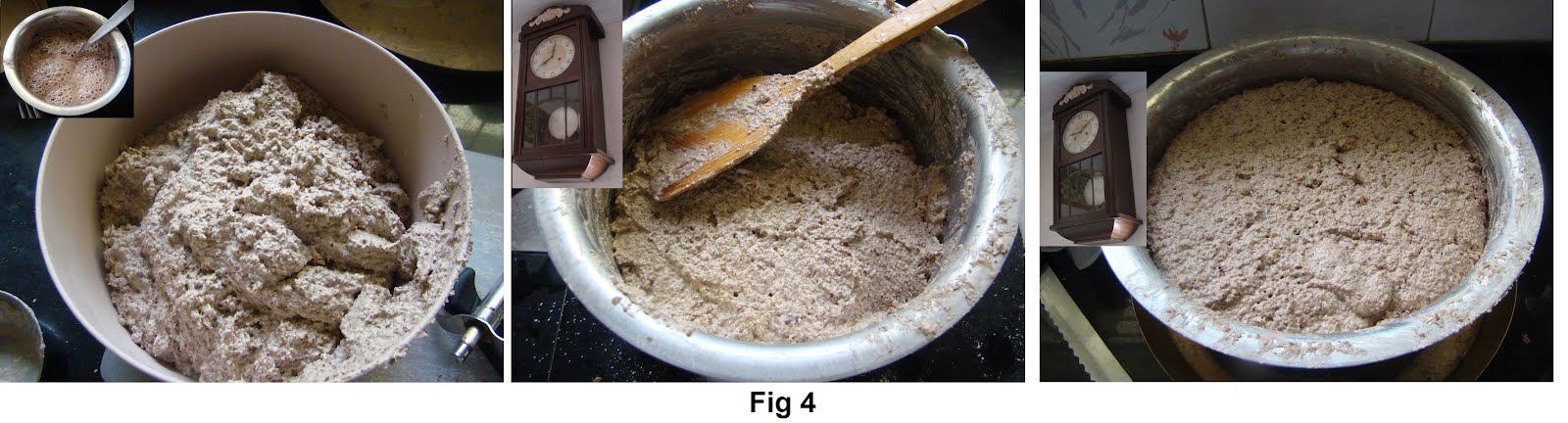
I kept making various versions of this bread without any substantial change. I used the whole black gram without decortication. Within the first few breads, I stopped using wheat grain. It was giving a cement-ish consistency to the dough which seemed to be un-necessary. Since it was summer, I reduced the amount of millet (by local Maharashtrian tradition) and replaced it by naachni or ragi (finger millet). I did not require fenugreek. The final dough required kneading-in a cup of naachni flour. I continued to add yeast batter (see top inset of Fig 4 right), using naachni flour instead of whole wheat flour.


The last dough that I have used before writing this blog had no wheat and less of millet. The batter that I got (Fig 4 left) after grinding was nice and fluffy (we dont know why exctly). I added less than a cup of naachni (finger millet) flour as well as the yeast batter using naachni. I had also found that instead of adding flour it helps to add a cup of oats flakes to the final dough. It was left to stand for an hour so (Figure 4, centre and right; don't miss the wall clock in the insets giving the time). The dough rose quite substantially in an hour.

I then lined the baking trays with mustard oil and poured the batter in after beating it a bit (Fig 5 left). I allowed it to rise for about forty minutes before baking in the oven at 225 C for about an hour. The bread came out cleanly and looked a bit rustic even though its flip side (first picture of this blog) looked as perfect as it could.

The bread was nice and crusty and made a lovely noise when sliced as a fresh bread almost as a fresh baguette would. It also sliced well (Fig 6 left) and looked well including having flakes of oats. The left-over dough made a good south-indian adai dosai-like or a Maharashtrian Thalipeeth-dish (Fig 6 center) that can be served with their usual traditional accompaniments. I preferred an half-fried egg (inset of Fig 6 center). The dough (with yeast and all) also makes good idlis (Fig 6, right) with their usual bland tastes waiting to be given a form of your choice (as usual).


Epilogue

A little bit of re-emphasis
The commercial food chains' emphasis on wheat products that are rich in gluten and other rubbish has been having a visibly harmful effect on the young. Its not that the newly rich and fashion-wise susceptible young people are not aware of the health problems in their food. Its just that they cannot be making the healthy food every day. What is alarming is that may be as high as 1 percent of the population in the United States are suffering from an autoimmune disorder that affects the small intestine because of gluten intolerance. This disease has the name celiac disease (see http://www.celiac.com/articles/1164/1/Celiac-Disease-Statistics/Page1.html) and arises from diets containing wheat, rye and barley. This means it includes white breads which rise well when they are gluten-rich, and many other instantly good-tasting foods such as pizzas and instant noodles, and beer which is made from barley. This is the food that young people, who think that they are upwardly mobile because of their hard work, eat comforting themselves that they require a 'little' relaxation of food control. Ignorance or neglect of this disease leads to alarming increases in the probability of getting gastrointestinal cancer (40 to 100 times higher) osteopoassis, diabetes.

On top of this, the new fear-word (see "The Lectin Report" http://www.krispin.com/lectin.html) is lectin that is a protein that recognises and binds to a specific type of carbohydrate in cell membranes. In some cases this binding disrupts the functioning of the membranes and damages the cell setting off a catastrophic cascade of immune and autoimmune disorders. The body has protections against these toxic lectins (e.g., glucosamine). It turns out that some cures of Celiac-Sprue related disease by the elimination of certain foods may also be due to these foods being high toxic lectin foods. An explanation that seems to me to be perfectly valid to such lectin sensistivity is that if our ancestors did not eat these foods and therefore develop immune system that could handle these txins then we have little chance of handling them ourselves. The safest route is to avoid food which has these toxic lectins and these include all soy and wheat products including oils from these substances. Soaking and washing of grains and sprouting them removes the lectins which could mean that cooking the grains would also do so.

What the young require, I think, is a standard grain-based sustainer, like gluten-free bread, or rice or idli, which they may then heighten by some salad, or gravy. It would of course be preferable if the bread is wholesome, soft like a regular bread, looks like a regular bread (brown or white) and which would last for some time so that once a few loaves are made one may use the bread for a few days (say, a week) without any fall in its edibility or springiness.

What is most preferable is that the grain be from the local soil and environment and is part of the food that has been passed on for generations. That's where the respect of the ancestors come and the real meaning of the term 'son of the soil' comes in. The good health of an immigrant really would require him not to immigrate --- at least after a certain stage of evolution?

When I first lived in France (at Bordeaux) we had two East-European scientists, who lamented the eating of the French bread, baguette, which did not fill their stomachs. So they carried with them a black bread which we called the German bread, which, they said, was more than three times the French bread, that is completely nutrition-less and completely unhealthy. I now know that the black bread is the pumpernickel bread. The antagonism between the French and the Germans began with their breads. According to one web site *... it was Napoleon proclaiming the bread was only fit for his horse ..." http://www.straightdope.com/columns/read/1978/whats-the-origin-of-pumpernickel. The Germans themselves do not seem to be unaware of the qualities of their bread as the very name pumpernickel suggests to the Germans (see Epilogue tp this article)

It is likely that the persistence with the pumpernickel bread in Germany is that the empirical evidence passed on through generations is that it is good for the health. This traditional bread has been ignored (see Epilogue) by some who prefer to use the white colour of the more commercially acceptable breads that one gets in the supermarket. The way the eating and storing of food grain has evolved is by itself a very important story that has in the way the bottle gourd and pottery from clay evolved in storing the grain. More important perhaps is the way the processing of the grain for food evolved. In Tibet/India and its descendants (south east, far east, Japan) the emphasis was on rice which was perhaps easier to process and store. In the western world, which would include the middle east and Europe (not USA, since it did not evolve), which we would now like to descend into, the vulgar (common) treatment of grains it was the unprocessed whole grains such as the bulgur or groat.

The pumpernickel bread is thought (as per the recipes on the internet) to be made from rye (Secale cereale)which has a short arm (1RS) in its chromosome that is thought to confer resistance to leaf rust, stem rust, stripe rust, powdery mildew, contributes to tolerance to abiotic stresses. In short, rye is something that will survive in the wild and must have formed an important part in the food chain of early men who had the advantage of learning to survive on natural food. However, it seems that in India such resistance provided by the 1RS gene in rye has "broken down in some wheat growing areas" (Kumar et al, Carylogia, 56, (2003). It ia perhaps because of this, that rye is not part of the traditional food chain in India and if we are to be true to our environment we should avoid the use of rye. Instead we should stick to our traditional non-wheat itesms such as bajra (sorghum), jawar (millet), ragi or nachni

Is there a poomph in the pumpern?
I have read (http://www.straightdope.com/columns/read/1978/whats-the-origin-of-pumpernickel) that the part pumpern of the name pumpernickel is an onomatopoeic (if that is the word) description of the breaking of wind. It is pronounced as 'p&m-p&r, which I imagine is a pooom--prrrrr (?) description of breaking wind, the ratio of poom/prrr indicating the health of your exhaust system. In german, the onomatopeia would become clear when the u in pumpern has an umlaut on it. The nickel refers to Nichol the goblin, the old feast of Nicholas being the current Christmas. Imagine what the Ho! Ho! Ho! of Santa Claus could be if is accompanied by the sound of Nicholas?

It is perhaps another matter to discuss why a pumpern bread should call for good appetite. It is also perhaps another matter why the pumpern is usually associated with traditional foods of various regions (mooli or raddish in Punjab, sambar for the tam-brahms, sauerkraut for the Germans. The german cheeee that produces a good pumpern is usually served as "Handkase mit Musik" with my daughter minsisting that the musik is for the pumpern. Perhaps the absence of a proper pumpern is worse than a body odour, even if it is now decoded by the deodorant one uses. I suppose that a good pumpern could mark the end stages of a good digestive process for unhealthy foods. In that case one could perhaps naturally allow some pomp in the pumpern?

This was not to be.

As a mark of sophistry, the breads were to be white. The bran from the grains were removed since it made the bread black, besides giving good laxative properties and healthy gas, which may have spoiled the atmosphere in wealth-orgies. So the more wealthy preferred the white breads. This may perhaps explain why the Normans of French developed preferred their white breads and imposed it on the English Saxons while the German Saxons remained untouched.

I am an instinctive believer in the African connection, probably Ethiopian or Sudanese, to good human values that gave the people who designed and built the pyramids and other good things to Egypt and the rest of the world. Their food was probably with bran especially when made from their millets. The latter day Egyptians would prefer white to distinguish themselves from the black. So they perfected their katharos, their most prized 'clean' white bread that could be afforded only by the rich.

It is fascinating to note that in their search for the elixir of life, the philosopher's stone (a white powder that gave miraculous properties such as turning things to gold and curing cancer) the early egyptioans identified it by their Hieroglyphic, vowel-less language, the word mfkzt. There is considerable buzz in the internet on mfkzt (manna to Moses) on the rediscovery of mfkzt by modern-day alchemists, and its association with plausibility-giving fancy technical names such as mono-atomic high-spin noble metals including gold and platinum or ORMEs (Orbitally Rearranged Metallic Elements). One of the important names in this connection is one Laurence Gardner (hopefully, no relation to Martin Gardner) who writes (http://www.bibliotecapleyades.net/biblianazar/esp_biblianazar_4.htm)
Returning to ancient Egypt, we find further references to mfkzt at various sacred locations. One of these relates to the treasures of Pharaoh Tuthmosis III, as reproduced in a bas-relief at the Temple of Karnak. In the metals section, there are a number of cone-shaped objects. They are explained as being made of gold, but carry the rather odd description, "white bread".

Pumpernickel anybody?

Tuesday, January 31, 2012

Thought of Food 8: Maska-da-golla in honey and molasses

The temptation to use paneer made from paneer phool continues.I have made cheese packets and they have aged well although I have not succeeded in introducing the deliciously rotten flavours of a Camembert or Brie nor have I introduced the penicillytus mold to make blue cheese. That is for another food-blog.

I had always thought that the paneer made by the traditional method of using the vegetarian rennet (see previou sblog) from paneer pool must have been the way they made milk-based sweets in the early days before Hekataios and Herodotos named the land of the Indus as India. It seems that the Greeks heard of India from the Persians. The Greeks could not pronounce "h" and had no proper "u". So instead of referring to India as the Vedic Sapta Sindhavah, the as the land of seven rivers in English, they referred to it as Hapta Hendvah (from http://ssubbanna.sulekha.com/blog/post/2007/05/greeks-in-india-before-alexander.htm). We would have all been Sindhis if the Greeks had heard about us directly from us.

What I meant from this unnecessary diversion is that "paneer phool" must have been known for making "paneer" even before we became Indos to the Greeks. The paneer that we get from cow's milk using this vegetarian rennet is very soft and may be spread easily even after sqeezing out the whey. It greases the palm very well. It may have been used for the local phrase, maska lagao which is the english equivalent of "buttering up". Everybody likes a little bit of maska, As they say "... maska toh bhagwaan ko bhi achha lagta hai ..." (ev god would like a little bit of maska). I have a suspicion that the Italian mascarpone that is used in tiramisu comes form the word maska since mascarpone is said to be derived from mascarpia a close relative to ricolta.

I thought that the first milk-based sweet that could be made and that would taste very different from what one gets in the market would be the very Bengali roshogolla which in Bengali would mean balls of juice. That is indeed exciting! That is what I thought it would be when I first heard of it at an age when I had begun to understand bengali. I took the meaning literally. It turned out to be balls of chhana (bengali for paneer) soaked in a hot watery syrup. In them days around independence, roshogolla was always taken fresh and hot from the local vendor around the corner. The syrup was not thick, and a proper bhadrolok (gentleman) gourmet would squeeze out the juice and have the rashogolla in one gulp, Three or four of such roshogollas would have been finished in one sitting of a few seconds. It was supposed to be good for the health. There was no diabetes mellitus at that time.

So I decided to use the paneer using paneer phool for making the roshogolla. The previous experience of making the roshogolla was with my mother (who else?). She would split the milk with lemon juice when the milk was hot. Then she would strain it with a cloth, and squeeze the whey out in a cloth first and then let the cloth with the chhana hang for some time. After hanging for some time (the next morning) she would sit and knead the chhana with the palm of her hand for about half an hour or so. She said that that was the secret of making good roshogolla. Then she woul roll it up into little balls and place them in a dilute boiling sugar solution for some time. We knew the roshogolla was done when there were no more left in the boiling sugar syrup! We had finished them off!

Later on, when we (Lalitha and I) tried to make the roshogolla the balls (golla) would disintegrate quickly and so we gave up making the sweet. When in Europe we had more success with the European milk. We could neer set curds with that milk the way we could in India. Milk products depend on the cow and the food they eat.

As if the cows did not know that!

I started with the paneer that I had made in the sual way, strained it a bit, and since I was not sure I did not squeeze the whey out hard enough. The paneer stuck to my palm while I was rolling them out. I could form abouta dozen balls of about 2 cm dia each (Figure below left; always click on picture to expand). The balls looked a little grainy.

The next step was to make the sugar syrup. Instead of sugar syrup, I tried a mixture of honey and molasses. Honey has been in use in India since vedic (which really means we don't know since when, but long long ago even before what is now Israel was known as the land of milk and honey) times. After all if India -- as we are told --- used to be a land of milk and honey then our sweets should have been made from honey, n'est ce pas?. The gur (organic molasses) was used to cut down the cost mainly. I took equal amounts of water and the hone-molasses mixture stirred it till I gort a clearish soultion.. boiled it and then threw the paneer balls in the honey-gur syrup. I let it come to a boil (Fig below middle), and gently turned them over and kept boiling for another ten minutes or so till I thought that the intended roshogollas could not take it any more (Figure below, right). I allowed for it to cool somewhat and then tasted it. The honey-gur syrup tasted fabulous, so did the "roshogolla" or what remained of it.

My wife suggested that one could take it as a dressing for a dish of fruits, or chilled gateaux. But it wont be recognised as a roshogolla even with sympathy and tolerance. They were certainly not "balls of juice" as I wanted them to be.

So ... I had to try again.
This time I squeezed out the whey by tying it in a muslin cloth (Figure below, left)(the muslin cloth made in Dhaka, Bangladesh, the jamdani variety of which was so fine that a sari could be pulled through a ring or "a 50-metre long muslin could be squeezed into a matchbox" --- from Kolkata Calling, posted by Rakhi Chakrabarti; the British cut the thumb of the Dhaka muslin weavers in order to destroy this cloth industry of Bengal for the benefit of the British mills, or so I was told by my mother).

All raditions have to be followed if you are making a traditional item. I let the paneer hang overnight. The paneer seemed reasonably dry when I removed the cloth. When I tried to press out the chhana as my mother didm I found it to be too buttery. I now realized that what I had got (Fig below, middle) could be the maska that gave the name to the Italian mascarpone. I rolled them into little balls, which looked more robust.

I dipped the chhana balls into a hot honey-gur syrup as before. Only this time I did not subjet the balls to a vigorous boiling as I did earlier. I let it rest and cool for some time. The gollas (balls) did not disintegrate as much.

When I tasted them, the balls were not at all spongy like the commercial roshogollas nor were they like the rasogollas from Assam (which tasted like the hot roshogollas of my childhood.

The taste was entirely different. The Punjabis would have called them Maska-da-golla if they had tasted what Ihad made, I suppose.
I thought it did not turn out that well. I would have converted all of them into a sweet cheese. But Lalitha, my wife, firmly disagreed. It tastes fine as it is. I like the ay it melts in your mouth like a juice ball.

That was satisfactin indeed.

Footnote.

After this blog was completed I went to Aroona Reejhsinghani's cook book ("Delicious Bengali Dishes" of 1975 (see my previous blog). The sugar syrup she made had 2:1 one sugar:water which was boiled to "one thread consistency". After bringing the syrup to a aoil she adds roughly 5% more cold ater before putting the chhana balls in. The crucial part could be that she adds one tea spoon of maida (refined wheat flour) to the syrup at this time. I think the purpose of this is to coat the chhana balls with a maida coating that prevents it from disintegrating. This could be clever chemistry. We purists of course avoid maida! The syrup was then boiled again for another five minutes and cold water added again. After five more minutes of boiling the chhana boils start swelling. It was then removed from the fire and kept overnight. The roshogollas last for a few days.

I like the idea of a honey-gur syrup base. After all there would have no sugar if we had stuck to honey and knew better the impact of the story of the birds and bees than the satisfaction one gets from acts that serves sometimes to extend one's lineage. Besides, honey has a long shelf-life. Moreover honey pobably dates back to earlier than paneer phool times.

That is another chicken and egg problem: We don't know which came first, the honey or the milk?

Thursday, November 3, 2011

Thought of Food 7; Malpua as dessert- Italian Upvas

This blog was to coincide with the Diwali festival when making very sweet dishes is a national obsession. Despite Cadbury company's efforts to target the IT (Information technology) leisure class, the average purely mixed blood pure Indian loves his traditional sweets simply because of the possible romance associated with the thoughts about them....

I could not finish the blog because I found that I could not get my scientific papers published in the journals I had targeted. That is another story, but I missed my Diwali blog...

Then came my seventieth birthday and the impact of no impact on society at large ,,, Never matter ....

At the age of seventy, when you are toothless (literally) but otherwise healthy for most things -- except being regally young -- one of the easily accessible sensual pleasures must remain those involving the taste buds --- especially those associated with loved events involving loved ones.

One of these must be that involving food cooked on festive occasions. My mother with five children, and a budget just sufficient for one, spent all her useful time doing things for her children that would make up for the finances she lacked. We did not ever feel the lack of anything as children simply because there were five of us and the only catching-up-with-Jones's that we had to do as children was with each other. Usually, this was about how much we could indulge ourselves in straight from the pot when mother was cooking.

Among the sweets she love to make was malpua. The time I remeber best was in 1970-1971s when I had finished typing up my Ph. D. thesis. I was at a loose end without a job, I had decided to be in love and marry the girl I married eventually, and I was singing at that time (I think) "Tie a yellow ribbon around the old oak tree" (http://www.youtube.com/watch?v=7NCZ4l8FCFc ... the only one on Youtube and which had a comment "It's good when you're a teenager and still love classic rock. I wish more were like me" ... I guess I remained a teenager). I remember popping in fresh malpuas in my mouth, singing yellow ribbon, and being very much in love with the world.

Since that time I have been trying to eat or make malpua the way my mother made them. I have not had the luck so far. I guess the circumstances of her presence and, therefore, the flavour of her cooking cannot be repeated.

So ... we have to go the written word, a poor compensation for the living word?

Among the books on bengali cooking that I have on my booshelf and that was bought after the first flush of my marriage, is "Delicious Bengali Dishes" by one Aroona Reejhsighani (now quite an achiever if one reads http://in.linkedin.com/pub/dr-aroona-reejhsinghani/16/223/2a8). We find the following on the internet:-
Aroona Reejhsinghani started writing when she was still a child. At the age of ten, she won the first prize in an All India writing competition, organized by the leading American magazine Spectator. She has now to her credit 150 titles and has achieved the rare distinction of writing 125 books on a single subject - cookery. In 1998 she won the 2000 millennium award for being the most memorable personality of the century by the American Geographical Institute. Femina has called her The Culinary Goddess of India. Eve's Weekly has called her "The real cookery queen of India". Above all she is one of those authors who has been featured in the Limca Book of Records.

I had picked up this book in the late 70s just after my marriage for Rs 6.00 (Jaico Books) The book on Bengali cooking could have destroyed my marriage like a Bengali mother-in-law could have destroyed a Tamila wife. My Bengali mother and my Tam btahm wife were different personalities altogether, however. Besides, we rarely used the boodk. Reejsighani describes malp[ua as malpura. In this recipe for malpura she mixes maida with milk, fries it and then dips into sugar syrup. Most others (including sanjeev kapoor) use thickened milk with maida. They all call the sweet malpua. When I searched the internet for malpura I found a recipe which uses rice flower which is mixed with jaggery and fried. It is not dipped into a sugar syrup after frying. In its basis essence the malpura seems to be closer to the adhirasam that Tamil ladies like to make (including my mother-in-law) for Diwali. The punjabi equivalent of this dish is perhaps the Poora/Pooda/Puda in which maida is mixed along with saunf (fennel seeds) with sugar and fried just as adhirasam or malpura. Another recipe on the internet is the Shahenshahi Malpura which (in keeping with its Persian king connotation) is malpura soaked in thickened sweet milk with saffron, and coarsely ground almonds, walnuts and cashewnuts.

The way my mother made the malpua was more in line, I think, with the maida-condensed-milk-fry-dip-in-sugar-syrup kind. Now that we are aware of the energy crisis and the probems with maida (made from the white of the grain and whitened by bleaching agents that are banned in sensible countries including China --- and which introduce alloxan that destroys beta cells of the pancreas thereby producing diabetes mellitus --- which I have --- one could not write a blog on making malpua without getting conscience pangs --- especially if you want to live long enough to see your children married or, at least, to see your grand children.

I am therefore writing a blog on a slightly more virtuous version of the malpua. This recipe should gladden the heart of fasting Maharashtrians --- because it has delicacies that one is allowed to eat when one is fasting. It is also a little a la mode --- because it has fresh cheese in it --- perhaps for the uppity IT-like crowd.

The idea of using the cheese is because I am a little bit enamoured by the possibilities one could find with our (subcontinent) own paneer phool. "Paneer phool" has been used from unrecorded time for making cottage cheese from milk, except that we called it paneer. The paneer that "... is used all over India to make delicious dishes ranging from curries to desserts" usually uses lemon juice or vinegar. The modern chefs co not seem to know that their forefathers used "paneer phool" that is available in the wild in India!

What one really uses (bottom left inset, picture below) is the dried seed of the size of coffee beans of the plant which has vegetable rennet.


It is interesting that in a report by Sheridan Lea of the Trinity College, Cambridge from the Proceedings of the Royal Society of 1884 entitled A "Rennet" Ferment Contained in the Seeds of Withania Coagulans the first paragraph has the following to say:-
The Report of the Royal Gardens at Kew for 1881 contains abstracts of correspondence in which it was pointed out that, in order to introduce a cheese-making industry in India, some vegetable substitute must be found for the ordinary animal rennet, since cheese made with the latter is unsaleable among the natives. In response to the above "Surgeon-Major Aitchison brought to the notice of the authorities at Kew that the fruit of Puneeria coagulans (The genus Puneeria is now reduced by botanists to Withania.), a shrub common in Afghanistan and Northern India, possesses the properties of coagulating milk;" and experiments showed that an aqueous extract of the seed-capsules of the above plant does somewhat rapidly coagulate milk..

The milk coagulating property is due to an enzyme withanin The interesting part of this paneer phool is that it has antidiabetic effcts besides other miraculous properties. The seeds of fruits are crushed and extracted with water for two days. I usually soak the seeds overnight and drink the extract first thing in the morning. Once I forgot and left the seed in the water for about three-four days when a mold-like fungus was found emanating from the seeds which might have made a pretty (if not appetizing) picture(see main image above) if one is not scared of molds.

Why an Indian cheese industry based on "paneer phhol" did not develop may have been due to the same reason that Indian (sub-continental) processes --- such as the indigo industry or the dhakai xaree weaves --- were killed for the benefit of the Imperial fatherland. This is no great surprise? Our own fatherland is doing it to us now? Maybe we require a motherland!

The "paneer phool" knoweledge requires being propagated in some way?!

It must come as a surprise (even to me) that one must introduce so much food for thought when all one wants is a plain and simple recipe when one thinks of food.

So here goes...

One starts with milk, of course. We cannot get fresh milk now. We don't even know whether there are enough number of cows for the amount of milk we consume. That's not unusual in India. After all there is the holy cow, Annapurna, which gave all the milk required. And we are not talking of synthetic melamine plus chalk plus what not (see the blog of Sunday, October 19, 2008; Milk sans Human Kindness; or why is the Iyer yogurt so gooey?) we could get in packaged milks. The packaged milk is also pasteurised which is not the best thing for getting good fresh cheese. Besides we dont know the origin --- buffalo, or cow or whatever. If you want to be alarmist about it, there is a Food and health Safety report which says that if you are not in Goa or Pondicherry, "... the first cup of morning milk, one is having a lot of things with milk, like starch, detergent, salt, glucose, urea and water, which also contains pesticides and other heavy metals". Moreover, the nouveau-riche youngsters from IT industries3and thereabouts, prefer to have the western equivalents of milk labels such Standardized milk (buffalo milk plus skimmed milk, 4.5% fat), Whole milk (3.5% fat), Reduced-fat milk (2%), Low-fat milk (1%), Skimmed milk/non-fat milk (as much fat removed as possible; good for humans but tasteless; that is why sensible Indians such as Gujaratis use butter milk). Because of this we do not really know whether we are really getting pure cow's milk in milk packets. So given all this, as well as the fact that milks is sometimes a pooled resource from different farmers with different cows or other milk-producing devices, we do not know have a standard milk. The failure of a milk recipe can always be attributed therefore to the quality of the milk. So different packaged milks from different sources can give different results.

I soaked 10- 12 paneer phool buds overnight in about half a cup of boiled water (tap water has its chlorine and bacteria)and soakedit overnight. I then crushed the seeds and strained out the mother liqueur into the milk. I took one litre of a popular packaged milk. I kept the milk with the paneer phool overnight and then filtered it through a muslin-like cloth (Figure below, left). I waited for the whey to drain to give a very smooth cheese (Fig below centre). I mixed the paneer with two heaped tablespoons each of shingara (water chestnut) powder and kuttu (buckwheat). I added one tablespoon of the whey and beat up the mixture to a fine paste (picture below right). It helps if the mixture is allowed to stand for an hour or so and then whisked again.

My first efforts to make the malpua was some sort of a disaster. When I put a slightly heaped teaspoon of the dough into heated oil it just burst into balls of a few milimeter sizes. Thee was nothing I could do wtih those sputtered balls. I thickened the dough a little bit more and lowered the temperature of the oil y putting off the gas. I slowly increased the temperature by putting on the gas. It did not help too much (Figure below left). With little more perseverance, things became better (figure below middle). The fried stuff tasted quite okay even without adding salt or using any sauce. Maybe the fried pieces could have gone well with something like Worcester sauce if you would prefer a Western taste or simply leave out the anchovies and garlic and onion and have the fries with good old imli chutney (tamnrind in jaggaery and the five spices). I dont know what to call the fries I made, so I wont try. My grandchildren, if they come at all, may call it later as "Dadu's folly".

I changed the frying pan to a flat one. I poured about 8-10 mm thick oil. Heated it on a low flame and then slowly poured in a level tablespoon of the dough and waited (Fig below, left). I waited for a few minutes for it to turn golden at the bottom after which I flipped it over (figure below, middle). After it had turned golden on both sides, I picked out the fried pieces and soaked them in a sugar syrup I had made. The syrup was made with with sugar and water in 60:40 proportion, boiled with a few cardamoms and cloves. After soaking for a little time (few minutes) I took them out (Fig below right).

I must say, that when Itook them out they looke dlike rather authentic malpua. The Shingara (water chestnut) and kuttu (buckwhea) added an extra dimension to the malpuas I have had in recent times. Shingara and kuttu are ingredients that are allowed when making foods for fasting. So it could be a fasting food for the gourmet of certain kinds.

The Italians (and others perhaps, though I suspect the French would not have) would have loved the cheesy aspects. The malpuas were not soggy and broke well. They also looked alright (Figure below left) and tasted good enough. They did not stay long on the plate and was finished quickly, depite my diabetes status.


I would call it a success as a "Happy Diwali+" sweet.

So "Happy Diwali" (Figure above right) even if it may be a little late.