Friday, April 6, 2012

Thought of Food 9: Making gluten-free multi-grain bread --- the idli way

I have been busy dealing with my science: so I am not writing blogs on general subjects, even if I may get the impression from Indian news avenues that there are so many things going wrong that I can blog about. It is futile bitching about the state of affairs when that is all that we seem to be good at. In any case, I do not think my blogs help in bucking the trend.

What I am worried about is my sugar level which is at an unhealthy high. My rather unsuccessful pursuit of my science gives me high blood pressure. I cannot eat the way I like. I am plus seventy and it really should not matter. Yet, I am continuously thinking of food.

This blog is a continuation of my earlier efforts (Thought of Food 3: A "Maharashtrian" Bread; Thought of Food 5: Multi-Grain Bread for Desis) to make a healthy breadThe blog may be a little long (which is not unexpected). If one has to cut a long story short, the final gluten-free bread that I made is shown below.

When commencing this blog I searched the net for gluten-free bread. The trouble with many gluten-free bread recipes is that the breads do not conform easily to images of ordinary bread that we have trained ourselves to use for working up an appetite. I came across a well thought out blog which nicely gives some of the hurdles in making a worthy gluten-free bread (GFB). This blog also gave a recipe which seemed to be as close to what giving a bread that is desirable (http://glutenfreegoddess.blogspot.in/2009/02/delicious-gluten-free-bread.html). The recipe here uses egg, tapioca or potato starch, and a gum (Xanthan, which increases the viscosity of the dough). As one can see the effort is to add things that would not make the GFB soggy as it actually is most of the time.

The recipe
After a little bit of experimenting, I think I have come up with a recipe for bread that is easily adaptable to Indian cuisine, especially the South-Indian ones who make idlis as their regular food. I use all the healthy grains except wheat and the ordinary rice used for making idli. I have been making the bread for the last three months and I have survived for the better with apparent (from the way I feel) loss of blood pressure, better sleep, no stomach disorder and very little pumpern (see Epilogue)

The recipe that I give below is eggless, gum-less, starch-less, and (essentially) flour-less, starting only with whole grains. The making of the dough is, in a way, similar to the making of our good old idli dough.

The traditional ingredients idli dough has two essential components, urad dal (black gram or Vigna mungo without its black skin ) and parboiled rice which helps to make the dough gelatinous and starchy.
One can always use whole Urad with the black skin. The only problem is cosmetics due to black fragments left after it is ground. Decorticated whole Urad is preferred.

The two grains are soaked in water for a few hours and ground in an idli grinder usually mae out of stone. A version of the traditional grinder that we were used to as children is shown in the left of Fig 1. It may be looked upon perhaps as the first portable version of the water-mill or the flour mill, though it can be hardly called the lap-top kind. It is usually kept outside the house which usually has a garden fed by the local drainage and kitchen and other waste. The person grinding the dough (usually a grand old lady of the house) has the grinder placed between two stretched feet while squatting on the ground, pours the soaked dough in the cavity rotates the inner stone with one hand pushing back the dough into the cavity of the idly grinder with the other. In the process considerable amount of air along with air-borne bacteria is mixed in and the dough is soft and fluffy. There are mechanized version ot the traditional idly grinder (Fig 1 right, always click to expand picture) which are used in closed confines of a restaurant fed by the vapours from cooks and waiters, or run outside road-side food-chains and stores when the achine mixes in roadside exhausts of vehicles of machine and animal kinds. It is then kept overnight in a half-filled vessel. The dough ferments and rises and is then ready for steaming into idlis the next morning.

(see http://chefinyou.com/2009/01/idli-recipe/ and http://www.indiacurry.com/south/batterexplained.htm)
Although I have used the stone grinder for this blog, one could as well use other routes for making the dough including what we call "electric mixer". There is no alternative, actually,, to the traditional stone grinder. The grains are lovingly sheared so that the flavour remains. They are not smashed and chopped and heated which kills the flavours, perhaps meaning that the wild yeasts are killed.

What we dont seem to know well enough is what makes the batter ferment without adding yeast. The answer is that there obvious (and most unsatisfactory answer) is that there is wild yeast. It is almost like saying --- like Crick and Orgel did in "Directed Panspermia", ICARUS 19, 341-346 (1973) --- that the origin of mankind is due to the intelligent seeding from aliens in outer space which is almost equivalent to saying that Jesus is the son of god because Mary is a virgin. It seems that wild yeast is everywhere and life is sustained in a medium of wild yeast --- just like some physicist would talk about ether if not the Higgs' boson by which the universe is controlled? Whatever it may be, the theory of "wild yeast" is useful in explaining why the dough is not successful:-
In United states --- as well as in home of resident Indians who would like to be or have been non-resident Indians --- fermentation of the idli dough is becoming a problem. The water is chlorinated, table salt is iodized and both these are not friends of wild yeast.
The homes have central air-conditioning many with hypo-allergenic filters, reducing the supply of the "wild yeast".
Urad dal (black gram) and Fenugreek seeds draw the wild yeast from air. So do not wash Urad Dal or Fenugreek seeds, as it will wash away the collected wild yeast.
Decortications processes for Urad dal involves introducing moisture to remove the skin. The split Urad has a problem. The pulse is split mechanically that generates heat and destroys much of the wild yeast see (http://www.indiacurry.com/south/batterexplained.htm).

My initial interest was to make bread using mainly millets since most millets are free of gluten or toxic lectins. They also do not require extensive amounts of water for their cultivation and therefore so so so environment friendly. I also wanted to try urad dal as a source of yeast for fermenting the dough and adding as well a gelatinous binding property that works so well for idlis. At the same time I was afraid that the bread may not work so well so I used wheat also. So myfirst "idli bread" went something like this.

Idli bread no 1.
Ingredients
Jawar (sorghum) : 1 cup
Bajra (millet) : 1 cup
naachni (finger
millet) : 1 cup
buckwheat : half cup
varai
wild rice : three-quarter cup
rajagira
amaranth seed : half cup
barley grain : half-cup
fenugreek seeds : half cup
Urad Dal
(black gram) : one cup (white,Decorticated)

The mixture was washed and soaked in water with aboout half an inch of water above the grains (Fig 2, left) for about six hours. I used boiled drinking water hoping to get rid of chlorine. We ground it in the idli grinder (Fig 1, right) for about twenty minutes hoping to keep the grains a little coarse. It was scraped off (Fig 2 middle) the grinder and then left in a vessel, the consistency of the dough being rather thicker (Fig 2, right, click to expand picture always) than the typical idli batter.

The dough that I had made had not risen enough overnight, or so I thought. It was sour in taste, like a good idli batter and one thought immediately of sourdough batter that was initially used in traditional bread-making. The traditional sourdough used the an earlier sourdough and which depended on yeast, say, from beer. I was also not sure whether it was going to make a good bread. It was also rather wet and sticky. So I added some whole wheat flour (about another cup or so) kneading it in slowly along with an yeast batter using flour, molasses and milk (see my earlier blog "Thought of food 5:). I also added the usual salt solution, some carraway seeds (shahi zeera), cumin seeds, and the Bengali's mustard oil (one heaped table spoon, magnesium in mustard is good for reducing blood pressure?).

The final dough for this bread had the usual consistency (Fig 3 left), it rose well on keeping for an hour (Fig 3 centre) and baked to give reasonably good-looking breads (Fig 3, right) of different shapes and a good-ish spongy heart (inset of Fig 3, right).

This first bread got a reasonably appreciative response at a cookout of cooking enthusiasts, that was organized the next day by the NGO Anthara.


Idly Bread no 5
Ingredients almost the same as idli bread no 1 without wheat grain and a cup of oats ro be added to batter at the end.

I kept making various versions of this bread without any substantial change. I used the whole black gram without decortication. Within the first few breads, I stopped using wheat grain. It was giving a cement-ish consistency to the dough which seemed to be un-necessary. Since it was summer, I reduced the amount of millet (by local Maharashtrian tradition) and replaced it by naachni or ragi (finger millet). I did not require fenugreek. The final dough required kneading-in a cup of naachni flour. I continued to add yeast batter (see top inset of Fig 4 right), using naachni flour instead of whole wheat flour.
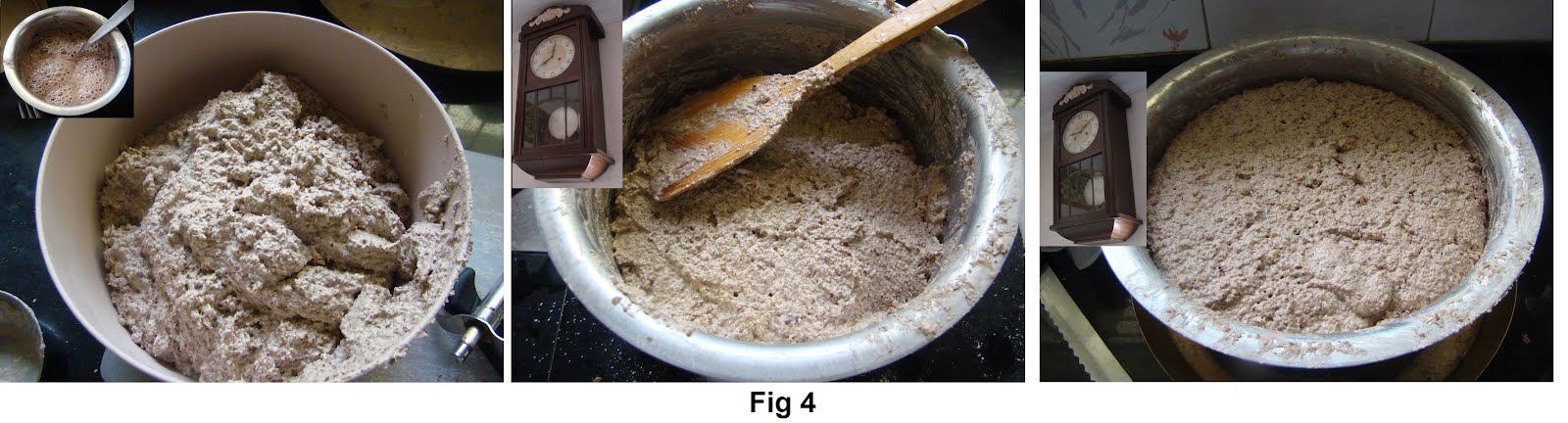

The last dough that I have used before writing this blog had no wheat and less of millet. The batter that I got (Fig 4 left) after grinding was nice and fluffy (we dont know why exctly). I added less than a cup of naachni (finger millet) flour as well as the yeast batter using naachni. I had also found that instead of adding flour it helps to add a cup of oats flakes to the final dough. It was left to stand for an hour so (Figure 4, centre and right; don't miss the wall clock in the insets giving the time). The dough rose quite substantially in an hour.

I then lined the baking trays with mustard oil and poured the batter in after beating it a bit (Fig 5 left). I allowed it to rise for about forty minutes before baking in the oven at 225 C for about an hour. The bread came out cleanly and looked a bit rustic even though its flip side (first picture of this blog) looked as perfect as it could.

The bread was nice and crusty and made a lovely noise when sliced as a fresh bread almost as a fresh baguette would. It also sliced well (Fig 6 left) and looked well including having flakes of oats. The left-over dough made a good south-indian adai dosai-like or a Maharashtrian Thalipeeth-dish (Fig 6 center) that can be served with their usual traditional accompaniments. I preferred an half-fried egg (inset of Fig 6 center). The dough (with yeast and all) also makes good idlis (Fig 6, right) with their usual bland tastes waiting to be given a form of your choice (as usual).


Epilogue

A little bit of re-emphasis
The commercial food chains' emphasis on wheat products that are rich in gluten and other rubbish has been having a visibly harmful effect on the young. Its not that the newly rich and fashion-wise susceptible young people are not aware of the health problems in their food. Its just that they cannot be making the healthy food every day. What is alarming is that may be as high as 1 percent of the population in the United States are suffering from an autoimmune disorder that affects the small intestine because of gluten intolerance. This disease has the name celiac disease (see http://www.celiac.com/articles/1164/1/Celiac-Disease-Statistics/Page1.html) and arises from diets containing wheat, rye and barley. This means it includes white breads which rise well when they are gluten-rich, and many other instantly good-tasting foods such as pizzas and instant noodles, and beer which is made from barley. This is the food that young people, who think that they are upwardly mobile because of their hard work, eat comforting themselves that they require a 'little' relaxation of food control. Ignorance or neglect of this disease leads to alarming increases in the probability of getting gastrointestinal cancer (40 to 100 times higher) osteopoassis, diabetes.

On top of this, the new fear-word (see "The Lectin Report" http://www.krispin.com/lectin.html) is lectin that is a protein that recognises and binds to a specific type of carbohydrate in cell membranes. In some cases this binding disrupts the functioning of the membranes and damages the cell setting off a catastrophic cascade of immune and autoimmune disorders. The body has protections against these toxic lectins (e.g., glucosamine). It turns out that some cures of Celiac-Sprue related disease by the elimination of certain foods may also be due to these foods being high toxic lectin foods. An explanation that seems to me to be perfectly valid to such lectin sensistivity is that if our ancestors did not eat these foods and therefore develop immune system that could handle these txins then we have little chance of handling them ourselves. The safest route is to avoid food which has these toxic lectins and these include all soy and wheat products including oils from these substances. Soaking and washing of grains and sprouting them removes the lectins which could mean that cooking the grains would also do so.

What the young require, I think, is a standard grain-based sustainer, like gluten-free bread, or rice or idli, which they may then heighten by some salad, or gravy. It would of course be preferable if the bread is wholesome, soft like a regular bread, looks like a regular bread (brown or white) and which would last for some time so that once a few loaves are made one may use the bread for a few days (say, a week) without any fall in its edibility or springiness.

What is most preferable is that the grain be from the local soil and environment and is part of the food that has been passed on for generations. That's where the respect of the ancestors come and the real meaning of the term 'son of the soil' comes in. The good health of an immigrant really would require him not to immigrate --- at least after a certain stage of evolution?

When I first lived in France (at Bordeaux) we had two East-European scientists, who lamented the eating of the French bread, baguette, which did not fill their stomachs. So they carried with them a black bread which we called the German bread, which, they said, was more than three times the French bread, that is completely nutrition-less and completely unhealthy. I now know that the black bread is the pumpernickel bread. The antagonism between the French and the Germans began with their breads. According to one web site *... it was Napoleon proclaiming the bread was only fit for his horse ..." http://www.straightdope.com/columns/read/1978/whats-the-origin-of-pumpernickel. The Germans themselves do not seem to be unaware of the qualities of their bread as the very name pumpernickel suggests to the Germans (see Epilogue tp this article)

It is likely that the persistence with the pumpernickel bread in Germany is that the empirical evidence passed on through generations is that it is good for the health. This traditional bread has been ignored (see Epilogue) by some who prefer to use the white colour of the more commercially acceptable breads that one gets in the supermarket. The way the eating and storing of food grain has evolved is by itself a very important story that has in the way the bottle gourd and pottery from clay evolved in storing the grain. More important perhaps is the way the processing of the grain for food evolved. In Tibet/India and its descendants (south east, far east, Japan) the emphasis was on rice which was perhaps easier to process and store. In the western world, which would include the middle east and Europe (not USA, since it did not evolve), which we would now like to descend into, the vulgar (common) treatment of grains it was the unprocessed whole grains such as the bulgur or groat.

The pumpernickel bread is thought (as per the recipes on the internet) to be made from rye (Secale cereale)which has a short arm (1RS) in its chromosome that is thought to confer resistance to leaf rust, stem rust, stripe rust, powdery mildew, contributes to tolerance to abiotic stresses. In short, rye is something that will survive in the wild and must have formed an important part in the food chain of early men who had the advantage of learning to survive on natural food. However, it seems that in India such resistance provided by the 1RS gene in rye has "broken down in some wheat growing areas" (Kumar et al, Carylogia, 56, (2003). It ia perhaps because of this, that rye is not part of the traditional food chain in India and if we are to be true to our environment we should avoid the use of rye. Instead we should stick to our traditional non-wheat itesms such as bajra (sorghum), jawar (millet), ragi or nachni

Is there a poomph in the pumpern?
I have read (http://www.straightdope.com/columns/read/1978/whats-the-origin-of-pumpernickel) that the part pumpern of the name pumpernickel is an onomatopoeic (if that is the word) description of the breaking of wind. It is pronounced as 'p&m-p&r, which I imagine is a pooom--prrrrr (?) description of breaking wind, the ratio of poom/prrr indicating the health of your exhaust system. In german, the onomatopeia would become clear when the u in pumpern has an umlaut on it. The nickel refers to Nichol the goblin, the old feast of Nicholas being the current Christmas. Imagine what the Ho! Ho! Ho! of Santa Claus could be if is accompanied by the sound of Nicholas?

It is perhaps another matter to discuss why a pumpern bread should call for good appetite. It is also perhaps another matter why the pumpern is usually associated with traditional foods of various regions (mooli or raddish in Punjab, sambar for the tam-brahms, sauerkraut for the Germans. The german cheeee that produces a good pumpern is usually served as "Handkase mit Musik" with my daughter minsisting that the musik is for the pumpern. Perhaps the absence of a proper pumpern is worse than a body odour, even if it is now decoded by the deodorant one uses. I suppose that a good pumpern could mark the end stages of a good digestive process for unhealthy foods. In that case one could perhaps naturally allow some pomp in the pumpern?

This was not to be.

As a mark of sophistry, the breads were to be white. The bran from the grains were removed since it made the bread black, besides giving good laxative properties and healthy gas, which may have spoiled the atmosphere in wealth-orgies. So the more wealthy preferred the white breads. This may perhaps explain why the Normans of French developed preferred their white breads and imposed it on the English Saxons while the German Saxons remained untouched.

I am an instinctive believer in the African connection, probably Ethiopian or Sudanese, to good human values that gave the people who designed and built the pyramids and other good things to Egypt and the rest of the world. Their food was probably with bran especially when made from their millets. The latter day Egyptians would prefer white to distinguish themselves from the black. So they perfected their katharos, their most prized 'clean' white bread that could be afforded only by the rich.

It is fascinating to note that in their search for the elixir of life, the philosopher's stone (a white powder that gave miraculous properties such as turning things to gold and curing cancer) the early egyptioans identified it by their Hieroglyphic, vowel-less language, the word mfkzt. There is considerable buzz in the internet on mfkzt (manna to Moses) on the rediscovery of mfkzt by modern-day alchemists, and its association with plausibility-giving fancy technical names such as mono-atomic high-spin noble metals including gold and platinum or ORMEs (Orbitally Rearranged Metallic Elements). One of the important names in this connection is one Laurence Gardner (hopefully, no relation to Martin Gardner) who writes (http://www.bibliotecapleyades.net/biblianazar/esp_biblianazar_4.htm)
Returning to ancient Egypt, we find further references to mfkzt at various sacred locations. One of these relates to the treasures of Pharaoh Tuthmosis III, as reproduced in a bas-relief at the Temple of Karnak. In the metals section, there are a number of cone-shaped objects. They are explained as being made of gold, but carry the rather odd description, "white bread".

Pumpernickel anybody?

Tuesday, January 31, 2012

Thought of Food 8: Maska-da-golla in honey and molasses

The temptation to use paneer made from paneer phool continues.I have made cheese packets and they have aged well although I have not succeeded in introducing the deliciously rotten flavours of a Camembert or Brie nor have I introduced the penicillytus mold to make blue cheese. That is for another food-blog.

I had always thought that the paneer made by the traditional method of using the vegetarian rennet (see previou sblog) from paneer pool must have been the way they made milk-based sweets in the early days before Hekataios and Herodotos named the land of the Indus as India. It seems that the Greeks heard of India from the Persians. The Greeks could not pronounce "h" and had no proper "u". So instead of referring to India as the Vedic Sapta Sindhavah, the as the land of seven rivers in English, they referred to it as Hapta Hendvah (from http://ssubbanna.sulekha.com/blog/post/2007/05/greeks-in-india-before-alexander.htm). We would have all been Sindhis if the Greeks had heard about us directly from us.

What I meant from this unnecessary diversion is that "paneer phool" must have been known for making "paneer" even before we became Indos to the Greeks. The paneer that we get from cow's milk using this vegetarian rennet is very soft and may be spread easily even after sqeezing out the whey. It greases the palm very well. It may have been used for the local phrase, maska lagao which is the english equivalent of "buttering up". Everybody likes a little bit of maska, As they say "... maska toh bhagwaan ko bhi achha lagta hai ..." (ev god would like a little bit of maska). I have a suspicion that the Italian mascarpone that is used in tiramisu comes form the word maska since mascarpone is said to be derived from mascarpia a close relative to ricolta.

I thought that the first milk-based sweet that could be made and that would taste very different from what one gets in the market would be the very Bengali roshogolla which in Bengali would mean balls of juice. That is indeed exciting! That is what I thought it would be when I first heard of it at an age when I had begun to understand bengali. I took the meaning literally. It turned out to be balls of chhana (bengali for paneer) soaked in a hot watery syrup. In them days around independence, roshogolla was always taken fresh and hot from the local vendor around the corner. The syrup was not thick, and a proper bhadrolok (gentleman) gourmet would squeeze out the juice and have the rashogolla in one gulp, Three or four of such roshogollas would have been finished in one sitting of a few seconds. It was supposed to be good for the health. There was no diabetes mellitus at that time.

So I decided to use the paneer using paneer phool for making the roshogolla. The previous experience of making the roshogolla was with my mother (who else?). She would split the milk with lemon juice when the milk was hot. Then she would strain it with a cloth, and squeeze the whey out in a cloth first and then let the cloth with the chhana hang for some time. After hanging for some time (the next morning) she would sit and knead the chhana with the palm of her hand for about half an hour or so. She said that that was the secret of making good roshogolla. Then she woul roll it up into little balls and place them in a dilute boiling sugar solution for some time. We knew the roshogolla was done when there were no more left in the boiling sugar syrup! We had finished them off!

Later on, when we (Lalitha and I) tried to make the roshogolla the balls (golla) would disintegrate quickly and so we gave up making the sweet. When in Europe we had more success with the European milk. We could neer set curds with that milk the way we could in India. Milk products depend on the cow and the food they eat.

As if the cows did not know that!

I started with the paneer that I had made in the sual way, strained it a bit, and since I was not sure I did not squeeze the whey out hard enough. The paneer stuck to my palm while I was rolling them out. I could form abouta dozen balls of about 2 cm dia each (Figure below left; always click on picture to expand). The balls looked a little grainy.

The next step was to make the sugar syrup. Instead of sugar syrup, I tried a mixture of honey and molasses. Honey has been in use in India since vedic (which really means we don't know since when, but long long ago even before what is now Israel was known as the land of milk and honey) times. After all if India -- as we are told --- used to be a land of milk and honey then our sweets should have been made from honey, n'est ce pas?. The gur (organic molasses) was used to cut down the cost mainly. I took equal amounts of water and the hone-molasses mixture stirred it till I gort a clearish soultion.. boiled it and then threw the paneer balls in the honey-gur syrup. I let it come to a boil (Fig below middle), and gently turned them over and kept boiling for another ten minutes or so till I thought that the intended roshogollas could not take it any more (Figure below, right). I allowed for it to cool somewhat and then tasted it. The honey-gur syrup tasted fabulous, so did the "roshogolla" or what remained of it.

My wife suggested that one could take it as a dressing for a dish of fruits, or chilled gateaux. But it wont be recognised as a roshogolla even with sympathy and tolerance. They were certainly not "balls of juice" as I wanted them to be.

So ... I had to try again.
This time I squeezed out the whey by tying it in a muslin cloth (Figure below, left)(the muslin cloth made in Dhaka, Bangladesh, the jamdani variety of which was so fine that a sari could be pulled through a ring or "a 50-metre long muslin could be squeezed into a matchbox" --- from Kolkata Calling, posted by Rakhi Chakrabarti; the British cut the thumb of the Dhaka muslin weavers in order to destroy this cloth industry of Bengal for the benefit of the British mills, or so I was told by my mother).

All raditions have to be followed if you are making a traditional item. I let the paneer hang overnight. The paneer seemed reasonably dry when I removed the cloth. When I tried to press out the chhana as my mother didm I found it to be too buttery. I now realized that what I had got (Fig below, middle) could be the maska that gave the name to the Italian mascarpone. I rolled them into little balls, which looked more robust.

I dipped the chhana balls into a hot honey-gur syrup as before. Only this time I did not subjet the balls to a vigorous boiling as I did earlier. I let it rest and cool for some time. The gollas (balls) did not disintegrate as much.

When I tasted them, the balls were not at all spongy like the commercial roshogollas nor were they like the rasogollas from Assam (which tasted like the hot roshogollas of my childhood.

The taste was entirely different. The Punjabis would have called them Maska-da-golla if they had tasted what Ihad made, I suppose.
I thought it did not turn out that well. I would have converted all of them into a sweet cheese. But Lalitha, my wife, firmly disagreed. It tastes fine as it is. I like the ay it melts in your mouth like a juice ball.

That was satisfactin indeed.

Footnote.

After this blog was completed I went to Aroona Reejhsinghani's cook book ("Delicious Bengali Dishes" of 1975 (see my previous blog). The sugar syrup she made had 2:1 one sugar:water which was boiled to "one thread consistency". After bringing the syrup to a aoil she adds roughly 5% more cold ater before putting the chhana balls in. The crucial part could be that she adds one tea spoon of maida (refined wheat flour) to the syrup at this time. I think the purpose of this is to coat the chhana balls with a maida coating that prevents it from disintegrating. This could be clever chemistry. We purists of course avoid maida! The syrup was then boiled again for another five minutes and cold water added again. After five more minutes of boiling the chhana boils start swelling. It was then removed from the fire and kept overnight. The roshogollas last for a few days.

I like the idea of a honey-gur syrup base. After all there would have no sugar if we had stuck to honey and knew better the impact of the story of the birds and bees than the satisfaction one gets from acts that serves sometimes to extend one's lineage. Besides, honey has a long shelf-life. Moreover honey pobably dates back to earlier than paneer phool times.

That is another chicken and egg problem: We don't know which came first, the honey or the milk?

Thursday, November 3, 2011

Thought of Food 7; Malpua as dessert- Italian Upvas

This blog was to coincide with the Diwali festival when making very sweet dishes is a national obsession. Despite Cadbury company's efforts to target the IT (Information technology) leisure class, the average purely mixed blood pure Indian loves his traditional sweets simply because of the possible romance associated with the thoughts about them....

I could not finish the blog because I found that I could not get my scientific papers published in the journals I had targeted. That is another story, but I missed my Diwali blog...

Then came my seventieth birthday and the impact of no impact on society at large ,,, Never matter ....

At the age of seventy, when you are toothless (literally) but otherwise healthy for most things -- except being regally young -- one of the easily accessible sensual pleasures must remain those involving the taste buds --- especially those associated with loved events involving loved ones.

One of these must be that involving food cooked on festive occasions. My mother with five children, and a budget just sufficient for one, spent all her useful time doing things for her children that would make up for the finances she lacked. We did not ever feel the lack of anything as children simply because there were five of us and the only catching-up-with-Jones's that we had to do as children was with each other. Usually, this was about how much we could indulge ourselves in straight from the pot when mother was cooking.

Among the sweets she love to make was malpua. The time I remeber best was in 1970-1971s when I had finished typing up my Ph. D. thesis. I was at a loose end without a job, I had decided to be in love and marry the girl I married eventually, and I was singing at that time (I think) "Tie a yellow ribbon around the old oak tree" (http://www.youtube.com/watch?v=7NCZ4l8FCFc ... the only one on Youtube and which had a comment "It's good when you're a teenager and still love classic rock. I wish more were like me" ... I guess I remained a teenager). I remember popping in fresh malpuas in my mouth, singing yellow ribbon, and being very much in love with the world.

Since that time I have been trying to eat or make malpua the way my mother made them. I have not had the luck so far. I guess the circumstances of her presence and, therefore, the flavour of her cooking cannot be repeated.

So ... we have to go the written word, a poor compensation for the living word?

Among the books on bengali cooking that I have on my booshelf and that was bought after the first flush of my marriage, is "Delicious Bengali Dishes" by one Aroona Reejhsighani (now quite an achiever if one reads http://in.linkedin.com/pub/dr-aroona-reejhsinghani/16/223/2a8). We find the following on the internet:-
Aroona Reejhsinghani started writing when she was still a child. At the age of ten, she won the first prize in an All India writing competition, organized by the leading American magazine Spectator. She has now to her credit 150 titles and has achieved the rare distinction of writing 125 books on a single subject - cookery. In 1998 she won the 2000 millennium award for being the most memorable personality of the century by the American Geographical Institute. Femina has called her The Culinary Goddess of India. Eve's Weekly has called her "The real cookery queen of India". Above all she is one of those authors who has been featured in the Limca Book of Records.

I had picked up this book in the late 70s just after my marriage for Rs 6.00 (Jaico Books) The book on Bengali cooking could have destroyed my marriage like a Bengali mother-in-law could have destroyed a Tamila wife. My Bengali mother and my Tam btahm wife were different personalities altogether, however. Besides, we rarely used the boodk. Reejsighani describes malp[ua as malpura. In this recipe for malpura she mixes maida with milk, fries it and then dips into sugar syrup. Most others (including sanjeev kapoor) use thickened milk with maida. They all call the sweet malpua. When I searched the internet for malpura I found a recipe which uses rice flower which is mixed with jaggery and fried. It is not dipped into a sugar syrup after frying. In its basis essence the malpura seems to be closer to the adhirasam that Tamil ladies like to make (including my mother-in-law) for Diwali. The punjabi equivalent of this dish is perhaps the Poora/Pooda/Puda in which maida is mixed along with saunf (fennel seeds) with sugar and fried just as adhirasam or malpura. Another recipe on the internet is the Shahenshahi Malpura which (in keeping with its Persian king connotation) is malpura soaked in thickened sweet milk with saffron, and coarsely ground almonds, walnuts and cashewnuts.

The way my mother made the malpua was more in line, I think, with the maida-condensed-milk-fry-dip-in-sugar-syrup kind. Now that we are aware of the energy crisis and the probems with maida (made from the white of the grain and whitened by bleaching agents that are banned in sensible countries including China --- and which introduce alloxan that destroys beta cells of the pancreas thereby producing diabetes mellitus --- which I have --- one could not write a blog on making malpua without getting conscience pangs --- especially if you want to live long enough to see your children married or, at least, to see your grand children.

I am therefore writing a blog on a slightly more virtuous version of the malpua. This recipe should gladden the heart of fasting Maharashtrians --- because it has delicacies that one is allowed to eat when one is fasting. It is also a little a la mode --- because it has fresh cheese in it --- perhaps for the uppity IT-like crowd.

The idea of using the cheese is because I am a little bit enamoured by the possibilities one could find with our (subcontinent) own paneer phool. "Paneer phool" has been used from unrecorded time for making cottage cheese from milk, except that we called it paneer. The paneer that "... is used all over India to make delicious dishes ranging from curries to desserts" usually uses lemon juice or vinegar. The modern chefs co not seem to know that their forefathers used "paneer phool" that is available in the wild in India!

What one really uses (bottom left inset, picture below) is the dried seed of the size of coffee beans of the plant which has vegetable rennet.


It is interesting that in a report by Sheridan Lea of the Trinity College, Cambridge from the Proceedings of the Royal Society of 1884 entitled A "Rennet" Ferment Contained in the Seeds of Withania Coagulans the first paragraph has the following to say:-
The Report of the Royal Gardens at Kew for 1881 contains abstracts of correspondence in which it was pointed out that, in order to introduce a cheese-making industry in India, some vegetable substitute must be found for the ordinary animal rennet, since cheese made with the latter is unsaleable among the natives. In response to the above "Surgeon-Major Aitchison brought to the notice of the authorities at Kew that the fruit of Puneeria coagulans (The genus Puneeria is now reduced by botanists to Withania.), a shrub common in Afghanistan and Northern India, possesses the properties of coagulating milk;" and experiments showed that an aqueous extract of the seed-capsules of the above plant does somewhat rapidly coagulate milk..

The milk coagulating property is due to an enzyme withanin The interesting part of this paneer phool is that it has antidiabetic effcts besides other miraculous properties. The seeds of fruits are crushed and extracted with water for two days. I usually soak the seeds overnight and drink the extract first thing in the morning. Once I forgot and left the seed in the water for about three-four days when a mold-like fungus was found emanating from the seeds which might have made a pretty (if not appetizing) picture(see main image above) if one is not scared of molds.

Why an Indian cheese industry based on "paneer phhol" did not develop may have been due to the same reason that Indian (sub-continental) processes --- such as the indigo industry or the dhakai xaree weaves --- were killed for the benefit of the Imperial fatherland. This is no great surprise? Our own fatherland is doing it to us now? Maybe we require a motherland!

The "paneer phool" knoweledge requires being propagated in some way?!

It must come as a surprise (even to me) that one must introduce so much food for thought when all one wants is a plain and simple recipe when one thinks of food.

So here goes...

One starts with milk, of course. We cannot get fresh milk now. We don't even know whether there are enough number of cows for the amount of milk we consume. That's not unusual in India. After all there is the holy cow, Annapurna, which gave all the milk required. And we are not talking of synthetic melamine plus chalk plus what not (see the blog of Sunday, October 19, 2008; Milk sans Human Kindness; or why is the Iyer yogurt so gooey?) we could get in packaged milks. The packaged milk is also pasteurised which is not the best thing for getting good fresh cheese. Besides we dont know the origin --- buffalo, or cow or whatever. If you want to be alarmist about it, there is a Food and health Safety report which says that if you are not in Goa or Pondicherry, "... the first cup of morning milk, one is having a lot of things with milk, like starch, detergent, salt, glucose, urea and water, which also contains pesticides and other heavy metals". Moreover, the nouveau-riche youngsters from IT industries3and thereabouts, prefer to have the western equivalents of milk labels such Standardized milk (buffalo milk plus skimmed milk, 4.5% fat), Whole milk (3.5% fat), Reduced-fat milk (2%), Low-fat milk (1%), Skimmed milk/non-fat milk (as much fat removed as possible; good for humans but tasteless; that is why sensible Indians such as Gujaratis use butter milk). Because of this we do not really know whether we are really getting pure cow's milk in milk packets. So given all this, as well as the fact that milks is sometimes a pooled resource from different farmers with different cows or other milk-producing devices, we do not know have a standard milk. The failure of a milk recipe can always be attributed therefore to the quality of the milk. So different packaged milks from different sources can give different results.

I soaked 10- 12 paneer phool buds overnight in about half a cup of boiled water (tap water has its chlorine and bacteria)and soakedit overnight. I then crushed the seeds and strained out the mother liqueur into the milk. I took one litre of a popular packaged milk. I kept the milk with the paneer phool overnight and then filtered it through a muslin-like cloth (Figure below, left). I waited for the whey to drain to give a very smooth cheese (Fig below centre). I mixed the paneer with two heaped tablespoons each of shingara (water chestnut) powder and kuttu (buckwheat). I added one tablespoon of the whey and beat up the mixture to a fine paste (picture below right). It helps if the mixture is allowed to stand for an hour or so and then whisked again.

My first efforts to make the malpua was some sort of a disaster. When I put a slightly heaped teaspoon of the dough into heated oil it just burst into balls of a few milimeter sizes. Thee was nothing I could do wtih those sputtered balls. I thickened the dough a little bit more and lowered the temperature of the oil y putting off the gas. I slowly increased the temperature by putting on the gas. It did not help too much (Figure below left). With little more perseverance, things became better (figure below middle). The fried stuff tasted quite okay even without adding salt or using any sauce. Maybe the fried pieces could have gone well with something like Worcester sauce if you would prefer a Western taste or simply leave out the anchovies and garlic and onion and have the fries with good old imli chutney (tamnrind in jaggaery and the five spices). I dont know what to call the fries I made, so I wont try. My grandchildren, if they come at all, may call it later as "Dadu's folly".

I changed the frying pan to a flat one. I poured about 8-10 mm thick oil. Heated it on a low flame and then slowly poured in a level tablespoon of the dough and waited (Fig below, left). I waited for a few minutes for it to turn golden at the bottom after which I flipped it over (figure below, middle). After it had turned golden on both sides, I picked out the fried pieces and soaked them in a sugar syrup I had made. The syrup was made with with sugar and water in 60:40 proportion, boiled with a few cardamoms and cloves. After soaking for a little time (few minutes) I took them out (Fig below right).

I must say, that when Itook them out they looke dlike rather authentic malpua. The Shingara (water chestnut) and kuttu (buckwhea) added an extra dimension to the malpuas I have had in recent times. Shingara and kuttu are ingredients that are allowed when making foods for fasting. So it could be a fasting food for the gourmet of certain kinds.

The Italians (and others perhaps, though I suspect the French would not have) would have loved the cheesy aspects. The malpuas were not soggy and broke well. They also looked alright (Figure below left) and tasted good enough. They did not stay long on the plate and was finished quickly, depite my diabetes status.


I would call it a success as a "Happy Diwali+" sweet.

So "Happy Diwali" (Figure above right) even if it may be a little late.

Monday, October 24, 2011

Thought of Food 6: October Fest with Kumro (pumpkin) and Kulmi (water spinach) Shaak

October in Pune is usually one of the warmer months. This year, because of the global warming, or Anna Hazare Movement,or whatever,and in the midst of the Occupy-Wall-Street Movement, and the hunting down and execution of another "dreaded" Arab terrorist that only the kick-sand-in-your-face bullies can justify doing, the southwest monsoon rains had delayed its departure until it was pushed out with parting thunderclaps and heavy showers by the untimely north-easternly winds.

The long sentence above was only to sey that Pune was unusually green even in October and green creepers were all over your garden. The markets were full of greens and the most excited of these were the Bengalis in the Pashan Market, picking up the seasonal pumpkin flowers, and stems and leaves of pumpkin creepers (kumro shaak) and pui (Malabar spinach or basella alba) shaak and kulmi shaak (water spinach). The advantage with kumro shaak that I rememebr my mother making, is that the stems are hollow and if a proper fluid-gravy can get into the stem with just the right kind of spice, then sucking on the stem and then chewing on it can lead effectively to a pleasurable heights of gastronomic ecstasy just as a very few other ecstasies can do for you. It is much more than what a non-vegeteranian fells after sucking on a bone marrow., because bones dont have juicy flowers and leaves.

The kumro shaak I found in the Pashan market two sundays ago was particularly interesting (see picture to the left below, click to enlarge) as there was a fairly large baby pumpkin and fe other pumpkin flowers attached to almost embryonic little pumpkins. This is a very rare privilege even in the month of October. I imagined how the baby pumpkin would cook and so I went ahead and bought the pumpkin stem and leaves. The lady selling the greens by weight was happy since the wreight of pumpkin effectively doubled the price she would have got.

Preparing the kumro shaak is another matter altogether since there is considerable cleaning and picking to be done. When the greens are not really fresh and tender, the stems can be rather hard and fibrous which is not always acceptable. So one has to remove the fibrous part of the skin of the stem delicately without breaking the stem since the stem has to be intact. So one does that over a half-hour period, if you are a novice and do not have very dexterous hands. Part of what one throws out is on the right of the picture above. I split the flowers along with the attache embryonic pumpkin in half, the leave were cut roughly as one inch strips if they did not look tender enough, the baby pumpkin was amazing to cut (I had not done it in my seventy earlier years!). It looked like a giant tender zucchini after cutting. I cut it into roughly one inch quasi-cubes, keeping the skin of the pumpkin (Fig above middle).

I kept the cut vegetables under (left of figure below) turmeric powder and granular sea-salt (rare getting it nowadays thanks to the ridiculous gimmick of iodized salts and the fear of goitre religiously advertised into your head from people with nano-sense). Like a good Bengali I fried "panch phoron" ( half a tea-spoon of cummin, fennel, black-mustard, fenugreek, and what we call as onion seed or kalonji seed or Nigella sativa). The kalonji seed cures everything it seems including cacer, so muh so that the word panacea which means in old latin a 'cure-all' is actually the name given to kalonji in the Western world (see my blog "Thought of Food 4: Steamed Wild Rice and Watermelon").

The paanch phoron was fried in mustard oil (one table spoon) in a thick (concession to my Iyer wife) wok (what else?) with five longitudinally split green chillies, till the seeds started popping. I think traditionally one uses dried red chillies. I had to grind coriander powder if I remembered the flavour right. I would have liked to grind it on a stone but my wife carefully kept it far away in our home-on-a-hill as she is always afraid that I will dirty the kitchen. I ground the coriander seed (two table spoon) in a coffee-seed grinder (picture above middle). I allowed the greens to stir fry along with paanch phoron for about three minutes on a high flame. I then reduced the flame, added the coriander powder and one table sppon of powdered jaggery. I added about two table spoons of water, covered the wok and lt it simmer for about five minutes. Put off the gas and let it cool under cover.

The final product looked (picture above, right) okay. The cut pieces of the baby pumpkin turned out exctly the way I thought it would, The hollows in the stem had (I imagined) the taste that I remembered. Like a good Bengali we had it with steamed rice of the white nutrition-less kind. No regrets about the rice that I used because the flavour of the kumro shaak came out much stronger.

Kulmi shaak
As I wrote in the beginning, I bought the kulmi shaak (water spinach) just because the Bengalis were buying the stuff very enthusiastically. I had no idea how to cook t after I brought it home. So I rang up my sisters. The one in Allahabad had heard of the kulmi shaak but had never cooked it. She said that she had eaten it somewhere, She remembers simply that it was stir-fried in "paanch phoron". The other sister had not heard of kulmi shaak. She guessed that one could probably cook it like any other shaak. She kept insisting that one has to blanch it (that was something new for me, it mean one had to dip it in boiling water for a second or so, to get rid of bacteria and insects and their eggs, I guess). Then she suggested that one puts brinjals, and onion and garlic and potatoes. It reminded me of Chitrita Banerjee's mother's recipe that I had looked up at http://www.epicurious.com/recipes/food/views/Spiced-Water-Spinach-106170. After 33 years of marriage to an orthodox Iyer, I did not like garlic in my fresh vegetables. My Patna sister's house-help had however heard of the kulmi shaak. She recommended just stir-fryng in paanch phoron the way the chinese cook them (see http://appetiteforchina.com/recipes/chinese-stir-fried-water-spinach/).

I had my doubts about how much of the stem I could use. The stems were hollow but they did not look too tender. Moreover the kulmi shaak that I got from the market would not have been kept very hygienically. Both my sisters had no idea how to handle the hollow stems. I just felt with my fingers what I thought would cook soft (middle of above figure) and not too chewy and threw away the rest (right of above figure). I cut them up a bit .
I cooked it almost the same way as I did the kumro shaak. Instead of coriander seeds for the flavoring, I used dried mango powder, a wonderful invention. As an inspiration of the day I used a raw green bannana (kaanch kola to the bengalis) which is very different from the unripened green bananas that make good fruits. The Chinese and the Indonesians and the Filipinos ad dried prw, or crab meat or pork slices, bengalis add pieces from the head of their favorite hilsa fish. I took kaanch kola in thin slices along with the skin.

So, i fried the paanch phoron with five longitudinally split green chillies, added the thinly sliced kaanch kola and sauteed for a little while (picture above) after which I threw in a tea-spoon or so of dried mango powder and the cut kulmi shaak. It was stir-fried on a high flame for a few minutes and was ready for serving. It looked nice. So nice that we sat for lunch immediately and consumed it before I could take a photograph for the blog!. That's how nice it was!
PS. The kaanch kola should have been a little more deeply fried.
PPS. This blog was posted on Diwali day. It added to the October Fest.

Happy Diwali

Sunday, October 16, 2011

Just Pontification 5: Occupy an Occupation, not Wall Street

The Occupy Wall Street (OWS) campaign is a curious campaign which has grown spontaneously in a way that one should have anticipated but did not. Just as one should have anticipated the real-estate bust and did not.

There is an inevitability in the way the disparities have grown. If one is not old enough one has to be reminded that Karl Marx predicted that disparities between the wealth of capitalists and the impoverishment of labor would grow continuously. Karl Marx put it in the language of the big fish swallowing the small fish till ... . Eventually the disparities would generate class conflict and finally to the triumph of a workers' revolution.

OWS may simply seem to be a natural outcome of what Marx had predicted. The Capitalists do not disregard Marx. They only dont allow Marxism to be popular.

OWS has no real aim to set up a communist society that Marx predicted to be the ultimate outcome. OWS only expresses a swarm-like dis-satisfaction over the way economic disparities have gone up.

OWS has set up a swarm cloud that is still looking for a common demand. The latest is Adbusters, the left-leaning Canadian magazine responsible for igniting the Occupy Wall Street protests, is encouraging the international movement to define one ultimate demand -- a 1 percent tax on all financial transactions and currency trades, better known as a "Robin Hood" tax.

This blog is not to support any of the arguments expressed in Marx's "Dielectical Materialism". At the end of the blog it will try to say that the fault is within when one depends on others for their occupation. After all the Bible (King James' version) had said
And why beholdest thou the mote that is in thy brother's eye, but considerest not the beam that is in thine own eye? Or how wilt thou say to thy brother, Let me pull out the mote out of thine eye; and, behold, a beam is in thine own eye? Thou hypocrite, first cast out the beam out of thine own eye; and then shalt thou see clearly to cast out the mote out of thy brother's eye (Matthew 7:3-5).

Strong words these.

Advantage Obama

It is quite possible that the Occupy Wall Street (OWS) Campaign is candidate Barack Obama's counter to the Tea-Party strategy of the republicans.

As an aid to his campaign, Obama has been trying to pass what he calls the American Jobs Act. He describes the Act as:-
The purpose of the American Jobs Act is simple: to put more people back to work and more money in the pockets of those who are working. It will create more jobs for construction workers, more jobs for teachers, more jobs for veterans, and more jobs for the long-term unemployed. It will provide a tax break for companies who hire new workers, and it will cut payroll taxes in half for every working American and every small business. ... This isn't political grandstanding. This isn't class warfare. This is simple math. These are real choices that we have to make.

Obama took all care for the message to be accepted by the general public. He timed his speech so that he (and the Republicans' response) could finish before the opening of the NFL season on the same night!

As part of the ploy of winning the majority poor man's vote, Obama has been insistent on taxing the rich. " From www.salient-news.com of september 2011 one gets:-
"Obama is proposing to set a minimum tax on people making $1m or more in income. They would pay the same overall tax rate as other taxpayers. It would prevent millionaires and billionaires taking advantage of lower tax rates on investment earnings than the rates middle-income taxpayers pay on their wages. White House is calling this proposal the “Buffett rule,” after billionaire investor Warren Buffett. Last month Buffett wrote an op-ed in The New York Times in which he pointed out that he has the lowest tax rate in his 20-person office, and he urged Congress to “stop coddling” the super-rich."

This (coincidentally?) was in the middle of September 2011 about the time Occupy Wall Street started.

I guess the OWS stir is all advantage to Obama in the sense of the American Presidential Election. Obama may have learnt from the Congress response in India to Anna Hazare's face-book inspired anti-corruption revolution. Unlike Manmohan Singh's Indian government, Obama now has the anti-rich (made synonomous with anti-corrupt) revolution on his side with the Tea Party proponents seemingly isolated.

Will the American Congress dare oppose Obama now?

Obama has the cunning and the deviousness to do this as his pre-Presidential record shows.

Marx is not a four letter word now, nor is Engels

I should have welcomed the Occupy Wall Street (OWS) movement just as I found in my youth a lot of heroism in the Bolsheviks and the communists in the first part of the last century. These revolutionaries were in turn citing the work of Marx and Engels. As the new-fangled industrial machines dispensed with human skills phrases such as "the suffering of the proletariat" started appearing (I learnt from Friedrich Engels' 1844 book on "The conditions of the Working Class in England").

In the Appendix to the 1886 American Edition of this book Engels gives a view (now very similar to that used in the OWS campaign) of the genesis of the employer-employee conflict.
"The wage-worker sells to the capitalist his labor-force for a certain daily sum. After a few hours’ work he has reproduced the value of that sum; but the substance of his contract is, that he has to work another series of hours to complete his working day; and the value he produces during these additional hours of surplus labor is surplus value which costs the capitalist nothing but yet goes into his pocket. That is the basis of the system which tends more and more to split up civilized society into a few Vanderbilts, the owners of all the means of production and subsistence, on the one hand, and an immense number of wage-workers, the owners of nothing but their labor-force, on the other."

Lenin would note "Engels was the first to say that the proletariat is not only a suffering class; that it is in fact, the disgraceful economic condition of the proletariat that drives it irresistibly forward and compels it to fight for its ultimate emancipation. And the fighting proletariat will help itself. "

Engels would quickly qualify on this in the 1886 Appendix to the American Edition. He would write
The revival of trade, after the crisis of 1847, was the dawn of a new industrial epoch. The repeal of the Corn Laws[1] and the financial reforms subsequent thereon gave to English industry and commerce all the elbow-room they had asked for. The discovery of the Californian and Australian gold-fields followed in rapid succession. The colonial markets developed at an increasing rate their capacity for absorbing English manufactured goods. In India millions of hand-weavers were finally crushed out by the Lancashire power-loom.

Engels would not mention, what we Bengalis believe: that the English cut the thumbs of the Bengali (Dacca) weavers so that they could not make the fine weaves that was so superior to the Lhat from the Lancashire Mills.

Engels would continue:- China was more and more being opened up. Above all, the United States — then, commercially speaking, a mere colonial market, but by far the biggest of them all — underwent an economic development astounding even for that rapidly progressive country. And, finally, the new means of communication introduced at the close of the preceding period — railways and ocean steamers — were now worked out on an international scale; they realised actually what had hitherto existed only potentially, a world-market. This world-market, at first, was composed of a number of chiefly or entirely agricultural countries grouped around one manufacturing centre — England which consumed the greater part of their surplus raw produce, and supplied them in return with the greater part of their requirements in manufactured articles. No wonder England’s industrial progress was colossal and unparalleled, and such that the status of 1844 now appears to us as comparatively primitive and insignificant.

Much of this is now applicable to the modern world if, say, we replace England by USA and the indistrial revolution by the digital revolution and 1844 by, say, the hippie revolution of the 1960s.

The language of that time appears now in the OWS movement in a slightly different garb than that used by Engels, for example.

The times have changed in the US of A. Marx is no longer a four-letter word! People with long beards are not Fidel Castros now. They are Talibans.

The Tea Party must be wondering how to find something evil in this now that the threat of communist nations have gone.

In an article that appeared in Lea, John and Geoffrey Pilling eds. (1996) The Condition of Britain: Essays on Frederick Engels. London: Pluto Books, John Lea, Professor of Criminology at Middlesex University,and a "left realist" writes:-
"What appears refreshingly new and relevant for us today about Engels is his method, his understanding of the suffering masses as not just objects to be studied and helped but, in the last analysis, as acting subjects, the bearers of the solution to their own problems through a historical transformation that only they can achieve. Even if his predictions of revolutionary transformation were premature and, even if we understand that today there are new and different obstacles to their realisation, Engels' perspective appears increasingly less dated as time passes. This is underlined by a second feature of the present crisis: the combination of rising poverty and misery, with a collapse, not just of traditional welfare state policies but, at a much more fundamental level, of popular confidence in the ability of politicians and political parties, of the left as well as the right, to actually do anything about it. The supposed passivity of the poor is a distorted reflection of the impotence of the politicians."

The above was written in 1996. Since that time things have only gone worse. Schemes such as globalization have succeeded at best in making costs of production still cheaper and making more profits for multinationals than for the resident USA-ians and other so-called first-world-ians. At the same time it has helped credit-card cultures to flourish in essentially third world countries such as India if not China. It keeps the so-called affluent young permanently indebted to a debted-ness. There seems to be a runaway prosperity that is accompanied by high levels of inflation. People who could not afford a good meal are now buying aerated drinks, and Instant Noodles, and milk (synthesized to meet the demand).

Despite all this, who would have said that communistic slogans are making an apppearance in a country which is considered to be wealthiest in the world has among the highest GDP in the world! The poverty line in USA is nearly 5000 dollars per year, which is about five times more than the average annual income in India!

Revolution is an idea for the Idle Mind?

Poverty must be a relative thing. You are considered poor judging from what you don't have relative to what your neighbours have. The advertisement industry as well as the communists and other socio-political industries exploit this comparison. I don't think that there is a great love for the advertisement industry among the ordinary people.

The current Anna 'revolution' in India is diligently bolstered by the advertisement of the muultimedia who have little else to worry about except the province of the idle mind --- gossip, games and glamour. It would be a great thing if team Anna and his anti-corruption stance is extended to advertisers, the real corruptors.

I am a little contemptuous of the communists who survive in official party-leadership now. Just as I remain contemptuous of most other leaders of political parties anywhere in the world. They have usurped the privilege of shepherding the underprivileged for the sole purpose of occupying their privileged position to protect (and partake of) the privileges of the privileged.

Here privilege for the politician would mean ''advantage', 'favour' 'benefit'.

For the ordinary man it is a privilege to be free and happy that is the more cherished.

One does not man by this that one is free to do what one wants as most advertisement-driven people, especially the face-lessened face-book young, think it should mean. Its a democracy they say and so they can party wickedly the whole night without savouring any joie de vivre; they have the right to drink liqueur as they want as a fundamental right they say if they can vote as they want.

Maybe they should increase the voting age?

Freedom here means to feel free within the confines of the society one lives in, protecting this freedom even if it should mean restricting one's individual limits of freedom for the greater free-spiriting of the greater society.

It certainly does not mean --- as advertisers would like to have us believe --- that one is happy only after acquiring what others have.

Happiness comes from the spirit of liberty. It includes being able to protect what one has.

Above all one must have an occupation.

An occupation by which one spends time and that is preferably useful to society. This should include music, telling stories, ploughing the land, treading the mill, weaving the cloth, stitching the dress, making the food, kneading the dough, lighting the fire, gathering the harvest, tending to ill, exchanging helpful gossip. An occupation , not as a personal property that can be bartered for profit especially of the cash kind, but of the kind that you would not barter for anything because it is your artisan life.

These are the artisans that were replaced by machines during the Industrial Revolution that Engels worried about. I suppose these artisans had little time for wasteful gossip that became the occupation of the leisured clsss and their conspicuous consumption.

The Simple life of Noah Dearborn

Some years back, on a return flight from Europe, I saw the movie "The Simple Life of Noah Dearborn". I liked the movie not because of the acting or directing but because it had a simple but bold message that made the ordinary viewer feel good about the way they live their life.

Such a viewer is usually confronted by greedy sharks (in the movie it is a developer) who want his little possession and are willing to threaten him for it. This ordinary viewer is usually a simple pop-corn-eating person depending on the cinema in a a dark public hall resonating to or basking in the feel good swarm response of others in the audience. They love to spend their time as others in the audience do, crunching gas-filled, nutrition-less, popcorns watching most of the time equally virtue-less virtual-life movies.

I liked the movie because it seemed to say that if you love your work you do not have the time to grow old. It reminded me of the Nat King Cole song (http://www.youtube.com/watch?v=mRGjGgQqUlw)
You will never...
never grow old.
For with my love in your heart, my darling,
You will never grow old.

I think one should watch this movie for only the bold assertion that if you love your work you dont have to worry negatively about the occupation of others. I have read some of the reviews of this movie. I include some excerpts below.

There is something about this unique simple movie which is really charming and will just draw you in. It makes a really great change to the usual rubbish movies that are dished out from Hollywood. ... It was almost like reading a good book for me rather than watching a movie - it had that special charm to it.

The film is very effective in showing how love, friendship and understanding is so much more important than money, career and greed.

Sidney Poitier plays a 91 year old local carpenter and legend, Noah Dearborn who is still in good health and is always working. Developers try to buy him off his land, including up-and-coming lawyer Christian Nelson ... . He brings his girlfriend and psychologist ... to try to prove Dearborn isn't of sound man in order to get him off his land.

Also, the film would've been more believable if they'd actually casted someone who was actually 91 years old - at least it would give some credibility to the film. Of course, there is no actor that old who isn't in as good mint condition as Dearborn. (Poitier was born 1927, almost 20 years younger than the character he plays.)

It's a simple movie about a carpenter who lives alone in solitude without using electricity or modern machinery. He's 91 but looks younger because of his years of hard work and dedication. His life takes a turn when a company wants to forcefully buy his land.

Sidney Poitier portrays Noah, who at 91 ... stays busy every waking hour and has virtually no life outside his daily labor. He keeps potential friends at arms length, but goes out of his way to be a good neighbor.

"When a man loves his work... truly loves it... sickness and death will get tired of chasing you."

Here ... is a carpenter touched by his tough life, which taught him to work as much as possible without hurting anyone. But one day some people wanted to take him away of his land and the tragedy started for him. However he took it as part of life and fought against it with patience and showing himself calm.

And that's another thing. The mixed messages abound in this film. The land developers are evil because they want to work his land in their way, and they will bring jobs to the small town, but that's evil; however, Mr. Dearborn's work, done with his hands and without electricity, is apparently what has given him such a long, healthy life...and yet he's been unable to touch anyone for decades. Hmm, doesn't sound so healthy after all.

A story that told the truth for so very many people in this country

That said, I think the movie is propaganda from Mother Earth News for self sufficient and back to the country living...my friends and I were joking about this for the first half hour of the movie, but we think the hypothesis was tested when the lawyer quit to start a vineyard.

I realize today's nihilistic generation calls simple wisdom and gentle goodness by such epithets as "sappy morals" and "hackneyed lines", "platitudes" and - it is as if the only innovative plots and topics are those that have to deal with sex and drugs, satanism and destruction. If these topics are what today's maturity is all about, I want no part of it.

Is it still OK for a man to love what he does? Is it still OK, in this age of families who uproot every few years to move to the next city that provides a rung up in the career ladder, in this age where books like "Who Moved My Cheese" now mock those who have decided to stay where they are, in this age of consultants and temp workers, is it still OK to anchor down? ... I'll take Noah's world anyday.

These are the movies that we as a people would have return to our screens. If not completely, then at least several times a year. At least they offer hope and faith...something that this planet is at this time so very short on. To The 'Simple Life of Noah Dearborn' we say thank you and BRAVO!!!!!!

Tuesday, September 20, 2011

Spotted Munia's nest-building: Dont save only the Tiger


An article in Nature (Krebs et al vol 400 August 1888) on The Second Silent Spring begins with this sentence:-
The drive to squeeze ever more food from the land has sent Europe’s farmland wildlife into a precipitous decline.

The birds in the picture above must have felt like Colerdige's Ancient Mariner
Food, food everywhere, not a grain to eat

The authors then ask the question How can agricultural policy be reformed so that we have fewer grain mountains and more skylarks?

How and Why, indeed?

Some would say, Ours is not to reason why. Should Monsanto also die?

I am not a great bird-watcher, even if I may have been a great bird-fanatsizer at my appropriate age many decades ago.

There is no special reason for me to write a blog on birds except that two members of this particular bird species started building a nest on the kitchen window sill of our apartment in this very bird-unfriendly, twin eleven storey apartment complex. The builder of this apartment complex had started his french-wise unique Mont Vert complex hoping to entice otherwise french-ignorant and many other-ignorant self-fancied elite middle class with image of green hills.

Why I noticed these birds was that they had built their nest on the neighbour's window the last year and left, what I thought, an ugly nest behind. It did not have the compactness of the sparrow's nest even if the bird at first ignorant glance may have registered itself as a sparrow in your mind. The nighbours had change and a newly married couple rented out the apartment and probably cleaned out the nest as it was being built.

We already had our paint brushes and varnishes and other painting equipment on the sill. I had every intention to paint our kitchen shelfthe very next day for the last three months or so. What my preparations for painting did was that we did not notice the nest being built till it was almost ready.
Then one morning (2nd August the nest-building time) when making my porridge I noticed the bird with a leaf several times its size with its beak. My attempts to get an appropriate still photograph failed and so I took a video. It recorded an interesting event. There is a mechanical pendulum clock hung on the kitchen wall and it provided the tick-tock of the back-ground noise.


This activity progressed with a leaf being brought every ten minites or so. Maybe they had to go some distance, avoid other predator birds and nuisance men and children. A second video two hours later saw a partner bird emerging after some nest-building activity within the nest and sorting out again. The squawking background noise towards the end in the video is not that of a crow, or goose,or peacock or donkey having fun or a pig being slaughtered but that of the electronic warning noise of a car backing out of its parking space below.


A few days later the nature of the grass being brought had changed. The stalk of the grass was thinner (Fig 1 left and video below) and the top of the stalk had dried grass flowers probably to provide a softer wall-lining.


The camera was not with me for the next month or so, having gone to the Himalayas with Vasishta. When I got back to using it, it was near the middle of August. The green grass of the nest had dried to straw colour (Fig 1 middle and right)

The next day I saw a bird examining the rear end of the nest (Fig 3 left). Within an hour some thick-leafed new grass had appeared (Fig 3 middle)and very soon there was a couple examining the rear (Fig 3 right) with more grass being added.

I could not understand the appearance of fresh grass at the back of the nest. I thought that maybe the babies were having some problems and they had to build an antechamber to expand their nest. These birds were supposed to lay several eggs and if all qhe eggs were hatched, the space would certainly have been too small.

I got some angry looks (Fig 4 left) from the birds but the building of the nests continued with thick grass leaves (Fig 4 middle) more than a month after the first nest building. Within two days a sizeable nest had formed (Fig 4 right).

The next day the nest towards the end had been completed (Fig 5 left).I had thought that there were four birds but photographing them together proved elusive. I finally got them together in somewhat acceptable focus hanging from a broadband cable (Fig 5 right). They could have made a better picture. They looked, however of the same adult size. They actually looked like two pairs and the second pair had built the new addition to the nest.

The next day (17th september) quite late in the evening I think I saw the baby birds out of their nest (Fig 6 left and middle). I did not see these birds for the next few days while the other pair continued busily with their new nest-building. Three days later I thought I saw the the baby birds briefly getting into their nests for the evening (Fig 6 right). The bird seemed to have grown to its full responsibility. Only time will tell.


It is nice to see now five or six birds fly out of the nest into the world. I have not figured out just how many little ones there are. This morning I think I saw at least three among the birds that flew out. A last young one was a little late when she (she must have been a she) scurried out of the nest on seeing my approaching shadow, ruffling a few of her feathers and tripping on the wire-net.

Epilogue


I know that Munia is a common nickname in Bengal and I know at least two nieces who are called munia. I dont think that the name munia is associated with the span style="font-style:italic;">Lonchura punctulata species is derived from any Indian language.

A 2007 blog by one Fahima Bintee Jamal (a muslim) nicknamed munia because of her father's fondness for the bird, has some nice secular things to say:-
One of the interesting things about my name (Munia), was that it was always unique in the British and American standard schools abroad, no one could definitely say whether I was Hindu, Muslim or Christian! Then of course there was the downside, most of my classmates would repeatedly inquire: "You are named after a BIRD????' (emphasis on the 'bird'). If only they'd ever met my maternal uncles. One of them is called 'Golap' (Bangla for 'rose', yes, the one that's a flower), while another distant uncle is called 'Angur' (Bangla for 'grape'-the fruit.). Sometimes I can't help wondering whether their parents gave them such names out of love, or malice. I mean, why name a guy after a flower, or worse, a fruit???

I learnt from the net that in Arabic Munia means "great anticipation". I also learnt that "... the term municipality is derived from municeps and must be formed from munia (sing. muni) the basic meaning of which is obligations or duties … the root meaning of munus was gift ...

The name munni is the common name for girl (munna for boy) made perhaps unnecessary sinful by the vulgarly (in the sense of commonly) exotic item (implying sizzling) dance routine Munni badnaam hui, darling tere liyeSee (see http://www.youtube.com/watch?v=YpnohT_a-2I for example) that could probably come from an ancient culture (I am not talking about Vedic culture, but rather the adivasi culture that gave buddha?) that cradled the kamasutra!

I like the name munia to mean a simple little girl when I think of the munia variety of birds. My knowledge of birds is less than minimal. I love listening to birds and give them in my mind fancy names that I have read about and that I do not recognise. I love the names such as finch and warbler and thrush and lark and the munia and the chidiya and the kuruvi. Given my awareness of the birds, I guess I can be forgiven if the lark and the munia belong to the same species (see figure below) in my imagery, even if the lark, I am told is nearly twice bigger than the spotted munia.


It seems a pity that while it is fashionable to save the tiger like NDTV claims 24x7 it is doing with the help of such great crowd-pullers as cricket-playing Dhoni. One does not think cricket the game eliminates crickets the Gryllidae along with their cricketing noise (http://www.youtube.com/watch?v=K8E_zMLCRNg&feature=related; see also Nityananada and Balakrishnan's article inhttp://www.springerlink.com/content/r546277030258771/) from bushes that gave way to levelled playing fields and were replaced by beer-swelled IT-invigorated mobs and other otherwise limp (microsoft) human imitators (see http://www.youtube.com/watch?v=IBUB2k9A5II&NR=1).

The tiger can only remain if the cricket and the swallow and the munia are allowed to survive.
These creatures in turn depend on the survival of other species. We know that but we do not care (?). Such "other species" include the invertebrates such as earthworm, which depend on wet clay-like soil preferably under a canopy of forest trees with its own ecology. We need trees and animal shit and creepers and insects.
So save the tiger if you want but please save the frogs also.
Maybe you should also save the septic tanks!?

Rohini Balakrishnan writes "The dawn chorus of birds, owls swooping down on their prey in total darkness, military formations of ants moving their eggs and larvae to new locations, bees foraging for nectar in brightly coloured flowers, hawks hovering overhead looking for prey that freeze into immobility on detecting them:..." This is poetry. She cites ethologist's views:- "Every behaviour of every individual of any species is brought about by causal physiological processes that may be influenced by the current and immediate environment, the ontogenetic history of that individual, its evolutionary history and by the survival or adaptive value of that behaviour."

She and other learned communities are then constrained by eliciting "... the science of animal behavior
."

In the meanwhile, it seems that the populaion of these bird species has reduced to 10-40% of what it was 30 years ago.
IS THAT TRUE?

What has happened in the last thirty years to have caused such a decline?

India and China have become richer adding to population/food pressure
microwave communication devices have increased throughout the world

Parsee-eating vultures have become extinct

Fertility of IT and computer-related professionas have decreased.

Consumption/Cultivation of seedless fruits and vegetables has increased. One seed produces another?

Globalisation has changed food eating and cultivation patterns

Exceessive chemical fertilizers have reduced the number of earthworms in the soil; these invertebrates serve as food for the early birdlings so that reduction in population may be due to the loss in the survival rate.

There seems to be a seven-fold increase in the use of chemical fertilizers as compared to the use of organic fertilizers in the last thirty yars. The decrease in bird population would correlate statistically well with the decrease in use of organic fertilizers.

Grain spillage after harvesting has reduced.

Monsanto and related families entered the scene aggressively

Has anybody recorded the reduction in the number of grandchildren for people above sixty?

Is there a necessity to stop the invasion of IT culture and its parasite, the mass-media advertisements, to eventually save the tiger?

In his Ode to a lark Shelley has written the unforgettable lines that make you feel like soaring

Higher still and higher
From the earth thou springest,
Like a cloud of fire;
The blue deep thou wingest,
And singing still dost soar, and soaring ever singest.


During my Anglo-Indian school days when I first heard this poem, I thought as a school child that the British were superior because they had thee larks and they soared like them.

Shelley would continue
What objects are the fountains
Of thy happy strain?
What fields, or waves, or mountains?
What shapes of sky or plain?
What love of thine own kind? what ignorance of pain?


The sparrows would have been happy as a lark in those days.

They would also have bebn happy in Tagore's times when Tagore wrote in his Stray Birds:-

The sparrow is sorry for the peacock at the burden of its tail.

Do we now require being more alert in saving the s sparrow and the munia and the earthworm if we have to save the Tiger.